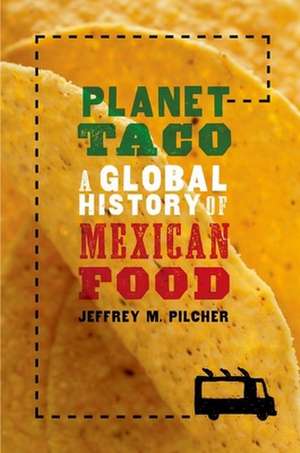
Planet Taco: A Global History of Mexican Food
Autor Jeffrey M. Pilcheren Limba Engleză Hardback – 17 oct 2012
In Planet Taco, Jeffrey Pilcher traces the historical origins and evolution of Mexico's national cuisine, explores its incarnation as a Mexican American fast-food, shows how surfers became global pioneers of Mexican food, and how Corona beer conquered the world. Pilcher is particularly enlightening on what the history of Mexican food reveals about the uneasy relationship between globalization and authenticity. The burritos and taco shells that many people think of as Mexican were actually created in the United States. But Pilcher argues that the contemporary struggle between globalization and national sovereignty to determine the authenticity of Mexican food goes back hundreds of years. During the nineteenth century, Mexicans searching for a national cuisine were torn between nostalgic "Creole" Hispanic dishes of the past and French haute cuisine, the global food of the day. Indigenous foods were scorned as unfit for civilized tables. Only when Mexican American dishes were appropriated by the fast food industry and carried around the world did Mexican elites rediscover the foods of the ancient Maya and Aztecs and embrace the indigenous roots of their national cuisine.
From a taco cart in Hermosillo, Mexico to the "Chili Queens" of San Antonio and tamale vendors in L.A., Jeffrey Pilcher follows this highly adaptable cuisine, paying special attention to the people too often overlooked in the battle to define authentic Mexican food: Indigenous Mexicans and Mexican Americans.
| Toate formatele și edițiile | Preț | Express |
|---|---|---|
| Paperback (1) | 131.00 lei 43-57 zile | |
| Oxford University Press – 30 mar 2017 | 131.00 lei 43-57 zile | |
| Hardback (1) | 171.04 lei 40-51 zile | |
| Oxford University Press – 17 oct 2012 | 171.04 lei 40-51 zile |
Preț: 171.04 lei
Preț vechi: 180.35 lei
-5%
Puncte Express: 257
Preț estimativ în valută:
30.24€ • 34.95$ • 26.13£
30.24€ • 34.95$ • 26.13£
Carte tipărită la comandă
Livrare economică 01-12 mai
Specificații
ISBN-13: 9780199740062
ISBN-10: 0199740062
Pagini: 292
Ilustrații: 46 halftones
Dimensiuni: 157 x 241 x 18 mm
Greutate: 0.54 kg
Editura: Oxford University Press
Colecția OUP USA
Locul publicării:New York, United States
ISBN-10: 0199740062
Pagini: 292
Ilustrații: 46 halftones
Dimensiuni: 157 x 241 x 18 mm
Greutate: 0.54 kg
Editura: Oxford University Press
Colecția OUP USA
Locul publicării:New York, United States
V-ar putea interesa
-
 -11%Preț: 332.16 lei373.20 lei
 -
 -14%Preț: 169.55 lei197.85 lei
 -
 The Founding Fathers ReconsideredR. B. BernsteinPreț: 136.86 lei
 -
 -8%Preț: 219.92 lei239.95 lei
 -
 Preț: 150.64 lei
 -
 The Populist VisionCharles PostelPreț: 246.95 lei
 -
 Barack Obama: A Pocket Biography of Our 44th PresidentSteven J Niven-9%Preț: 48.73 lei53.34 lei
 -
 Studs Terkel's WorkingHarvey PekarPreț: 161.07 lei
Descriere
Planet Taco asks the question, "what is authentic Mexican food?" The burritos and taco shells that many people think of as Mexican were actually created in the United States, and Americanized foods have recently been carried around the world in tin cans and tourist restaurants. But the contemporary struggle between globalization and national sovereignty to determine the meaning of Mexican food is far from new. In fact, Mexican food was the product of globalizationfrom the very beginning — the Spanish conquest — when European and Native American influences blended to forge the mestizo or mixed culture of Mexico. The historic struggle between globalization and the nation continued in the nineteenth century, as Mexicans searching for a national cuisine were torn between nostalgic "Creole" Hispanic dishes of the past and French haute cuisine, the global food of the day. Indigenous foods, by contrast, were considered strictly déclassé. Yet another version of Mexican food was created in the U.S. Southwest by Mexican American cooks, including the "Chili Queens" of San Antonio and tamale vendors ofLos Angeles. When Mexican American dishes were appropriated by the fast food industry and carried around the world, Mexican elites rediscovered the indigenous roots of their national cuisine among the ancient Aztecs and the Maya. Even this Nueva Cocina Mexicana was a transnational phenomenon, called "New Southwestern" by chefs in the United States. Rivalries within this present-day gourmet movement recalled the nineteenth-century struggles between Creole, Native, and French foods. Planet Taco also seeks to recover the history of people who have been ignored in the struggles to define authentic Mexican, especially those who are marginal to both nations: Indians and Mexican Americans.
Recenzii
Jeffrey Pilcher takes us through the many permutations of subsequent Mexican cuisine with a sure hand.
Planet Taco does more than trace the movement of a single food item through history and across continents. Rather, it tackles the growth, emergence and spread of an entire national cuisine. Jeffrey M. Pilcher ... uses the lowly taco as an emblem of the complex origins of Mexican food, its global expansion and its mutations.
Planet Taco does more than trace the movement of a single food item through history and across continents. Rather, it tackles the growth, emergence and spread of an entire national cuisine. Jeffrey M. Pilcher ... uses the lowly taco as an emblem of the complex origins of Mexican food, its global expansion and its mutations.
Notă biografică
Jeffrey M. Pilcher first tasted Mexican food at the age of eighteen in Las Cruces, New Mexico. After recovering from the initial blast of salsa, he dedicated himself to studying the history and cuisine of Mexico. A professor of history at the University of Minnesota, he is the author of Que vivan los tamales! Food and the Making of Mexican Identity, The Sausage Rebellion: Public Health, Private Enterprise and Meat in Mexico City, and Food in World History, and theeditor of the Oxford Handbook of Food History.