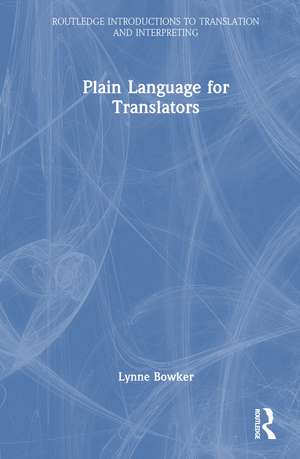
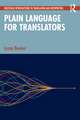
Plain Language for Translators: Routledge Introductions to Translation and Interpreting
Autor Lynne Bowkeren Limba Engleză Hardback – 11 mar 2026
This book provides practical guidance on implementing and evaluating the plain language principles of relevance, findability, understandability, and usability, as well as information about pertinent tools. Closely related concepts such as document design, inclusive language, easy language, and controlled language are also explored.
Each chapter includes key questions, discussion topics, activities, and suggestions for further reading – all designed to empower translators to develop the skills needed to work as plain language practitioners.

Preț: 898.19 lei
Preț vechi: 1274.08 lei
-30% Precomandă
Puncte Express: 1347
Preț estimativ în valută:
158.96€ • 185.78$ • 138.01£
158.96€ • 185.78$ • 138.01£
Carte nepublicată încă
Doresc să fiu notificat când acest titlu va fi disponibil:
Se trimite...
Preluare comenzi: 021 569.72.76
Specificații
ISBN-13: 9781032597881
ISBN-10: 1032597887
Pagini: 202
Ilustrații: 66
Dimensiuni: 156 x 234 mm
Ediția:1
Editura: Taylor & Francis
Colecția Routledge
Seria Routledge Introductions to Translation and Interpreting
Locul publicării:Oxford, United Kingdom
ISBN-10: 1032597887
Pagini: 202
Ilustrații: 66
Dimensiuni: 156 x 234 mm
Ediția:1
Editura: Taylor & Francis
Colecția Routledge
Seria Routledge Introductions to Translation and Interpreting
Locul publicării:Oxford, United Kingdom
Public țintă
Postgraduate, Professional Practice & Development, and Undergraduate AdvancedCuprins
List of Figures
List of Tables
Acknowledgements
Series editor forward
Abbreviations
Introduction
Chapter 1. Basic concepts and terms in plain language
Chapter 2. Brief history and key motivations for plain language
Chapter 3. Principles and techniques for plain language
Chapter 4. Inclusive language
Chapter 5. Plain language writing and document design
Chapter 6. Evaluating plain language
Chapter 7. Plain language in different communicative settings
Chapter 8. Easy language
Chapter 9. Controlled language
Conclusion
Glossary
Bibliography
Index
List of Tables
Acknowledgements
Series editor forward
Abbreviations
Introduction
Chapter 1. Basic concepts and terms in plain language
Chapter 2. Brief history and key motivations for plain language
Chapter 3. Principles and techniques for plain language
Chapter 4. Inclusive language
Chapter 5. Plain language writing and document design
Chapter 6. Evaluating plain language
Chapter 7. Plain language in different communicative settings
Chapter 8. Easy language
Chapter 9. Controlled language
Conclusion
Glossary
Bibliography
Index
Recenzii
“Exemplifying what Plain Language should strive to be, Lynne Bowker’s Plain Language for Translators is easy to understand and put in practice. Even better, it’s a severely needed how-to guide for translators and writers in all fields. A must-read!”
Valérie Florentin, York University (Glendon Campus), Canada
“Plain Language for Translators is a comprehensive yet practical look at the why, when, and how of producing information in plain language, which is increasingly requested in a variety of fields. The book is a valuable resource for all types of communication professionals.“
Mary Nurminen, Tampere University, Finland
Valérie Florentin, York University (Glendon Campus), Canada
“Plain Language for Translators is a comprehensive yet practical look at the why, when, and how of producing information in plain language, which is increasingly requested in a variety of fields. The book is a valuable resource for all types of communication professionals.“
Mary Nurminen, Tampere University, Finland
Notă biografică
Lynne Bowker is Full Professor and Canada Research Chair in Translation, Technologies, and Society in the Department of Languages, Linguistics, and Translation at Université Laval in Quebec, Canada. She is a certified translator and editor of the journal Digital Translation. Her most recent book is De-mystifying Translation: Introducing Translation to Non-translators (Routledge 2023).
Descriere
This guide helps translators create clear documents for government, legal, health, and scientific sectors. Learn key principles and how translation skills transfer to plain language writing in this growing field.