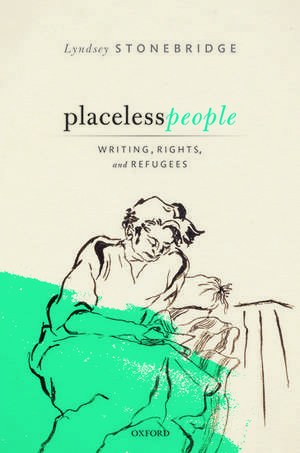
Placeless People: Writings, Rights, and Refugees
Autor Lyndsey Stonebridgeen Limba Engleză Hardback – 25 oct 2018
Preț: 298.93 lei
Preț vechi: 340.38 lei
-12%
Puncte Express: 448
Carte tipărită la comandă
Livrare economică 03-08 decembrie
Livrare prin curier în România Termenul estimat este afișat lângă disponibilitate.
Transport gratuit de la 400.00 lei Plată online sau ramburs, în funcție de opțiunile comenzii.
Retur gratuit în 14 zile Comandă securizată și suport în română.
Specificații
ISBN-13: 9780198797005
ISBN-10: 0198797001
Pagini: 260
Dimensiuni: 163 x 242 x 22 mm
Greutate: 0.56 kg
Editura: OUP OXFORD
Colecția OUP Oxford
Locul publicării:Oxford, United Kingdom
ISBN-10: 0198797001
Pagini: 260
Dimensiuni: 163 x 242 x 22 mm
Greutate: 0.56 kg
Editura: OUP OXFORD
Colecția OUP Oxford
Locul publicării:Oxford, United Kingdom
V-ar putea interesa
-
 -31%Preț: 708.95 lei1029.90 lei
 -
 The Nonsense Club: Literature and Popular Culture, 1749-1764Lance Bertelsen-33%Preț: 915.55 lei1361.73 lei
 -
 -32%Preț: 538.15 lei797.19 lei
 -
 -28%Preț: 372.43 lei519.57 lei
 -
 -33%Preț: 1213.70 lei1810.42 lei
 -
 Robert Frost and Northern Irish PoetryRachel Buxton-33%Preț: 1244.09 lei1857.06 lei
 -
 Modernism and Democracy: Literary Culture 1900-1930Rachel Potter-23%Preț: 166.38 lei217.42 lei
 -
 Some Versions of EmpsonMatthew Bevis-31%Preț: 996.97 lei1448.95 lei
 -
 Wisdom of Two: The Spiritual and Literary Collaboration of George and W. B. YeatsMargaret Mills Harper-33%Preț: 979.49 lei1456.90 lei
 -
 The Destructive ElementLyndsey StonebridgePreț: 345.84 lei
 -
 Reading Melanie KleinJohn Phillips-5%Preț: 1100.95 lei1158.90 lei
 -
 Reading Melanie KleinJohn Phillips-5%Preț: 401.78 lei422.92 lei
 -
 Ecocriticism: The Essential ReaderKen HiltnerPreț: 426.82 lei
 -
 Modernism (Routledge Revivals)Peter FaulknerPreț: 369.53 lei
 -
 The Judicial ImaginationLyndsey Stonebridge-17%Preț: 175.77 lei210.92 lei
 -
 The Cambridge Companion to Irish ModernismJoe ClearyPreț: 245.37 lei
 -
 Preț: 404.31 lei
 -
 Literary GeographiesS. HonesPreț: 402.26 lei
 -
 Nadine Gordimer (Routledge Revivals)Judie Newman-15%Preț: 667.99 lei785.87 lei
 -
 Humor in Contemporary Junior LiteratureJulie Cross-15%Preț: 420.47 lei494.67 lei
 -
 Adaptation Theory and Criticism: Postmodern Literature and Cinema in the USAGordon E. Slethaug-17%Preț: 264.90 lei319.95 lei
 -
 The Lost Frontier: Reading Annie Proulx's Wyoming StoriesDr Mark Asquith-24%Preț: 211.84 lei279.96 lei
 -
 Staging Intercultural IrelandCharlotte McIvorPreț: 351.43 lei
Recenzii
Placeless People is an extraordinary book that deserves a wide readership. It is a ground-breaking contribution to the feld of literary refugee studies and a textbook example of how intellectual history can help us read literature and vice versa.
This carefully researched, elegantly and passionately argues book exemplifies the values of practicing "law and literature" for apprehending modern exile and understanding refugees.
The book is beautifully written, and brings an intricate perspective to the topics of rights, citizenship, statelessness and refugee experience.
Scrupulously researched and documented, this invaluable and informative volume is illustrated with relevant photographs and quotations.
A stunning study as much of literature's own "endurance beyond nation, and its worldly capacity to conjure up human community out of despair" as of migrant refuge and the powerplay of state refusal of refuge, via the 20th century's great writers of displacement.
[An] incandescent and admirably polemical new book ... Placeless People should help change conversations about humanitarianism, migration, citizenship, and democracy.
Magisterial.
Anybody seeking to understand the contemporary challenges faced by refugees, and the responses by nation states that view themselves as sovereign, will find in Placeless People clues as to how we got here and ideas as to what we ought to do next ... The book navigates contested themes from multiple viewpoints. In doing so, it illuminates historical and contemporary challenges to national distinctions, political communities and human rights.
Placeless People delves deeply into the philosophy of human rights but with easy prose and a structure that would give anyone pause when thinking about our times ... This small book makes a fast but thought provoking read.
Stonebridge offers a nuanced and complex interdisciplinary treatment of the problems of citizenship, statelessness, and mass displacement.
[A] deft and incisive book ... The canon of writers assembled is one of Placeless People's great strengths ... The contribution Stonebridge makes lies in her readings. It is with close engagement that she demonstrates the ability of novels, poems, plays, and journalism to move beyond the banalising morality inherent to the idea that literature is a locus for empathy.
This is a book about displacement but it offers us ways to feel at home despite these toxic and hateful times.
Lyndsey Stonebridge's Placeless People, whilst outwardly a study based in literary criticism and theory, works impressively through the wide-ranging implications of statelessness to explore the real meanings of citizenship and belonging through the eyes of some of the twentieth century's most innovative writers and thinkers ... Where this book distinguishes itself, for all scholars of placelessness, is its ability to move, through a sharplyfocussed discussion of some of the twentieth century's most renowned literary or philosophical voices, to offer insights into the ways in which, now as then,'[m]odern placelessness demonstrates how fragile everybody's place in the world is.
Lyndsey Stonebridge's excellent Placeless People: Writing, Rights, and Refugees is a welcome addition to this interdisciplinary field as well as to the broader field of twentieth-century literary and cultural studies.
Lyndsey Stonebridge's sensitive and assertive book succeeds on a range of levels. Placeless People combines careful thinking on the situation of refugees, engaged moral philosophy, and purposeful literary criticism ... Full of fascinating information, fresh perspectives, and important episodes recovered from history, Placeless People is a valuable read for those working on the injustices of forced displacement and statelessness today.
This carefully researched, elegantly and passionately argues book exemplifies the values of practicing "law and literature" for apprehending modern exile and understanding refugees.
The book is beautifully written, and brings an intricate perspective to the topics of rights, citizenship, statelessness and refugee experience.
Scrupulously researched and documented, this invaluable and informative volume is illustrated with relevant photographs and quotations.
A stunning study as much of literature's own "endurance beyond nation, and its worldly capacity to conjure up human community out of despair" as of migrant refuge and the powerplay of state refusal of refuge, via the 20th century's great writers of displacement.
[An] incandescent and admirably polemical new book ... Placeless People should help change conversations about humanitarianism, migration, citizenship, and democracy.
Magisterial.
Anybody seeking to understand the contemporary challenges faced by refugees, and the responses by nation states that view themselves as sovereign, will find in Placeless People clues as to how we got here and ideas as to what we ought to do next ... The book navigates contested themes from multiple viewpoints. In doing so, it illuminates historical and contemporary challenges to national distinctions, political communities and human rights.
Placeless People delves deeply into the philosophy of human rights but with easy prose and a structure that would give anyone pause when thinking about our times ... This small book makes a fast but thought provoking read.
Stonebridge offers a nuanced and complex interdisciplinary treatment of the problems of citizenship, statelessness, and mass displacement.
[A] deft and incisive book ... The canon of writers assembled is one of Placeless People's great strengths ... The contribution Stonebridge makes lies in her readings. It is with close engagement that she demonstrates the ability of novels, poems, plays, and journalism to move beyond the banalising morality inherent to the idea that literature is a locus for empathy.
This is a book about displacement but it offers us ways to feel at home despite these toxic and hateful times.
Lyndsey Stonebridge's Placeless People, whilst outwardly a study based in literary criticism and theory, works impressively through the wide-ranging implications of statelessness to explore the real meanings of citizenship and belonging through the eyes of some of the twentieth century's most innovative writers and thinkers ... Where this book distinguishes itself, for all scholars of placelessness, is its ability to move, through a sharplyfocussed discussion of some of the twentieth century's most renowned literary or philosophical voices, to offer insights into the ways in which, now as then,'[m]odern placelessness demonstrates how fragile everybody's place in the world is.
Lyndsey Stonebridge's excellent Placeless People: Writing, Rights, and Refugees is a welcome addition to this interdisciplinary field as well as to the broader field of twentieth-century literary and cultural studies.
Lyndsey Stonebridge's sensitive and assertive book succeeds on a range of levels. Placeless People combines careful thinking on the situation of refugees, engaged moral philosophy, and purposeful literary criticism ... Full of fascinating information, fresh perspectives, and important episodes recovered from history, Placeless People is a valuable read for those working on the injustices of forced displacement and statelessness today.
Notă biografică
Lyndsey Stonebridge is Professor of Humanities and Human Rights at University of Birmingham. Her books include: The Judicial Imagination: Writing after Nuremberg (2011/2014), winner of the British Academy Rose Mary Crawshay Prize, The Destructive Element (1998), Reading Melanie Klein (with John Phillips, 1998), The Writing of Anxiety (2007), and British Fiction after Modernism (with Marina MacKay, 2007). She is currently writing a short book on Literature and Human Rights for OUP's Literary Agendas series, and collaborating on a large interdisciplinary project, Refugee Hosts.