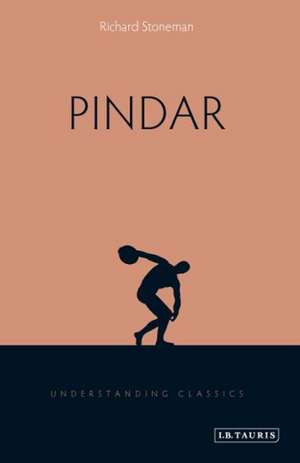
Pindar: Understanding Classics
Autor Dr Richard Stonemanen Limba Engleză Hardback – 16 dec 2013
Din seria Understanding Classics
- 15%
 Preț: 146.63 lei
 - 20%
 Preț: 169.00 lei
 - 22%
 Preț: 364.77 lei
 - 25%
 Preț: 120.48 lei
 - 15%
 Preț: 139.29 lei
 - 21%
 Preț: 157.11 lei
 - 16%
 Preț: 141.69 lei
 - 20%
 Preț: 167.70 lei
 - 15%
 Preț: 143.53 lei
 - 11%
 Preț: 135.81 lei
 - 20%
 Preț: 167.82 lei
 - 27%
 Preț: 154.87 lei
 - 9%
 Preț: 144.82 lei
 - 21%
 Preț: 143.97 lei
 - 16%
 Preț: 128.70 lei
 - 15%
 Preț: 157.13 lei
 - 20%
 Preț: 167.37 lei
 - 9%
 Preț: 136.65 lei
Preț: 448.62 lei
Preț vechi: 540.28 lei
-17%
Puncte Express: 673
Carte disponibilă
Livrare economică 07-21 noiembrie
Livrare prin curier în România Termenul estimat este afișat lângă disponibilitate.
Transport gratuit pentru acest produs Plată online sau ramburs, în funcție de opțiunile comenzii.
Retur gratuit în 14 zile Comandă securizată și suport în română.
Specificații
ISBN-13: 9781780761848
ISBN-10: 1780761848
Pagini: 256
Ilustrații: 7 bw integrated, 2 maps, 5 line
Dimensiuni: 138 x 216 x 25 mm
Greutate: 0.43 kg
Editura: Bloomsbury Publishing
Colecția I.B.Tauris
Seria Understanding Classics
Locul publicării:London, United Kingdom
ISBN-10: 1780761848
Pagini: 256
Ilustrații: 7 bw integrated, 2 maps, 5 line
Dimensiuni: 138 x 216 x 25 mm
Greutate: 0.43 kg
Editura: Bloomsbury Publishing
Colecția I.B.Tauris
Seria Understanding Classics
Locul publicării:London, United Kingdom
V-ar putea interesa
-
 The Lords Of AvarisDavid Rohl-17%Preț: 104.37 lei125.50 lei
 -
 The Trojan WarBarry Strauss-19%Preț: 75.39 lei93.10 lei
 -
 The Roman Family in Italy: Status, Sentiment, SpaceBeryl Rawson-33%Preț: 694.82 lei1030.44 lei
 -
 Alexander the GreatRichard StonemanPreț: 389.89 lei
 -
 The Women of Pliny's LettersJoann Shelton-18%Preț: 1131.56 lei1379.95 lei
 -
 Prehistory: The Making Of The Human MindProfessor Lord Colin Renfrew-27%Preț: 67.24 lei91.80 lei
 -
 The History of Central AsiaChristoph Baumer-31%Preț: 586.37 lei848.36 lei
 -
 EusebiusAaron P. Johnson-20%Preț: 169.00 lei210.58 lei
 -
 The Book of Alexander the Great: A Life of the ConquerorDr Richard Stoneman-21%Preț: 143.12 lei180.77 lei
 -
 Legends of Alexander the GreatDr Richard Stoneman-22%Preț: 163.07 lei208.31 lei
 -
 The Poets of AlexandriaSusan A. Stephens-16%Preț: 128.70 lei153.45 lei
 -
 -22%Preț: 180.71 lei231.09 lei
 -
 Preț: 164.90 lei
 -
 Cleopatra: Last Queen of EgyptJoyce Tyldesley-19%Preț: 75.21 lei93.03 lei
 -
 Egyptian Amduat: The Book of the Hidden ChamberErik Hornung-15%Preț: 602.91 lei709.30 lei
Notă biografică
Richard Stoneman is Honorary Visiting Professor in Classics at the University of Exeter, the author of many books, and editor of the Understanding Classics series.
Cuprins
IllustrationsPreface1. Pindar the Poet 2. Pindar's Career3. The Range of Pindar's Poetry4.Athletes and Heroes5. The Practice of Praise6.Telling Stories7.ReceptionGlossaryAbbreviationsTimeline of Pindar's CareerThe Odes of BacchylidesFestivals, Victors, Events and MythsNotesBibliographyIndex
Descriere
Descriere de la o altă ediție sau format:
The 6th/5th century BCE Greek melic (or songwriting) poet Pindar was one of the most celebrated lyricists of antiquity. His famous victory odes offer a paean to the heroic athlete, and collectively are an attempt to encapsulate, through choral songs of exaltation, the glory of the sportsman's moment of victory - whether in athletics or horse-racing - at a variety of Panhellenic festivals and Olympian games. Yet Pindar, though still respected, is now considered a difficult poet, and is sometimes dismissed as a reactionary, celebrating an aristocratic world that was passing and that deserved to pass. In this first work on the subject for many years, Richard Stoneman shows that Pindar's works, while at first seeming obscure and fragmentary, reward further study. An unmatched craftsman with words, and witness to a profoundly religious sensibility, he is a poet who takes modern readers to the heart of Greek ideas about the gods, fleeting human achievement and fallibility. The author examines questions of performance and genre; patronage; imagery; and reception, beginning with Horace.
The 6th/5th century BCE Greek melic (or songwriting) poet Pindar was one of the most celebrated lyricists of antiquity. His famous victory odes offer a paean to the heroic athlete, and collectively are an attempt to encapsulate, through choral songs of exaltation, the glory of the sportsman's moment of victory - whether in athletics or horse-racing - at a variety of Panhellenic festivals and Olympian games. Yet Pindar, though still respected, is now considered a difficult poet, and is sometimes dismissed as a reactionary, celebrating an aristocratic world that was passing and that deserved to pass. In this first work on the subject for many years, Richard Stoneman shows that Pindar's works, while at first seeming obscure and fragmentary, reward further study. An unmatched craftsman with words, and witness to a profoundly religious sensibility, he is a poet who takes modern readers to the heart of Greek ideas about the gods, fleeting human achievement and fallibility. The author examines questions of performance and genre; patronage; imagery; and reception, beginning with Horace.