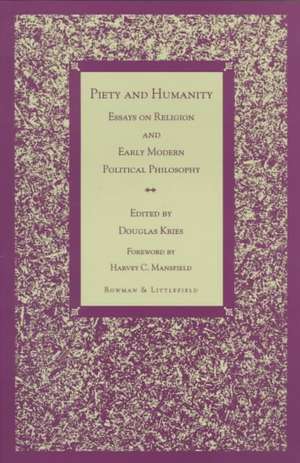
Piety and Humanity: Essays on Religion in Early Modern Political Philosophy
Editat de Douglas Kriesen Limba Engleză Paperback – 14 aug 1997
Preț: 364.72 lei
Preț vechi: 463.19 lei
-21%
Puncte Express: 547
Carte tipărită la comandă
Livrare economică 07-21 decembrie
Livrare prin curier în România Termenul estimat este afișat lângă disponibilitate.
Transport gratuit de la 400.00 lei Plată online sau ramburs, în funcție de opțiunile comenzii.
Retur gratuit în 14 zile Comandă securizată și suport în română.
Specificații
ISBN-13: 9780847686193
ISBN-10: 0847686191
Pagini: 308
Dimensiuni: 146 x 226 x 20 mm
Greutate: 0.44 kg
Ediția:New.
Editura: Bloomsbury Publishing
Colecția Rowman & Littlefield
Locul publicării:New York, United States
ISBN-10: 0847686191
Pagini: 308
Dimensiuni: 146 x 226 x 20 mm
Greutate: 0.44 kg
Ediția:New.
Editura: Bloomsbury Publishing
Colecția Rowman & Littlefield
Locul publicării:New York, United States
V-ar putea interesa
-
 Oxford Studies in Medieval Philosophy, Volume 2Robert Pasnau-21%Preț: 264.06 lei333.30 lei
 -
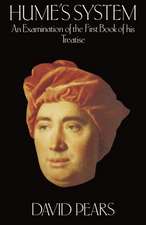 -20%Preț: 295.46 lei367.21 lei
 -
 Approaches to IntentionalityWilliam Lyons-18%Preț: 340.30 lei415.01 lei
 -
 -30%Preț: 647.66 lei925.43 lei
 -
 Essays on Spinoza's Ethical TheoryMatthew J. Kisner-31%Preț: 760.91 lei1096.62 lei
 -
 Words and Images: An Essay on the Origin of IdeasChristopher Gauker-11%Preț: 314.21 lei353.62 lei
 -
 Joint Ventures: Mindreading, Mirroring, and Embodied CognitionAlvin I. Goldman-30%Preț: 618.67 lei880.50 lei
 -
 -31%Preț: 641.41 lei925.16 lei
 -
 Thomas Aquinas: A PortraitDenys TurnerPreț: 131.96 lei
 -
 IrrationalityLisa BortolottiPreț: 186.57 lei
 -
 On the World and OurselvesZygmunt BaumanPreț: 157.13 lei
 -
 The Political Philosophy of Niccolò MachiavelliFilippo Del Lucchese-17%Preț: 176.65 lei211.57 lei
 -
 Spinoza and PoliticsÉtienne BalibarPreț: 112.55 lei
 -
 Preț: 58.80 lei
 -
 Key Philosophical WritingsRene DescartesPreț: 44.98 lei
Recenzii
A provocative introduction for a clearer understanding of what was involved in making Christianity politically friendly. The contributors have unearthed important philosophical and political assumptions of nascent modernity that help explain what was lost and what was gained in the radical transformation of Christianity. This is an important contribution to understanding present day culture wars.
This excellent book is a most impressive and thorough defense of the relationship between "early modern political philosophy" and "the theologico-political problem" first put forward by Leo Strauss.
. . . striking . . .
This excellent book is a most impressive and thorough defense of the relationship between "early modern political philosophy" and "the theologico-political problem" first put forward by Leo Strauss.
. . . striking . . .