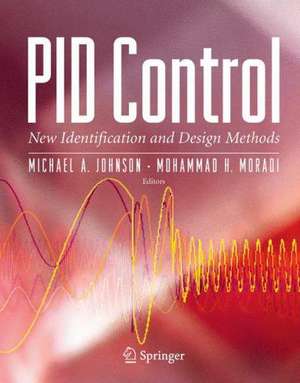
PID Control: New Identification and Design Methods
Editat de Michael A. Johnson, Mohammad H. Moradien Limba Engleză Paperback – 13 oct 2010
Preț: 926.36 lei
Preț vechi: 1129.70 lei
-18%
Puncte Express: 1390
Carte tipărită la comandă
Livrare economică 09-23 noiembrie
Livrare prin curier în România Termenul estimat este afișat lângă disponibilitate.
Transport gratuit pentru acest produs Plată online sau ramburs, în funcție de opțiunile comenzii.
Retur gratuit în 14 zile Comandă securizată și suport în română.
Specificații
ISBN-13: 9781849968973
ISBN-10: 1849968977
Pagini: 572
Ilustrații: XXVIII, 544 p.
Greutate: 0.97 kg
Ediția:Softcover reprint of hardcover 1st ed. 2005
Editura: SPRINGER LONDON
Colecția Springer
Locul publicării:London, United Kingdom
ISBN-10: 1849968977
Pagini: 572
Ilustrații: XXVIII, 544 p.
Greutate: 0.97 kg
Ediția:Softcover reprint of hardcover 1st ed. 2005
Editura: SPRINGER LONDON
Colecția Springer
Locul publicării:London, United Kingdom
V-ar putea interesa
-
 Industrial Automation: Hands OnFrank Lamb-32%Preț: 372.33 lei547.27 lei
 -
 Arduino Projects for Amateur RadioJack Purdum-40%Preț: 189.12 lei314.42 lei
 -
 The Technological SingularityMurray Shanahan-21%Preț: 95.19 lei121.21 lei
 -
 A 1980s ChildhoodMichael A. JohnsonPreț: 70.73 lei
 -
 Humanity Before GodWilliam SchweikerPreț: 226.80 lei
 -
 Integrated Vehicle Dynamics and ControlWuwei Chen-23%Preț: 750.29 lei974.40 lei
 -
 Arduino SketchesJames A Langbridge-20%Preț: 209.71 lei262.14 lei
 -
 Practical Field RoboticsSturges-8%Preț: 636.53 lei691.87 lei
 -
 Adventures in ArduinoBecky StewartPreț: 110.09 lei
 -
 Modelling and Simulation of Power Generation PlantsAndrzej W. Ordys-15%Preț: 646.09 lei760.11 lei
 -
 Brother B and Sister DMichael A. JohnsonPreț: 60.04 lei
 -
 Little B and Pet PMichael A. JohnsonPreț: 60.04 lei
 -
 Nonlinear and Hybrid Systems in Automotive ControlRolf Johansson-18%Preț: 929.89 lei1134.01 lei
 -
 Dynamic Modelling of Gas TurbinesGennady G Kulikov-18%Preț: 942.69 lei1149.62 lei
 -
 PneumatikP. Croser-15%Preț: 539.05 lei634.18 lei
 -
 -15%Preț: 608.09 lei715.40 lei
 -
 -15%Preț: 621.73 lei731.46 lei
 -
 Preț: 381.19 lei
 -
 Preț: 367.19 lei
 -
 PID Control for Multivariable ProcessesQing-Guo Wang-15%Preț: 618.50 lei727.65 lei
 -
 Preț: 315.17 lei
 -
 Preț: 365.28 lei
Public țintă
ResearchCuprins
PID Control Technology.- Some PID Control Fundamentals.- On-line Model-Free Methods.- Automatic PID Controller Tuning — the Nonparametric Approach.- Relay Experiments for Multivariable Systems.- Phase-Locked Loop Methods.- Phase-Locked Loop Methods and PID Control.- Process Reaction Curve and Relay Methods Identification and PID Tuning.- Fuzzy Logic and Genetic Algorithm Methods in PID Tuning.- Tuning PID Controllers Using Subspace Identification Methods.- Design of Multi-Loop and Multivariable PID Controllers.- Restricted Structure Optimal Control.- Predictive PID Control.
Textul de pe ultima copertă
The effectiveness of proportional-integral-derivative (PID) controllers for a large class of process systems has ensured their continued and widespread use in industry. Similarly there has been a continued interest from academia in devising new ways of approaching the PID tuning problem.
To the industrial engineer and many control academics this work has previously appeared fragmented; but a key determinant of this literature is the type of process model information used in the PID tuning methods. PID Control presents a set of coordinated contributions illustrating methods, old and new, that cover the range of process model assumptions systematically. After a review of PID technology, these contributions begin with model-free methods, progress through non-parametric model methods (relay experiment and phase-locked-loop procedures), visit fuzzy-logic- and genetic-algorithm-based methods; introduce a novel subspace identification method before closing with an interesting set of parametric model techniques including a chapter on predictive PID controllers. Highlights of PID Control include:
an introduction to PID control technology features and typical industrial implementations;
chapter contributions ordered by the increasing quality of the model information used;
novel PID control concepts for multivariable processes.
PID Control will be useful to industry-based engineers wanting a better understanding of what is involved in the steps to a new generation of PID controller techniques. Academics wishing to have a broader perspective of PID control research and development will find useful pedagogical material and research ideas in this text.
To the industrial engineer and many control academics this work has previously appeared fragmented; but a key determinant of this literature is the type of process model information used in the PID tuning methods. PID Control presents a set of coordinated contributions illustrating methods, old and new, that cover the range of process model assumptions systematically. After a review of PID technology, these contributions begin with model-free methods, progress through non-parametric model methods (relay experiment and phase-locked-loop procedures), visit fuzzy-logic- and genetic-algorithm-based methods; introduce a novel subspace identification method before closing with an interesting set of parametric model techniques including a chapter on predictive PID controllers. Highlights of PID Control include:
an introduction to PID control technology features and typical industrial implementations;
chapter contributions ordered by the increasing quality of the model information used;
novel PID control concepts for multivariable processes.
PID Control will be useful to industry-based engineers wanting a better understanding of what is involved in the steps to a new generation of PID controller techniques. Academics wishing to have a broader perspective of PID control research and development will find useful pedagogical material and research ideas in this text.