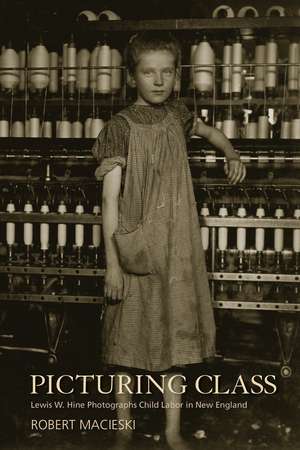
Picturing Class: Lewis W. Hine Photographs Child Labor in New England
Autor Robert Macieskien Limba Engleză Paperback – 4 noi 2015
In Picturing Class, Macieski explores the historical context of Hine's photographs and the social worlds of his subjects. He offers a detailed analysis of many of the images, unearthing the stories behind the creation of these photographs and the lives of their subjects. In telling the story of these photographs, their creation, and their reception, Macieski demonstrates how Hine worked to advance an unvarnished picture of a rapidly changing region and the young workers at the center of this important shift.
Preț: 233.66 lei
Puncte Express: 350
Preț estimativ în valută:
41.29€ • 47.66$ • 36.01£
41.29€ • 47.66$ • 36.01£
Carte disponibilă
Livrare economică 28 aprilie-12 mai
Livrare express 11-17 aprilie pentru 28.88 lei
Specificații
ISBN-13: 9781625341846
ISBN-10: 1625341849
Pagini: 312
Ilustrații: 174 b&w illus.
Dimensiuni: 178 x 235 x 20 mm
Greutate: 0.45 kg
Ediția:First Edition
Editura: University of Massachusetts Press
Colecția University of Massachusetts Press
ISBN-10: 1625341849
Pagini: 312
Ilustrații: 174 b&w illus.
Dimensiuni: 178 x 235 x 20 mm
Greutate: 0.45 kg
Ediția:First Edition
Editura: University of Massachusetts Press
Colecția University of Massachusetts Press
V-ar putea interesa
-
 DisconnectedNick BarhamPreț: 110.21 lei
 -
 -34%Preț: 673.81 lei1026.74 lei
 -
 Children and Childhood in Roman ItalyBeryl Rawson-23%Preț: 355.18 lei460.24 lei
 -
 Doing Action Research in Early Childhood Studies: A step-by-step guideGlenda Mac Naughton-30%Preț: 175.57 lei249.32 lei
 -
 The Secret of ChildhoodMaria MontessoriPreț: 51.26 lei
 -
 Children and the InternetSonia LivingstonePreț: 189.99 lei
 -
 Putting Children First: A handbook for separated parentsKaren WoodallPreț: 168.41 lei
 -
 -21%Preț: 139.35 lei176.09 lei
 -
 The Developing World of the ChildAnna Gupta-26%Preț: 208.95 lei281.72 lei
 -
 -26%Preț: 205.38 lei279.41 lei
 -
 -24%Preț: 202.74 lei267.97 lei
 -
 Preț: 271.78 lei
 -
 Contemporary Art Therapy with AdolescentsMs Cathy A Malchiodi-29%Preț: 235.14 lei331.53 lei
 -
 The ADHD Handbook: A Guide for Parents and ProfessionalsAlison MundenPreț: 164.04 lei
 -
 -26%Preț: 110.26 lei148.24 lei
 -
 Preț: 367.52 lei
 -
 Preț: 252.60 lei
 -
 The Kate Greenaway First Year Baby BookKate Greenaway-6%Preț: 52.91 lei56.47 lei
Notă biografică
ROBERT MACIESKI is associate professor of history at the University of New Hampshire at Manchester.
Recenzii
“Macieski's finely textured analysis of Hine's work and worldview makesPicturing Class a significant contribution to the history of photography. Hisawareness of the agency that the children possessed brings the book into fruitfulconversation with labor history and histories of childhood and capitalism.”—John Edwin Mason, Journal of the History of Childhood and Youth
“Hine's images carry their greatest impact when their stories are most clearly stated, and Macieski's book goes farther than any other scholarly literature on Hine in reconstituting the progression of images, the children's names and biographical information, the specific industries and factories involved, and the larger legal, cultural, and social issues around their work in these industries.”—Kim Sichel, New England Quarterly
“This book serves as a model of how historians can engage photographs and visual sources as essential primary sources that drive an argument, rather than just as illustrations. It will be of significant interest to social and labor historians, public historians, and those interested in the visual culture of New England.”—Journal of American Ethnic History
“Macieski attends to how gender, race, and ethnicity complicate narratives of child labor—showing Hine's distinctive visual rhetoric for different subjects. The author's immersion in the reform milieu of the early twentieth century and the primary research done for this book are phenomenal.”—Carol Quirke, author of Eyes on Labor: New Photography and America's Working Class
“Hine's images carry their greatest impact when their stories are most clearly stated, and Macieski's book goes farther than any other scholarly literature on Hine in reconstituting the progression of images, the children's names and biographical information, the specific industries and factories involved, and the larger legal, cultural, and social issues around their work in these industries.”—Kim Sichel, New England Quarterly
“This book serves as a model of how historians can engage photographs and visual sources as essential primary sources that drive an argument, rather than just as illustrations. It will be of significant interest to social and labor historians, public historians, and those interested in the visual culture of New England.”—Journal of American Ethnic History
“Macieski attends to how gender, race, and ethnicity complicate narratives of child labor—showing Hine's distinctive visual rhetoric for different subjects. The author's immersion in the reform milieu of the early twentieth century and the primary research done for this book are phenomenal.”—Carol Quirke, author of Eyes on Labor: New Photography and America's Working Class