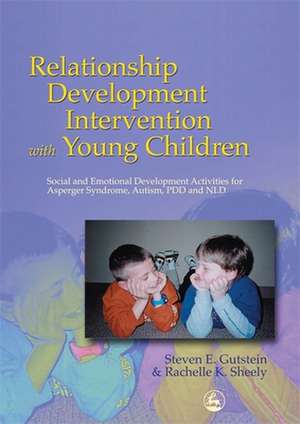
Relationship Development Intervention with Young Children: Social and Emotional Development Activities for Asperger Syndrome, Autism, PDD and NLD
Autor Steven Gutstein, Rachelle K Sheelyen Limba Engleză Paperback – 15 feb 2002
Preț: 211.73 lei
Preț vechi: 276.38 lei
-23%
Puncte Express: 318
Carte disponibilă
Livrare economică 09-23 noiembrie
Livrare express 23-29 octombrie pentru 118.79 lei
Livrare prin curier în România Termenul estimat este afișat lângă disponibilitate.
Transport gratuit de la 400.00 lei Plată online sau ramburs, în funcție de opțiunile comenzii.
Retur gratuit în 14 zile Comandă securizată și suport în română.
Specificații
ISBN-13: 9781843107149
ISBN-10: 1843107147
Pagini: 336
Ilustrații: references, indexes
Dimensiuni: 208 x 294 x 20 mm
Greutate: 0.9 kg
Editura: JESSICA KINGSLEY PUBLISHERS
Colecția Jessica Kingsley Publishers
Locul publicării:London, United Kingdom
ISBN-10: 1843107147
Pagini: 336
Ilustrații: references, indexes
Dimensiuni: 208 x 294 x 20 mm
Greutate: 0.9 kg
Editura: JESSICA KINGSLEY PUBLISHERS
Colecția Jessica Kingsley Publishers
Locul publicării:London, United Kingdom
V-ar putea interesa
-
 -15%Preț: 535.29 lei629.75 lei
 -
 Somebody SomewhereDonna WilliamsPreț: 102.50 lei
 -
 Understanding Autism through Rapid Prompting MethodSoma MukhopadhyayPreț: 287.52 lei
 -
 -26%Preț: 214.50 lei288.78 lei
 -
 Preț: 282.78 lei
 -
 Contemporary Art Therapy with AdolescentsMs Cathy A Malchiodi-28%Preț: 245.59 lei342.45 lei
 -
 The ADHD Handbook: A Guide for Parents and ProfessionalsAlison MundenPreț: 170.67 lei
 -
 -25%Preț: 115.16 lei153.21 lei
 -
 The Social Skills Picture BookJed BakerPreț: 242.96 lei
 -
 Preparing for LifeJed BakerPreț: 245.22 lei
 -
 No More MeltdownsJed BakerPreț: 96.85 lei
 -
 How to Teach Life Skills to Kids with Autism or Asperger'sJennifer McIlwee MyersPreț: 121.19 lei
Recenzii
The book is applicable for parents of those on the spectrum, children and adults on the spectrum, teachers, counsellors and anyone involved with, and wishing to help, those to whom social skills do not come naturally... The book is divided into sex levels from novice right through to partner. Each chapter has a similar format which makes it familiar and easy to use. After an initial summary and explanation about the purpose of the section, plus coaching tips, a series of worksheets and activities are provided with clear objectives and instructions. Creative coaches can adapt and extend many of the ideas. Each sheet has a simple objective e.g. In the novice stage, developing attentiveness to communication is a formative skill... Overall this is an extremely useful book with some stimulating and enjoyable exercises that could easily be used as the bases for a parent-let group. Many of the exercises could be carried out by motivated individuals with one or more willing partners. This is good value for money due to the quality and number of worksheets.
The book contains step by step well laid out activities to teach and encourage skills such as attending, social referencing, improvisation, co-creativity and collaborating, among many others. It is a very much a user friendly `manual' and will be great for planning play dates. The first book is aimed at ages 2 - 8
This Publication is much more than a book, it is a prescription of detailed objective-based interventions in developmental progression for children aged 2 to 8 to develop friendships, relationships and appropriate social behaviour. This manual is suitable for parental use and is an excellent frame of reference to adopt when working with children to acquire relationship skills. It discreetly covers attention, motivation, eye contact and management. This book is not the fix-it model for relationship difficulties, but I fail to see how even implementing one of the activities could not have a positive outcome for both child and therapist.
It provides a wealth of activities, following a developmental model, for therapists, teachers and parents. The authors suggest that children with autism do not develop friendships just by being among peers, but need strategies and activities to develop the foundations of social referencing, regulation of their own behaviour, and practice in becoming a social partner. The activities focus on teaching the child how to see others as real people, develop a curiosity for social interaction, become a team member, and adapt in social settings. Although some initial activities are a little unorthodox, they are fun and designed to provide the scaffolding needed to teach relationship skills.
The book contains step by step well laid out activities to teach and encourage skills such as attending, social referencing, improvisation, co-creativity and collaborating, among many others. It is a very much a user friendly `manual' and will be great for planning play dates. The first book is aimed at ages 2 - 8
This Publication is much more than a book, it is a prescription of detailed objective-based interventions in developmental progression for children aged 2 to 8 to develop friendships, relationships and appropriate social behaviour. This manual is suitable for parental use and is an excellent frame of reference to adopt when working with children to acquire relationship skills. It discreetly covers attention, motivation, eye contact and management. This book is not the fix-it model for relationship difficulties, but I fail to see how even implementing one of the activities could not have a positive outcome for both child and therapist.
It provides a wealth of activities, following a developmental model, for therapists, teachers and parents. The authors suggest that children with autism do not develop friendships just by being among peers, but need strategies and activities to develop the foundations of social referencing, regulation of their own behaviour, and practice in becoming a social partner. The activities focus on teaching the child how to see others as real people, develop a curiosity for social interaction, become a team member, and adapt in social settings. Although some initial activities are a little unorthodox, they are fun and designed to provide the scaffolding needed to teach relationship skills.
Cuprins
Activities. 1. Introduction 2. Friendships are Relationships 3. Relationship Development Intervention (RDI). Level I: Novice. Stage 1. Attend. Stage 2. Reference. Stage 3. Regulate. Stage 4. Coordinate. Level II: Apprentice. Stage 5. Variation. Stage 6. Transformation. Stage 7. Synchronization. Stage 8. Duets. Level III: Challenger. Stage 9. Collaboration. Stage 10. Improvisation. Stage 11. Co-Creation. Stage 12. Running Mates. Appendix A: Progress Tracking Form. Topic Index for Activities. Levels and Stages of the Complete RDI Program.