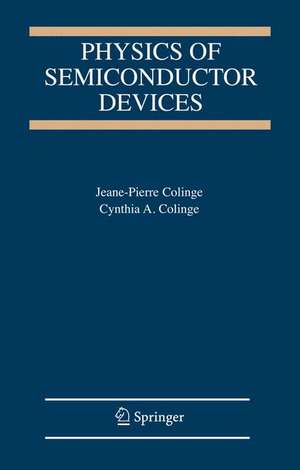
Physics of Semiconductor Devices
Autor J -P Colinge, C a Colingeen Limba Engleză Paperback – 3 oct 2005
Physics of Semiconductor Devices contains a list of problems that can be used as homework assignments or can be solved in class to exemplify the theory. Many of these problems make use of Matlab and are aimed at illustrating theoretical concepts in a graphical manner.
| Toate formatele și edițiile | Preț | Express |
|---|---|---|
| Paperback (1) | 1334.74 lei 43-57 zile | |
| Springer Us – 3 oct 2005 | 1334.74 lei 43-57 zile | |
| Hardback (1) | 1338.08 lei 43-57 zile | |
| Springer Us – 31 mai 2002 | 1338.08 lei 43-57 zile |
Preț: 1334.74 lei
Preț vechi: 1627.74 lei
-18%
Puncte Express: 2002
Preț estimativ în valută:
236.04€ • 276.100$ • 204.73£
236.04€ • 276.100$ • 204.73£
Carte tipărită la comandă
Livrare economică 09-23 martie
Specificații
ISBN-13: 9780387285238
ISBN-10: 0387285237
Pagini: 436
Ilustrații: XIV, 436 p.
Dimensiuni: 156 x 242 x 28 mm
Greutate: 0.67 kg
Ediția:2002 edition
Editura: Springer Us
Locul publicării:New York, NY, United States
ISBN-10: 0387285237
Pagini: 436
Ilustrații: XIV, 436 p.
Dimensiuni: 156 x 242 x 28 mm
Greutate: 0.67 kg
Ediția:2002 edition
Editura: Springer Us
Locul publicării:New York, NY, United States
V-ar putea interesa
-
 -30%Preț: 136.33 lei193.62 lei
 -
 Superconductivity, Superfluids and CondensatesJames F. Annett-12%Preț: 301.89 lei344.90 lei
 -
 SuperconductorsA. V. Narlikar-27%Preț: 703.62 lei961.50 lei
 -
 Quantum Processes in SemiconductorsBrian K. Ridley-22%Preț: 456.65 lei585.90 lei
 -
 Fundamentals of Optical Fiber SensorsZujie Fang-9%Preț: 745.45 lei819.18 lei
 -
 Fundamentals of Silicon Carbide TechnologyTsunenobu Kimoto-9%Preț: 1005.04 lei1104.44 lei
 -
 Physical Properties of High-Temperature SuperconductorsRainer Wesche-9%Preț: 1207.13 lei1326.52 lei
 -
 Semiconductor Laser Engineering, Reliability and DiagnosticsPeter W Epperlein-9%Preț: 822.67 lei904.03 lei
Public țintă
ResearchCuprins
Energy Band Theory.- Theory of Electrical Conduction.- Generation/Recombination Phenomena.- The PN Junction Diode.- Metal-semiconductor Contacts.- Jfet and Mesfet.- The MOS Transistor.- The Bipolar Transistor.- Heterojunction Devices.- Quantum-effect Devices.- Semiconductor Processing.
Textul de pe ultima copertă
Physics of Semiconductor Devices is a textbook aimed at college undergraduate and graduate teaching. It covers both basic classic topics such as energy band theory and the gradual-channel model of the MOSFET as well as advanced concepts and devices such as MOSFET short-channel effects, low-dimensional devices and single-electron transistors. As a prerequisite, this text requires mathematics through differential equations and modern physics where students are introduced to quantum mechanics. Concepts are introduced to the reader in a simple way, often using comparisons to everyday-life experiences such as simple fluid mechanics. They are then explained in depth and mathematical developments are fully described.
Physics of Semiconductor Devices contains a list of problems that can be used as homework assignments or can be solved in class to exemplify the theory. Many of these problems make use of Matlab and are aimed at illustrating theoretical concepts in a graphical manner. A series of these Matlab problems is based on a simple finite-element solution of semiconductor equations. These yield the exact solution to equations that have no analytical solutions and are usually solved using approximations, such as the depletion approximation. The exact numerical solution can then be graphically compared to the solution using the approximation.
The different chapters of Physics of Semiconductor Devices cover the following material: Energy Band Theory. Theory of Electrical Conduction. Generation/Recombination Phenomena. The PN Junction Diode. Metal-semiconductor contacts. JFET and MESFET. The MOS Transistor. The Bipolar Transistor. Heterojunction Devices. Quantum-Effect Devices. Semiconductor Processing.
Physics of Semiconductor Devices contains a list of problems that can be used as homework assignments or can be solved in class to exemplify the theory. Many of these problems make use of Matlab and are aimed at illustrating theoretical concepts in a graphical manner. A series of these Matlab problems is based on a simple finite-element solution of semiconductor equations. These yield the exact solution to equations that have no analytical solutions and are usually solved using approximations, such as the depletion approximation. The exact numerical solution can then be graphically compared to the solution using the approximation.
The different chapters of Physics of Semiconductor Devices cover the following material: Energy Band Theory. Theory of Electrical Conduction. Generation/Recombination Phenomena. The PN Junction Diode. Metal-semiconductor contacts. JFET and MESFET. The MOS Transistor. The Bipolar Transistor. Heterojunction Devices. Quantum-Effect Devices. Semiconductor Processing.
Caracteristici
Soft cover edition at lower price Concepts explained in depth with full mathematical development Problems at end of chapters, many make use of Matlab Request lecturer material: sn.pub/lecturer-material