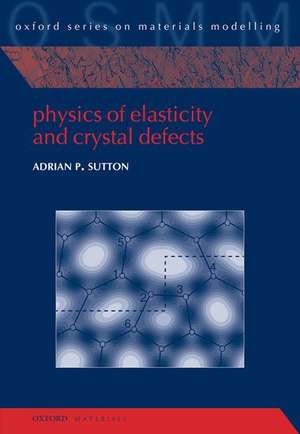
Physics of Elasticity and Crystal Defects: Oxford Series on Materials Modelling, cartea 6
Autor Adrian P. Suttonen Limba Engleză Hardback – 25 iun 2020
Evoluția recentă în știința materialelor a mutat accentul de la descrierea macroscopică a solidelor către o înțelegere profundă a defectelor la scară atomică, recunoscându-le drept motorul principal al transformărilor chimice și mecanice. În acest context, Physics of Elasticity and Crystal Defects reflectă maturizarea domeniului prin integrarea riguroasă a teoriei elasticității în studiul defectelor punctuale, al dislocațiilor și al granițelor de cereale. Observăm că această a doua ediție aduce o claritate sporită prin extinderea tratamentului incluziunii Eshelby într-un capitol de sine stătător, oferind derivații matematice complete, esențiale pentru modelarea modernă a materialelor.
Lucrarea extinde cadrul propus de Introduction to Elasticity Theory for Crystal Defects (Second Edition) de Robert W. Balluffi prin accentul pus pe legătura directă dintre structura atomică specifică și câmpurile elastice rezultate, oferind o perspectivă mai tehnică asupra interacțiunilor la distanță. Dacă în Concepts of Materials Science Adrian P. Sutton oferea o privire de ansamblu asupra evoluției civilizației prin materiale, iar în Electronic Structure of Materials explora abordarea în spațiul real a proprietăților electronice, volumul de față reprezintă o specializare necesară spre mecanica defectelor. Ne-a atras atenția structura didactică impecabilă: autorul nu se limitează la teorie, ci include probleme noi, lucrate de la zero, ale căror soluții detaliate transformă textul dintr-o monografie într-un instrument de lucru activ. Un element distinctiv este capitolul final, care propune cinci direcții de cercetare nerezolvate, oferind studenților la doctorat un punct de plecare valoros în cariera academică.




Preț: 406.91 lei
Preț vechi: 519.89 lei
-22%
Carte disponibilă
Livrare economică 21-26 mai
Specificații
ISBN-10: 0198860781
Pagini: 288
Ilustrații: 38 color line figures
Dimensiuni: 179 x 249 x 19 mm
Greutate: 0.73 kg
Ediția:1
Editura: OUP OXFORD
Colecția OUP Oxford
Seria Oxford Series on Materials Modelling
Locul publicării:Oxford, United Kingdom
De ce să citești această carte
Această lucrare este esențială pentru studenții postuniversitari și cercetătorii care doresc să stăpânească fundamentul matematic al defectelor cristaline. Spre deosebire de manualele pur teoretice, volumul oferă soluții complete la probleme și sugerează teme concrete de cercetare pentru doctorat, facilitând tranziția de la învățare la producția de cunoaștere originală în fizica materiei condensate.
Despre autor
Adrian P. Sutton este un distins specialist în fizica solidului, recunoscut pentru contribuțiile sale în modelarea materialelor la scară atomică. Este autorul unor lucrări de referință publicate de OUP Oxford, precum Concepts of Materials Science și Electronic Structure of Materials. Expertiza sa se concentrează pe interfața dintre structura electronică și proprietățile mecanice, fiind un membru activ al comunității științifice care promovează înțelegerea fundamentală a modului în care imperfecțiunile la nivel microscopic dictează comportamentul materialelor utilizate în inginerie și medicină.
Descriere
Recenzii
Sutton is a giant in the field... I am certain this book will be a classic.
Superb... and written in an excellent, engaging style Sutton is an internationally respected expert in structural materials science and condensed matter physics, one of very few people to have such status in these two domains simultaneously.
Sutton emphasizes the physical meaning behind the mathematical models he clearly introduces. The style is simple, didactic, and effective. The coverage of some of the Open Questions in Chapter 10 (e.g. electroplasticity) is entirely unique to this book.
Although there are other relevant texts in this field, this book includes connections to atomic treatments of defects. These are timely additions, and provide new physical insights. Although the book contains much mathematics, it is essentially readable, and stimulating.
This is an outstanding book. Students will appreciate the clarity of the arguments, including careful derivations of some important formulas for elasticity.
The book is highly accessible, and provides the level of insight into the subject that you would rarely find in academic literature It is particularly significant that the author has made a clear connection between Physics and Elasticity and Defects in this book. There is an established element of tradition here, where L. D. Landau and E. M. Lifshitz included Theory of Elasticity in their famous Course in Theoretical Physics. This new book by Adrian Sutton matches the Landau-Lifshitz book extremely well, providing new, modern insights into the phenomena, and matching the needs of contemporary generations of students and researchers.
It is quite obvious that the majority of the content is material that the author has worked through from scratch, much of it original, and this is especially reflected in the problems, which are detailed and novel.