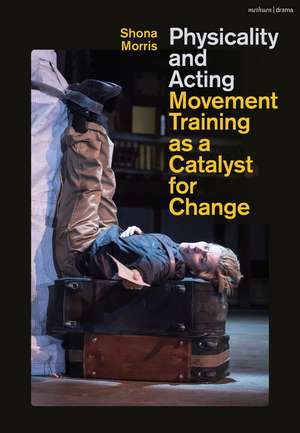
Physicality and Acting: Movement Training as a Catalyst for Change
Autor Shona Morrisen Limba Engleză Hardback – 30 apr 2026
In recognition of the movement pioneers, this book is part-memoir and part-historical research as author Shona Morris traces the roots of her own pedagogy for movement training in drama schools from these radical beginnings. She acknowledges some of the shadows, which affected her own practice, the provenance of Laban in particular, and the current need for discourse to review these approaches, through practice-based research.
The book includes exercises and approaches developed by the author in the classroom and the studio that illustrate how actors can link their physicality to the craft of transformation and interpretation. The exercises accessibly cover both technical and expressive work, and offer principles for transformation through animal study, mask work, and character work.
The book also includes numerous practical examples, interviews and cases studies of how to teach and apply movement to theatre making. It also offers ways to facilitate your own vision and actor's movement course in response to the present moment.
Lively, imaginative, critical and investigative, this book mirrors Morris's classes and her approach to theatre. It is an essential read for anyone interested in how actors are trained in movement and how theatre is made.
Preț: 523.31 lei
Preț vechi: 702.85 lei
-26%
Puncte Express: 785
Carte disponibilă
Livrare economică 16-30 noiembrie
Livrare prin curier în România Termenul estimat este afișat lângă disponibilitate.
Transport gratuit pentru acest produs Plată online sau ramburs, în funcție de opțiunile comenzii.
Retur gratuit în 14 zile Comandă securizată și suport în română.
Specificații
ISBN-13: 9781350369153
ISBN-10: 1350369152
Pagini: 256
Ilustrații: 12 bw illus
Dimensiuni: 169 x 244 x 25 mm
Greutate: 0.64 kg
Editura: Bloomsbury Publishing
Colecția Methuen Drama
Locul publicării:London, United Kingdom
ISBN-10: 1350369152
Pagini: 256
Ilustrații: 12 bw illus
Dimensiuni: 169 x 244 x 25 mm
Greutate: 0.64 kg
Editura: Bloomsbury Publishing
Colecția Methuen Drama
Locul publicării:London, United Kingdom
V-ar putea interesa
-
 The Actor's Art and CraftWilliam EsperPreț: 109.10 lei
 -
 100 Acting Exercises for 8 - 18 Year OldsSamantha Marsden-17%Preț: 126.32 lei151.74 lei
 -
 Trish Arnold: The Legacy of Her Movement Training for ActorsLizzie Ballinger-13%Preț: 188.67 lei217.20 lei
 -
 -10%Preț: 140.26 lei155.47 lei
 -
 Acting: A Backstage GuideLucian Msamati-10%Preț: 73.17 lei81.42 lei
 -
 -10%Preț: 160.94 lei179.55 lei
 -
 -8%Preț: 170.64 lei185.61 lei
 -
 -10%Preț: 170.84 lei188.82 lei
 -
 Movement Training for ActorsJackie Snow-22%Preț: 282.59 lei360.53 lei
 -
 -19%Preț: 192.87 lei237.30 lei
 -
 -13%Preț: 150.74 lei173.57 lei
 -
 We Are Movement: A User's Guide to the Human BodyWayne McGregor-25%Preț: 92.78 lei123.22 lei
 -
 Preț: 201.12 lei
 -
 Source Work for ActorsDiane EdgecombPreț: 190.48 lei
 -
 Acting Through SongPaul HarvardPreț: 115.78 lei
 -
 The Viewpoints BookAnne BogartPreț: 108.14 lei
 -
 Laban for Actors and DancersJean NewlovePreț: 106.18 lei
 -
 Different Every NightMike AlfredsPreț: 125.82 lei
 -
 Freeing the Natural VoiceKristin Linklater-6%Preț: 118.76 lei125.72 lei
Cuprins
PART 1 - ORIGINS
1 Introduction
Why write about Actor's Movement? A synopsis of what Actor's Movement is, and its provenance, and how recent compelling events have forced a re-appraisal. A guide to how to use this book.
2 First Steps
Memories and stories of how the writer first encountered Actor's Movement, through the theatre and her family, from the 1950's. Reflections on the history of Actor's Movement, and descriptions of the writer's first encounters with its practice and pedagogy
3 Transformation
Acting is transformation, movement is transformation, transformation as part of social change. How Drama Schools changed to reflect the social changes- or didn't. The role of women in the development of movement training and theatre, and its relationship (or not) to feminism.
4 The need for a system and how to place that system in a contemporary context: The traces that matter.
Legacy and provenance, can we ignore its political context? The traces of political ideology in some accepted movement practices. Examining Litz Pisk's artistic legacy and questioning that of FM Alexander and Rudolf Laban. Linking this to the present day and students' needs as learners and artists, and the need to re-frame teaching in response to this. The perils of "saying yes". Reflecting on how some of the traces have affected the writer's practice, forcing her to change and question its terminology.
PART 2- THE BODY AS PLAY TEXT
5 Trish Arnold and her legacy
Reflections on the pedagogy of Trish Arnold, and the development of Pure Movement as a progressive and expressive pedagogy. Pure Movement for Actors' connection to Sigurd Leeder and Jacques Lecoq, and its' "community of practice", whose teachers in Drama Schools innovated it and developed if for Acting. Pure Movement and Expressive Movement as distinct subjects. The Gravity Swing as central to the teaching of Pure Movement.
6 First Classes
How to introduce Pure Movement in Drama Schools and teach the first classes in a positive learning environment. Trish Arnold's "Tenets of Pure Movement". From Feet to Spine- inaugural exercises described, including ice-breakers to create an ensemble and a collective and collaborative use of the space. Reasons to work collectively, and the challenges currently facing students and teachers to work as a group.
7 Working in Three Dimensions
Working with the body and the spine in space- is working in three dimensions. The swings as the basis of all dynamic movement, which open expression and emotional connection. Part One - specific exercises for the dynamic and expressive movement of the spine, described in detail. Part Two- a selection of Gravity Swings and how to introduce their journeys in space through the "rib stretches". Specific exercises, including The Arrow Swing, Tree Topple, Swing in Wide and the Leg Swing, described in detail.
8 In praise of play: Pure and Expressive Movement in praise of play
We re-enact the world through play through "mimesis". Play as essential to theatre and to acting. How to "play" stage directions, and their contribution to story and meaning. How stage directions need actors to have bodies. How movement is not theoretical, but practical, alive and communicative. Some reflections on the relevance of post-modernism (or not) to training and theatre.
PART 3- MOVEMENT IN THE WORLD
9 Chameleon
The drama and surprise of Animal Study. The origins of Animal Study in Drama Schools, as part of the development of body-based training after the Second World War. How to use "real life" as material for theatre and for acting. The perils of training for a theatre that doesn't exist. The work of Michel Saint Denis, Jacques Copeau and Jacques Lecoq - French practitioners and their influence on British Actors' training. Reflections on how to teach Animal Study and Animal into Character in Drama Schools. Examples of how Animal Study is an acting exercise.
10 Animal Studies
Exercises specific to the actor's craft. Animal Study- how the actor chooses an animal and learns to break down and study how it moves. Animal Into Character- how to take the essence of the animal to create a believable and sustainable characterisation. Detailed warm-ups and exercises for Animal Study classes, including how to approach physically embodying their different ways of moving. Examples of how to lead and embed animal transformation through class teaching. "A day in the life of your animal". Animal into character improvisations.
11 Mask Work
Neutral Mask work: What is it. Is it still relevant? Can it be taught? Neutral mask is the actor "unadorned". How the neutral mask is an effective teaching tool for the physical expression of dramatic action. Character Mask work as a development from Neutral Mask. Examples of Character Mask for improvisation and emotional connection. The lineage of Neutral Mask from Noh Theatre, to Jacques Copeau to Jacques Lecoq, and its place in Drama Schools.
12 Neutral Mask and Chorus
How to teach Neutral Mask in Drama Schools and its connection to Chorus work,
Particularly Greek Tragedy. The exercises for Neutral Mask as developed for a text-based Drama School training. Including exercises on Chorus Work and The Elements. The importance of Greek Chorus in theatre training, and how to develop Chorus dramatically.
13 Actors and play and end notes
Concluding comments and reflections on the importance of movement training in Drama Schools. Some concluding exercises on The Elements. An example of a movement class. Conclusions on how to keep searching, and a recognition of the outliers and women who developed the practice.
1 Introduction
Why write about Actor's Movement? A synopsis of what Actor's Movement is, and its provenance, and how recent compelling events have forced a re-appraisal. A guide to how to use this book.
2 First Steps
Memories and stories of how the writer first encountered Actor's Movement, through the theatre and her family, from the 1950's. Reflections on the history of Actor's Movement, and descriptions of the writer's first encounters with its practice and pedagogy
3 Transformation
Acting is transformation, movement is transformation, transformation as part of social change. How Drama Schools changed to reflect the social changes- or didn't. The role of women in the development of movement training and theatre, and its relationship (or not) to feminism.
4 The need for a system and how to place that system in a contemporary context: The traces that matter.
Legacy and provenance, can we ignore its political context? The traces of political ideology in some accepted movement practices. Examining Litz Pisk's artistic legacy and questioning that of FM Alexander and Rudolf Laban. Linking this to the present day and students' needs as learners and artists, and the need to re-frame teaching in response to this. The perils of "saying yes". Reflecting on how some of the traces have affected the writer's practice, forcing her to change and question its terminology.
PART 2- THE BODY AS PLAY TEXT
5 Trish Arnold and her legacy
Reflections on the pedagogy of Trish Arnold, and the development of Pure Movement as a progressive and expressive pedagogy. Pure Movement for Actors' connection to Sigurd Leeder and Jacques Lecoq, and its' "community of practice", whose teachers in Drama Schools innovated it and developed if for Acting. Pure Movement and Expressive Movement as distinct subjects. The Gravity Swing as central to the teaching of Pure Movement.
6 First Classes
How to introduce Pure Movement in Drama Schools and teach the first classes in a positive learning environment. Trish Arnold's "Tenets of Pure Movement". From Feet to Spine- inaugural exercises described, including ice-breakers to create an ensemble and a collective and collaborative use of the space. Reasons to work collectively, and the challenges currently facing students and teachers to work as a group.
7 Working in Three Dimensions
Working with the body and the spine in space- is working in three dimensions. The swings as the basis of all dynamic movement, which open expression and emotional connection. Part One - specific exercises for the dynamic and expressive movement of the spine, described in detail. Part Two- a selection of Gravity Swings and how to introduce their journeys in space through the "rib stretches". Specific exercises, including The Arrow Swing, Tree Topple, Swing in Wide and the Leg Swing, described in detail.
8 In praise of play: Pure and Expressive Movement in praise of play
We re-enact the world through play through "mimesis". Play as essential to theatre and to acting. How to "play" stage directions, and their contribution to story and meaning. How stage directions need actors to have bodies. How movement is not theoretical, but practical, alive and communicative. Some reflections on the relevance of post-modernism (or not) to training and theatre.
PART 3- MOVEMENT IN THE WORLD
9 Chameleon
The drama and surprise of Animal Study. The origins of Animal Study in Drama Schools, as part of the development of body-based training after the Second World War. How to use "real life" as material for theatre and for acting. The perils of training for a theatre that doesn't exist. The work of Michel Saint Denis, Jacques Copeau and Jacques Lecoq - French practitioners and their influence on British Actors' training. Reflections on how to teach Animal Study and Animal into Character in Drama Schools. Examples of how Animal Study is an acting exercise.
10 Animal Studies
Exercises specific to the actor's craft. Animal Study- how the actor chooses an animal and learns to break down and study how it moves. Animal Into Character- how to take the essence of the animal to create a believable and sustainable characterisation. Detailed warm-ups and exercises for Animal Study classes, including how to approach physically embodying their different ways of moving. Examples of how to lead and embed animal transformation through class teaching. "A day in the life of your animal". Animal into character improvisations.
11 Mask Work
Neutral Mask work: What is it. Is it still relevant? Can it be taught? Neutral mask is the actor "unadorned". How the neutral mask is an effective teaching tool for the physical expression of dramatic action. Character Mask work as a development from Neutral Mask. Examples of Character Mask for improvisation and emotional connection. The lineage of Neutral Mask from Noh Theatre, to Jacques Copeau to Jacques Lecoq, and its place in Drama Schools.
12 Neutral Mask and Chorus
How to teach Neutral Mask in Drama Schools and its connection to Chorus work,
Particularly Greek Tragedy. The exercises for Neutral Mask as developed for a text-based Drama School training. Including exercises on Chorus Work and The Elements. The importance of Greek Chorus in theatre training, and how to develop Chorus dramatically.
13 Actors and play and end notes
Concluding comments and reflections on the importance of movement training in Drama Schools. Some concluding exercises on The Elements. An example of a movement class. Conclusions on how to keep searching, and a recognition of the outliers and women who developed the practice.
Recenzii
At a time when theatre studies in academia are still largely constrained by script-centric approaches, Shona Morris's book Physicality and Acting: Movement Training as a Catalyst for Change is an important intervention, offering a pedagogical approach to movement training.