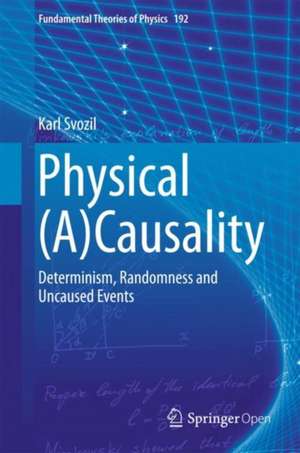
Physical (A)Causality: Fundamental Theories of Physics, cartea 192
Autor Karl Svozilen Limba Engleză Hardback – 22 feb 2018
All our knowledge is based on self-reflexive theorizing, as well as on operational means of empirical perception. Some of the questions that arise are the following: are these limitations reflected by our models? Under what circumstances does chance kick in? Is chance in physics merely epistemic? In other words, do we simply not know enough, or use too crude levels of description for our predictions? Or are certain events "truly", that is, irreducibly, random?
The book tries to answer some of these questions by introducing intrinsic, embedded observers and provable unknowns; that is, observables and procedures which are certified (relative to the assumptions) to be unknowable or undoable. A (somewhat iconoclastic) review of quantum mechanics is presented which is inspired by quantum logic. Postulated quantum (un-)knowables are reviewed. More exotic unknowns originate in the assumption of classical continua, and in finite automata and generalized urn models, which mimic complementarity and yet maintain value definiteness. Traditional conceptions of free will, miracles and dualistic interfaces are based on gaps in an otherwise deterministic universe.
Din seria Fundamental Theories of Physics
-
 Preț: 439.78 lei
- 18%
 Preț: 997.97 lei
- 18%
 Preț: 809.77 lei
- 18%
 Preț: 990.83 lei
- 18%
 Preț: 985.37 lei
- 18%
 Preț: 976.47 lei
- 18%
 Preț: 1182.53 lei
- 18%
 Preț: 1276.06 lei
- 18%
 Preț: 908.76 lei
-
 Preț: 399.61 lei
- 18%
 Preț: 989.70 lei
- 18%
 Preț: 1280.68 lei
- 18%
 Preț: 984.47 lei
- 18%
 Preț: 967.29 lei
- 18%
 Preț: 977.93 lei
- 15%
 Preț: 670.97 lei
- 18%
 Preț: 1270.88 lei
- 18%
 Preț: 962.19 lei
- 18%
 Preț: 950.63 lei
- 20%
 Preț: 623.48 lei
- 15%
 Preț: 662.49 lei
-
 Preț: 394.22 lei
- 18%
 Preț: 753.83 lei
-
 Preț: 380.05 lei
- 15%
 Preț: 627.14 lei
-
 Preț: 386.04 lei
- 24%
 Preț: 639.70 lei
- 15%
 Preț: 623.88 lei
- 18%
 Preț: 1265.43 lei
- 18%
 Preț: 954.64 lei
- 15%
 Preț: 669.04 lei
-
 Preț: 381.51 lei
- 18%
 Preț: 983.40 lei
Preț: 427.83 lei
Puncte Express: 642
Carte tipărită la comandă
Livrare economică 27 noiembrie-03 decembrie
Livrare prin curier în România Termenul estimat este afișat lângă disponibilitate.
Transport gratuit pentru acest produs Plată online sau ramburs, în funcție de opțiunile comenzii.
Retur gratuit în 14 zile Comandă securizată și suport în română.
Specificații
ISBN-13: 9783319708140
ISBN-10: 3319708147
Pagini: 236
Ilustrații: XIV, 219 p. 32 illus., 24 illus. in color.
Dimensiuni: 160 x 241 x 18 mm
Greutate: 0.52 kg
Ediția:1st edition 2018
Editura: Springer
Colecția Fundamental Theories of Physics
Seria Fundamental Theories of Physics
Locul publicării:Cham, Switzerland
ISBN-10: 3319708147
Pagini: 236
Ilustrații: XIV, 219 p. 32 illus., 24 illus. in color.
Dimensiuni: 160 x 241 x 18 mm
Greutate: 0.52 kg
Ediția:1st edition 2018
Editura: Springer
Colecția Fundamental Theories of Physics
Seria Fundamental Theories of Physics
Locul publicării:Cham, Switzerland
Cuprins
Part I Embedded observers, reflexive perception and representation: Intrinsic and extrinsic observation mode.- Embedded observers and self-expression.- Reflexive measurement.- Intrinsic self-representation.- Part II Provable unknowns: On what is entirely hopeless.- Forecasting and unpredictability.- Induction by rule inference.- Other types of recursion theoretic unknowables.- What if there are no laws? Emergence of laws.- Part III Quantum unknowns: "Shut up and calculate".- Evolution by permutation.- Quantum mechanics in a nutshell.- Quantum oracles.- Vacuum fluctuations.- Radioactive decay.- Part IV Exotic unknowns: Classical continua and infinities.- Classical (in)determinism.- Deterministic chaos.- Partition logics, finite automata and generalized urn models.- Part V Transcendence: Miracles.- Dualistic interfaces.- Part VI Executive summary: Executive summary.- Appendix A: Formal (in)computability and randomness.- B: Two particlecorrelations and expectations.
Notă biografică
Karl Svozil is an Austrian theoretical physicist at the TU Wien specializing in quantum theory and the logical foundations of chaotic systems. After studies in Vienna and Heidelberg, he continued his career as a visiting scientist in various locations, in particular, UC Berkeley and the Department of Energy's Lawrence Berkeley National Laboratory as well as Lomonosov Moscow State University and The University of Auckland. He has a broad range of interests, including philosophy of science, psychoanalysis and economy, and has served in various interdisciplinary research funding panels.
Svozil's main motivation to study physics has been a desire which seems both pathetic and hard: very fast space travel to other solar systems, to contemplate and invent physical principles that would allow mankind to explore our galaxy. Although specializing in other areas of physics because of the obvious lack of opportunity to realize such ambitions with present physical means, he has neverforgotten this passion.
Svozil holds that we should be acutely aware of the conceivable inverse situation, namely "us'' being visited by extraterrestrials. One of his first visits to UC Berkeley's Main Library was to fetch a copy of the Condon report. For him, the potential consequences are more than worth the effort of thorough scientific investigation.
Textul de pe ultima copertă
This book is open access under a CC BY 4.0 license.
This book addresses the physical phenomenon of events that seem to occur spontaneously and without any known cause. These are to be contrasted with events that happen in a (pre-)determined, predictable, lawful, and causal way.
All our knowledge is based on self-reflexive theorizing, as well as on operational means of empirical perception. Some of the questions that arise are the following: are these limitations reflected by our models? Under what circumstances does chance kick in? Is chance in physics merely epistemic? In other words, do we simply not know enough, or use too crude levels of description for our predictions? Or are certain events "truly", that is, irreducibly, random?
The book tries to answer some of these questions by introducing intrinsic, embedded observers and provable unknowns; that is, observables and procedures which are certified (relative to the assumptions) to be unknowable or undoable. A (somewhat iconoclastic) review of quantum mechanics is presented which is inspired by quantum logic. Postulated quantum (un-)knowables are reviewed. More exotic unknowns originate in the assumption of classical continua, and in finite automata and generalized urn models, which mimic complementarity and yet maintain value definiteness. Traditional conceptions of free will, miracles and dualistic interfaces are based on gaps in an otherwise deterministic universe.
Caracteristici
Provides a concise overview of the current debate on physical unknowables Discusses how to generate a "truly" irreducibly random number Considers the various counterarguments against claims of absolute physical randomness