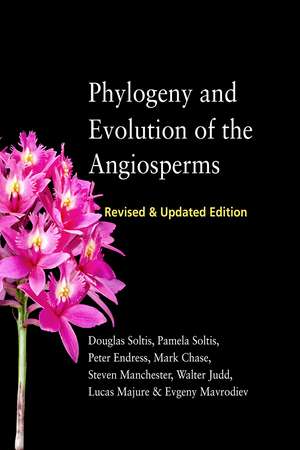
Phylogeny and Evolution of the Angiosperms: Revised and Updated Edition
Autor Douglas Soltis, Pamela Soltis, Peter Endress, Mark W. Chase, Steven Manchester, Walter Judd, Lucas Majure, Evgeny Mavrodieven Limba Engleză Hardback – 24 ian 2018
Domeniul botanicii a parcurs o transformare radicală în ultimele decenii, trecând de la clasificări bazate strict pe morfologie la sisteme complexe care integrează genetica moleculară cu înregistrările fosile. Remarcăm modul în care această a doua ediție a lucrării Phylogeny and Evolution of the Angiosperms, publicată de University of Chicago Press, reușește să sintetizeze acest progres, oferind un cadru filogenetic robust pentru cele peste 350.000 de specii de plante cu flori. Subliniem faptul că autorii nu se limitează la o simplă actualizare, ci recalibrează ipoteze evolutive fundamentale prin coroborarea datelor moleculare cu dovezi paleobotanice recente.
Structura cărții este riguros organizată, pornind de la relația angiospermelor cu alte plante cu semințe (Capitolul 1) și avansând prin analiza gradului ANA, a monocotiledonatelor și eudicotiledonatelor, până la teme transversale precum evoluția dimensiunii genomului și poliploidia. Această progresie facilitează o înțelegere profundă a modului în care plantele cu flori au ajuns să domine peisajele terestre. Credem că relevanța acestei ediții este sporită de cele 60 de planșe color și numeroasele desene tehnice care ilustrează diversitatea florală și structurile fosile.
În comparație cu Early Flowers and Angiosperm Evolution de Else Marie Friis, care se concentrează predominant pe înregistrările fosile din Cretacic, lucrarea de față propune o abordare mult mai interdisciplinară, punând un accent egal pe datele moleculare actuale. De asemenea, spre deosebire de The Enigma of Angiosperm Origins de Norman Francis Hughes, care prioritizează palinomorfia și microscopia electronică, textul semnat de Douglas Soltis și colaboratorii săi oferă o viziune de ansamblu, integrând sistematica modernă cu biologia dezvoltării.
Preț: 547.67 lei
Preț vechi: 595.29 lei
-8%
Carte disponibilă
Livrare economică 18 mai-01 iunie
Livrare express 01-07 mai pentru 104.21 lei
Specificații
ISBN-10: 022638361X
Pagini: 590
Ilustrații: 60 color plates, 36 halftones, 129 line drawings, 18 tables
Dimensiuni: 216 x 279 x 36 mm
Greutate: 2.33 kg
Ediția:Revizuită
Editura: University of Chicago Press
Colecția University of Chicago Press
V-ar putea interesa
-
 Plant Biotechnology: The genetic manipulation of plantsAdrian Slater-22%Preț: 373.75 lei478.98 lei
 -
 Lichens of North AmericaIrwin M. Brodo-9%Preț: 855.95 lei940.61 lei
 -
 The Names of PlantsDavid GledhillPreț: 445.02 lei
 -
 Preț: 294.75 lei
 -
 EthnobotanyBarbara M Schmidt-9%Preț: 908.98 lei998.88 lei
 -
 Gooseberry IslandSteven ManchesterPreț: 80.00 lei
 -
 Aquatic Plants: Composition, Nutrient Concentration & Environmental ImpactCrystal Eveline Rodney-26%Preț: 978.50 lei1315.57 lei
 -
 Poplars & Willows: Cultivation, Applications & Environmental BenefitsMadeline V Desmond-26%Preț: 1136.43 lei1528.25 lei
 -
 -26%Preț: 870.14 lei1169.04 lei
 -
 The Cabaret of Plants: Botany and the ImaginationRichard Mabey-19%Preț: 61.23 lei76.02 lei
De ce să citești această carte
Această ediție este resursa definitivă pentru botaniști și biologi evoluționiști care doresc să înțeleagă arborele genealogic al angiospermelor. Cititorul câștigă o perspectivă clară asupra mecanismelor care au condus la diversitatea vegetală actuală, beneficiind de o sinteză între datele moleculare de ultimă oră și descoperirile paleobotanice recente. Este o lucrare de referință esențială pentru orice bibliotecă universitară sau de cercetare în domeniul științelor naturale.
Despre autor
Echipa de autori reunește unii dintre cei mai respectați cercetători în domeniul botanicii sistematice. Douglas Soltis și Pamela Soltis sunt recunoscuți la nivel mondial pentru contribuțiile lor la înțelegerea evoluției plantelor prin tehnici moleculare. Această lucrare reprezintă o extindere teoretică a conceptelor explorate în The Great Tree of Life, unde autorii au analizat metafora arborelui vieții pentru publicul larg. Alături de experți precum Peter Endress și Mark W. Chase, aceștia aduc o expertiză vastă ce acoperă de la morfologie florală la genomică și paleobotanică, oferind o autoritate științifică incontestabilă textului.
Descriere scurtă
This fully revised edition of Phylogeny and Evolution of the Angiosperms provides an up-to-date, comprehensive overview of the evolution of and relationships among these vital plants. Incorporating molecular phylogenetics with morphological, chemical, developmental, and paleobotanical data, as well as presenting a more detailed account of early angiosperm fossils and important fossil information for each evolutionary branch of the angiosperms, the new edition integrates fossil evidence into a robust phylogenetic framework. Featuring a wealth of new color images, this highly synthetic work further reevaluates long-held evolutionary hypotheses related to flowering plants and will be an essential reference for botanists, plant systematists, and evolutionary biologists alike.
Notă biografică
Cuprins
Chapter 2. The Age and Diversity of Early Angiosperms: Integration of the Fossil Record and Molecular Dates
Chapter 3. Phylogeny of Angiosperms: An Overview
Chapter 4. The ANA Grade
Chapter 5. Magnoliids and Chloranthales
Chapter 6. Character Evolution: The Ancestral Angiosperm and General Trends
Chapter 7. Monocots
Chapter 8. Eudicots (+ Ceratophyllaceae): Introduction and Early-Diverging Lineages
Chapter 9. Core Eudicots: Introduction, Gunnerales, and Dilleniales
Chapter 10. Superrosids
Chapter 11. Superasterids
Chapter 12. Angiosperm Classification
Chapter 13. Parallel and Convergent Evolution
Chapter 14. Floral Diversification
Chapter 15. The Evolution of Genome Size
Chapter 16. Polyploidy
Descriptions of Major Clades
Acknowledgments
Reference List
Index