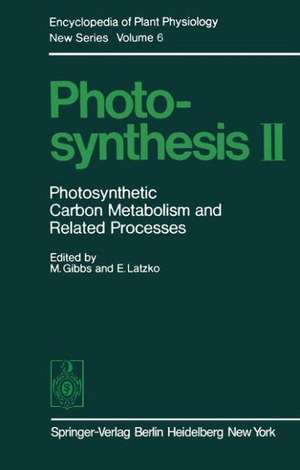
Photosynthesis II: Photosynthetic Carbon Metabolism and Related Processes: Encyclopedia of Plant Physiology, cartea 6
Editat de M. Gibbs, E. Latzkoen Limba Engleză Paperback – 24 noi 2011
Observăm în Photosynthesis II o abordare riguros interdisciplinară, situată la intersecția dintre biochimie, fiziologie vegetală și microbiologie. Volumul, integrat în prestigioasa serie Encyclopedia of Plant Physiology, explorează mecanismele complexe prin care plantele asimilează dioxidul de carbon, pornind de la fundamentul teoretic al ciclului Calvin-Benson-Bassham și ajungând la procese de reglare fină în organisme procariote și eucariote.
Suntem de părere că această ediție, o reeditare a lucrării clasice din 1979, rămâne un pilon de referință pentru înțelegerea metabolismului carbonului. Structura volumului este exemplară: primele secțiuni analizează Ciclul Reductiv al Pentozo-Fosfaților și izolarea protoplastelor, în timp ce partea a doua detaliază căile metabolice C4 și CAM, inclusiv utilizarea izotopului 13C ca indicator al reacțiilor de carboxilare. Finalul cărții este dedicat factorilor externi, analizând interacțiunea vitală dintre fotosinteză și respirația mitocondrială, un subiect care anticipează cercetările moderne despre eficiența energetică a plantelor.
Cititorii familiarizați cu Photosynthesis: Physiology and Metabolism de Richard C. Leegood vor aprecia în acest volum rigoarea istorică a datelor experimentale care au stat la baza modelelor actuale. Dacă lucrarea lui Leegood oferă o viziune integrată modernă, volumul editat de M. Gibbs și E. Latzko furnizează detaliile biochimice primare și protocoalele de laborator care au definit disciplina. Deși M. Gibbs a explorat în alte lucrări, precum Inhibition of Memory Formation, procese fiziologice la animale, expertiza sa în biochimia enzimatică este aici aplicată magistral asupra enzimelor cheie precum RuBP carboxilaza și NADP-GAP dehidrogenaza.
Din seria Encyclopedia of Plant Physiology
- 18%
 Preț: 927.86 lei
 - 18%
 Preț: 936.82 lei
 - 15%
 Preț: 652.47 lei
 - 15%
 Preț: 644.42 lei
 - 15%
 Preț: 628.24 lei
 - 15%
 Preț: 619.61 lei
 - 15%
 Preț: 683.21 lei
 - 18%
 Preț: 938.79 lei
 - 15%
 Preț: 642.87 lei
 - 15%
 Preț: 630.91 lei
 - 15%
 Preț: 646.46 lei
 - 15%
 Preț: 631.08 lei
 - 15%
 Preț: 650.73 lei
 - 18%
 Preț: 933.61 lei
 - 15%
 Preț: 639.57 lei
Preț: 925.12 lei
Preț vechi: 1128.19 lei
-18%
Carte disponibilă
Livrare economică 09-23 noiembrie
Specificații
ISBN-10: 3642672442
Pagini: 604
Ilustrații: XX, 578 p.
Dimensiuni: 156 x 244 x 32 mm
Greutate: 0.93 kg
Ediția:Softcover reprint of the original 1st ed. 1979
Editura: Springer Berlin, Heidelberg
Colecția Springer
Seria Encyclopedia of Plant Physiology
Locul publicării:Berlin, Heidelberg, Germany
V-ar putea interesa
-
 Ecology of the Shortgrass Steppe: A Long-Term PerspectiveW. K. Lauenroth-31%Preț: 684.47 lei987.93 lei
 -
 Plants: A Very Short IntroductionTimothy Walker-20%Preț: 57.15 lei71.12 lei
 -
 Plants and MicroclimateHamlyn G. Jones-11%Preț: 466.68 lei524.35 lei
 -
 Reaching for the SunJohn KingPreț: 374.78 lei
 -
 Terrestrial Photosynthesis in a Changing EnvironmentJaume Flexas-5%Preț: 1106.98 lei1165.24 lei
 -
 Botany For DummiesRF KratzPreț: 139.26 lei
 -
 The Role of Plant Roots in Crop ProductionNand Kumar Fageria-18%Preț: 1432.93 lei1747.48 lei
 -
 Physiological Plant EcologyWalter Larcher-18%Preț: 771.23 lei940.53 lei
Public țintă
ResearchDe ce să citești această carte
Această lucrare este esențială pentru cercetătorii în botanică și biochimie care doresc să înțeleagă bazele asimilării carbonului. Cititorul câștigă acces la o documentare exhaustivă a căilor metabolice C4 și CAM, precum și la detalii tehnice despre izolarea cloroplastelor. Este o resursă academică fundamentală care explică trecerea de la observațiile istorice ale lui Priestley la modelele enzimatice contemporane.