
Phonetic Data Analysis
Autor Ladefogeden Limba Engleză Hardback – 15 sep 2003
- Examines the procedures involved in describing the sounds of a language and illustrates the basic techniques of experimental phonetics.
- Written by Peter Ladefoged, one of the world's leading phoneticians.
- Enables readers to work with a speaker in class or go out into the field and make their own discoveries about how the sounds of a language are made.
- Provides full descriptions of techniques that are readily available and do not require the resources of a major phonetics laboratory.
- Includes enlightening comments throughout about Ladefoged's own fieldwork experiences.
Preț: 913.31 lei
Preț vechi: 1251.11 lei
-27%
Puncte Express: 1370
Carte tipărită la comandă
Livrare economică 27 noiembrie-11 decembrie
Livrare prin curier în România Termenul estimat este afișat lângă disponibilitate.
Transport gratuit pentru acest produs Plată online sau ramburs, în funcție de opțiunile comenzii.
Retur gratuit în 14 zile Comandă securizată și suport în română.
Specificații
ISBN-13: 9780631232698
ISBN-10: 0631232699
Pagini: 210
Dimensiuni: 161 x 240 x 16 mm
Greutate: 0.43 kg
Ediția:X, 219 P. 128 I.
Editura: Wiley
Locul publicării:Chichester, United Kingdom
ISBN-10: 0631232699
Pagini: 210
Dimensiuni: 161 x 240 x 16 mm
Greutate: 0.43 kg
Ediția:X, 219 P. 128 I.
Editura: Wiley
Locul publicării:Chichester, United Kingdom
V-ar putea interesa
-
 The Syntax of Sentential StressArsalan Kahnemuyipour-19%Preț: 351.18 lei435.55 lei
 -
 Sound Change and the History of EnglishJeremy J. Smith-28%Preț: 345.37 lei481.97 lei
 -
 Syllable Structure: The Limits of VariationSan Duanmu-19%Preț: 300.09 lei369.32 lei
 -
 Analysing Conversation: An Introduction to ProsodyBeatrice Szczepek ReedPreț: 272.55 lei
 -
 Understanding MorphologyMartin HaspelmathPreț: 387.98 lei
 -
 NeutralizationDaniel SilvermanPreț: 301.64 lei
 -
 Transcribing the Sound of EnglishPaul TenchPreț: 337.14 lei
 -
 Underlying RepresentationsMartin KrämerPreț: 303.68 lei
 -
 Intonational PhonologyD. Robert Ladd-11%Preț: 421.97 lei474.11 lei
 -
 CliticsAndrew SpencerPreț: 310.61 lei
 -
 PhoneticsRachael-Anne KnightPreț: 320.56 lei
 -
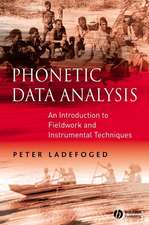 Phonetic Data AnalysisPeter LadefogedPreț: 348.98 lei
 -
 -18%Preț: 218.25 lei267.44 lei
 -
 The Sounds of KoreanJiyoung ShinPreț: 261.23 lei
 -
 Vowels and ConsonantsPeter LadefogedPreț: 271.33 lei
Public țintă
advanced undergraduate and graduate students, academics and researchers in phonetics and speech sciences, as well as those undertaking fieldworkNotă biografică
Peter Ladefoged, UCLA Research Phonetician and Professor of Phonetics Emeritus, was Director of the UCLA Phonetics Laboratory from 1962 to 1991. His numerous books include Vowels and Consonants (Blackwell, 2001), Sounds of the World's Languages (with Ian Maddieson, Blackwell, 1996), and A Course in Phonetics (fourth edition, 2001).
Cuprins
Preface. Acknowledgments.
1. Recording The Sounds Of A Language:.
Deciding What To Record.
Finding Speakers.
Recording Systems.
Making A Recording.
Digital Recording.
Listening To Recordings.
Field Notes.
Instrumental Phonetic Techniques.
2. Finding The Places Of Articulation:.
Still And Video Photography.
Basic Palatography.
More Elaborate Palatography.
Electropalatography.
Further Reading.
3. Aerodynamic Investigations:.
Recording Air Pressure And Airflow.
Measuring Air Pressure And Airflow.
Interpreting Aerodynamic Records.
Quantifying Nasalization.
Phonation Types.
Electroglottography.
Further Reading.
4. Pitch, Loudness And Length:.
Pitch Analysis.
Interpreting Pitch Curves.
Loudness, Intensity And Stress.
Waveforms And The Measurement Of Duration.
Further Reading.
5. Characterizing Vowels:.
Sound Spectrograms.
Spectra.
Vowel Charts.
Nasalized Vowels.
Further Reading.
6. Acoustic Analysis Of Consonants:.
Waveforms, Spectrograms And Duration Measurements.
Spectral Characteristics Of Nasals, Laterals, Approximants And Trills.
Fricatives And Stop Bursts.
Spectrograms And Place Of Articulation.
Spectrograms And Articulatory Movements.
Further Reading.
7. Acoustic Analysis Of Phonation Types:.
Waveforms Of Different Glottal States.
Spectral Characteristics Of Phonation Types.
Further Reading.
8. Coda:.
A General Purpose Phonetics Laboratory.
More Elaborate Instrumental Phonetic Techniques.
Saying Goodbye To Fieldwork.
Index.
1. Recording The Sounds Of A Language:.
Deciding What To Record.
Finding Speakers.
Recording Systems.
Making A Recording.
Digital Recording.
Listening To Recordings.
Field Notes.
Instrumental Phonetic Techniques.
2. Finding The Places Of Articulation:.
Still And Video Photography.
Basic Palatography.
More Elaborate Palatography.
Electropalatography.
Further Reading.
3. Aerodynamic Investigations:.
Recording Air Pressure And Airflow.
Measuring Air Pressure And Airflow.
Interpreting Aerodynamic Records.
Quantifying Nasalization.
Phonation Types.
Electroglottography.
Further Reading.
4. Pitch, Loudness And Length:.
Pitch Analysis.
Interpreting Pitch Curves.
Loudness, Intensity And Stress.
Waveforms And The Measurement Of Duration.
Further Reading.
5. Characterizing Vowels:.
Sound Spectrograms.
Spectra.
Vowel Charts.
Nasalized Vowels.
Further Reading.
6. Acoustic Analysis Of Consonants:.
Waveforms, Spectrograms And Duration Measurements.
Spectral Characteristics Of Nasals, Laterals, Approximants And Trills.
Fricatives And Stop Bursts.
Spectrograms And Place Of Articulation.
Spectrograms And Articulatory Movements.
Further Reading.
7. Acoustic Analysis Of Phonation Types:.
Waveforms Of Different Glottal States.
Spectral Characteristics Of Phonation Types.
Further Reading.
8. Coda:.
A General Purpose Phonetics Laboratory.
More Elaborate Instrumental Phonetic Techniques.
Saying Goodbye To Fieldwork.
Index.
Descriere
This work examines the procedures involved in describing the sounds of a language and illustrates the basic techniques of experimental phonetics, most of them requiring little more than a tape recorder, a video camera and a computer.