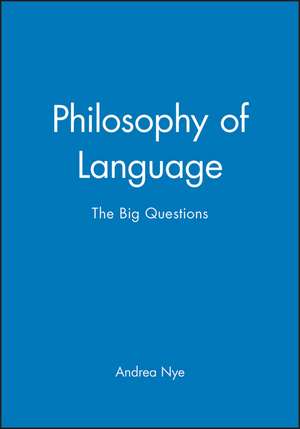
Philosophy Language
Autor Nyeen Limba Engleză Hardback – 29 oct 1998
Preț: 1036.71 lei
Preț vechi: 1420.15 lei
-27%
Puncte Express: 1555
Carte tipărită la comandă
Livrare economică 18 noiembrie-02 decembrie
Livrare prin curier în România Termenul estimat este afișat lângă disponibilitate.
Transport gratuit pentru acest produs Plată online sau ramburs, în funcție de opțiunile comenzii.
Retur gratuit în 14 zile Comandă securizată și suport în română.
Specificații
ISBN-13: 9780631206019
ISBN-10: 0631206019
Pagini: 320
Dimensiuni: 175 x 250 x 22 mm
Greutate: 0.74 kg
Ediția:New.
Editura: Wiley
Locul publicării:Chichester, United Kingdom
ISBN-10: 0631206019
Pagini: 320
Dimensiuni: 175 x 250 x 22 mm
Greutate: 0.74 kg
Ediția:New.
Editura: Wiley
Locul publicării:Chichester, United Kingdom
V-ar putea interesa
-
 The Language InstinctSteven Pinker-29%Preț: 77.56 lei108.48 lei
 -
 Language, Cognition, and Human NatureSteven Pinker-20%Preț: 177.64 lei222.37 lei
 -
 Linguistics: A Very Short IntroductionP. H. Matthews-21%Preț: 55.39 lei69.91 lei
 -
 Metaphor: A Practical IntroductionZoltan Kövescses-13%Preț: 279.01 lei318.89 lei
 -
 Assertion: New Philosophical EssaysJessica Brown-20%Preț: 289.11 lei362.65 lei
 -
 -28%Preț: 526.50 lei734.75 lei
 -
 The Logical Structure of KindsEric Funkhouser-29%Preț: 521.91 lei732.07 lei
 -
 -21%Preț: 353.17 lei448.21 lei
 -
 Structuring Sense: Volume III: Taking FormHagit Borer-31%Preț: 832.52 lei1199.93 lei
 -
 Quantifiers in Language and LogicStanley Peters-22%Preț: 447.19 lei571.96 lei
 -
 Epistemic ModalityAndy Egan-11%Preț: 377.54 lei424.38 lei
 -
 Definite DescriptionsPaul ElbournePreț: 383.33 lei
 -
 -31%Preț: 561.62 lei815.68 lei
 -
 Intercultural PragmaticsIstvan Kecskes-31%Preț: 741.55 lei1080.82 lei
 -
 Reference and Existence: The John Locke LecturesSaul A. Kripke-19%Preț: 459.08 lei566.77 lei
 -
 Feminism and Modern PhilosophyAndrea NyePreț: 384.94 lei
 -
 Feminist Theory and the Philosophies of ManAndrea NyePreț: 411.72 lei
 -
 The Cat Who Knew a CardinalLilian Jackson BraunPreț: 56.29 lei
 -
 -24%Preț: 267.37 lei352.88 lei
Public țintă
undergraduate and graduate courses in the philosophy of language, epistemology, and metaphysicsNotă biografică
Andrea Nye is Professor of Philosophy at the University of Wisconsin-Whitewater. She is the author of Feminist Theory and the Philosophies of Man (1988), Words of Power: a Feminist Reading of the History of Logic (1990), Philosophia: the Thought of Rosa Luxemburg, Simone Weil, Hannah Arendt (1994), Philosophy and Feminism: at the Border (1995).
Cuprins
General Introduction. Part I: Language: What is it?:.
1. Language as the Weaving Together of Forms: Plato.
2. The Origins of Language: Jean-Jacques Rousseau.
3. On Words: John Locke.
4. On the Scientific Justification of a Conceptual Notation: Gottlob Frege.
5. The Existential Matrix of Inquiry: John Dewey.
6. Picturing Reality: Ludwig Wittgenstein.
7. Subjectivity in Language: Emile Benveniste.
8. Private Language, Public Languages: Jerry Fodor.
9. The Mark of Gender: Monnique Wittig.
Part II: Meaning: How do Words get their Sense?:.
10. On Sense and Reference: Gottlob Frege.
11. The Principle of Verifiability: A.J. Ayer.
12. Meaning as Use: Ludwig Wittgenstein.
13. Biosemantics: Ruth Millikan.
14. How can Language be Sexist?: Merrill and Jaakko Hintikka.
Part III: Speaking: What is it to Say Something:.
15. Meaning: H.P. Grice.
16. Performative Utterances: John Austin.
17. Verbal Interaction: V.N. Volosinov.
18. Telling as Letting Know: Arindam Chakrabati.
19. He I Sought but did not Find: Luce Irigaray.
Part IV: Reference: what do we Talk About?:.
20. On Denoting: Bertrand Russell.
21. Naming and Necessity (excerpts): Saul Kripke.
22. The Formation of Objects: Michel Foucault.
23. Critically Queer: Judith Butler.
24. 'Worlds' and World Travelling: Maria Lugones.
Part V: Truth: What is the Reaction Between Language and Reality?:.
25. The Semantic Theory of Truth: Alfred Tarski.
26. The Method of Truth in Metaphysics: Donald Davidson.
27. Truth as Coherence: Linda Alcoff.
28. Truth Through Social Praxis: David Theo Goldberg.
29. Are Truth Claims Dysfunctional?: Sandra Harding.
Part VI: Other Minds and Foreign Tongues: How is it Possible to Understand What Someone Else Says?:.
30. The Translation of Unstranslatable Words: Bronislaw Malinowski.
31. Indeterminacy of Translation: W.V. Quine.
32. On the Very Idea of a Conceptual Scheme: Donald Davidson.
33. An American Indian Model of the Universe: Benjamin Whorf.
34. How to Tame a Wild Tongue: Gloria Anzaldua.
35. Language as Boundary: Wole Soyinka.
1. Language as the Weaving Together of Forms: Plato.
2. The Origins of Language: Jean-Jacques Rousseau.
3. On Words: John Locke.
4. On the Scientific Justification of a Conceptual Notation: Gottlob Frege.
5. The Existential Matrix of Inquiry: John Dewey.
6. Picturing Reality: Ludwig Wittgenstein.
7. Subjectivity in Language: Emile Benveniste.
8. Private Language, Public Languages: Jerry Fodor.
9. The Mark of Gender: Monnique Wittig.
Part II: Meaning: How do Words get their Sense?:.
10. On Sense and Reference: Gottlob Frege.
11. The Principle of Verifiability: A.J. Ayer.
12. Meaning as Use: Ludwig Wittgenstein.
13. Biosemantics: Ruth Millikan.
14. How can Language be Sexist?: Merrill and Jaakko Hintikka.
Part III: Speaking: What is it to Say Something:.
15. Meaning: H.P. Grice.
16. Performative Utterances: John Austin.
17. Verbal Interaction: V.N. Volosinov.
18. Telling as Letting Know: Arindam Chakrabati.
19. He I Sought but did not Find: Luce Irigaray.
Part IV: Reference: what do we Talk About?:.
20. On Denoting: Bertrand Russell.
21. Naming and Necessity (excerpts): Saul Kripke.
22. The Formation of Objects: Michel Foucault.
23. Critically Queer: Judith Butler.
24. 'Worlds' and World Travelling: Maria Lugones.
Part V: Truth: What is the Reaction Between Language and Reality?:.
25. The Semantic Theory of Truth: Alfred Tarski.
26. The Method of Truth in Metaphysics: Donald Davidson.
27. Truth as Coherence: Linda Alcoff.
28. Truth Through Social Praxis: David Theo Goldberg.
29. Are Truth Claims Dysfunctional?: Sandra Harding.
Part VI: Other Minds and Foreign Tongues: How is it Possible to Understand What Someone Else Says?:.
30. The Translation of Unstranslatable Words: Bronislaw Malinowski.
31. Indeterminacy of Translation: W.V. Quine.
32. On the Very Idea of a Conceptual Scheme: Donald Davidson.
33. An American Indian Model of the Universe: Benjamin Whorf.
34. How to Tame a Wild Tongue: Gloria Anzaldua.
35. Language as Boundary: Wole Soyinka.
Descriere
This anthology brings together a diversity of readings in the philosophy of language from the ancient Greeks to contemporary analytic, feminist, and multicultural perspectives. The emphasis is on issues that have a direct bearing on concerns about knowledge, reality, meaning, and understanding.