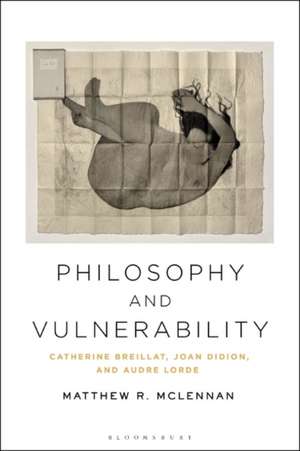
Philosophy and Vulnerability: Catherine Breillat, Joan Didion, and Audre Lorde
Autor Dr. Matthew R. McLennanen Limba Engleză Paperback – 20 aug 2020
Developing an invigorating, if at times painful, sense of the finitude and fragility of human life, Philosophy and Vulnerability provocatively marshals three disciplinary "nonphilosophers" to make its argument: French filmmaker and novelist Catherine Breillat, journalist and masterful cultural commentator Joan Didion and feminist poet and civil rights activist Audre Lorde. Through this encounter, this book suggests ways in which rigorous attention to difference and diversity must nourish a militant philosophical universalism in the future.
Preț: 242.12 lei
Preț vechi: 331.45 lei
-27%
Puncte Express: 363
Carte tipărită la comandă
Livrare economică 01-15 decembrie
Livrare prin curier în România Termenul estimat este afișat lângă disponibilitate.
Transport gratuit de la 400.00 lei Plată online sau ramburs, în funcție de opțiunile comenzii.
Retur gratuit în 14 zile Comandă securizată și suport în română.
Specificații
ISBN-13: 9781350176423
ISBN-10: 1350176427
Pagini: 200
Dimensiuni: 152 x 232 x 12 mm
Greutate: 0.34 kg
Editura: Bloomsbury Publishing
Colecția Bloomsbury Academic
Locul publicării:London, United Kingdom
ISBN-10: 1350176427
Pagini: 200
Dimensiuni: 152 x 232 x 12 mm
Greutate: 0.34 kg
Editura: Bloomsbury Publishing
Colecția Bloomsbury Academic
Locul publicării:London, United Kingdom
Cuprins
Acknowledgments
Introduction: Toward a Definition of Philosophy which Incorporates Vulnerability
Chapter 1. Catherine Breillat I: An Erotic Suspension of the Ethical
Chapter 2. Joan Didion: Becoming Frail
Chapter 3. Audre Lorde: We must learn to count the living with that same particular attention with which we number the dead
Chapter 4. Catherine Breillat II: Embrace of Weakness?
Conclusion: Vulnerability and the Profession
Notes
Bibliography
Index
Introduction: Toward a Definition of Philosophy which Incorporates Vulnerability
Chapter 1. Catherine Breillat I: An Erotic Suspension of the Ethical
Chapter 2. Joan Didion: Becoming Frail
Chapter 3. Audre Lorde: We must learn to count the living with that same particular attention with which we number the dead
Chapter 4. Catherine Breillat II: Embrace of Weakness?
Conclusion: Vulnerability and the Profession
Notes
Bibliography
Index
Recenzii
As a discipline, philosophy too often alibis the hyperbolic sense of autonomy, self-interest, and instrumentality that undergird the supposed common sense of capitalism. As an antidote, Matthew McLennan argues that the ability to philosophize itself relies on vulnerability-both in our finitude and our relationships with others, and in the kinds of egalitarian social solidarity that not only make these relationships possible, but desirable.
Against the androcentric myth of the independent command of rationality, terribly central to philosophy's conception of itself, Matthew R. McLennan has produced an adept introspection on philosophy as dependent and vulnerable--a practice that is the "mastery of being mastered". To explore this theme of vulnerability, as both philosophical object and philosophy itself, Philosophy and Vulnerability methodically but beautifully develops its themes through the work of Catheriene Breillat, Joan Didion, and Audre Lorde. Treating these figures as "pre-disciplinary philosophers" who "hit up against a wall of finitude" and "struggle from within that finitude," McLennan succeeds in crafting a work of gracefully fragile militancy. This book indeed contributes to the survival and democratization of philosophy in the face of the closure of thought.
Against the androcentric myth of the independent command of rationality, terribly central to philosophy's conception of itself, Matthew R. McLennan has produced an adept introspection on philosophy as dependent and vulnerable--a practice that is the "mastery of being mastered". To explore this theme of vulnerability, as both philosophical object and philosophy itself, Philosophy and Vulnerability methodically but beautifully develops its themes through the work of Catheriene Breillat, Joan Didion, and Audre Lorde. Treating these figures as "pre-disciplinary philosophers" who "hit up against a wall of finitude" and "struggle from within that finitude," McLennan succeeds in crafting a work of gracefully fragile militancy. This book indeed contributes to the survival and democratization of philosophy in the face of the closure of thought.
Notă biografică
Matthew R. McLennan is Full Professor in the School of Ethics and Public Affairs, Saint Paul University/Université Saint-Paul, Canada.