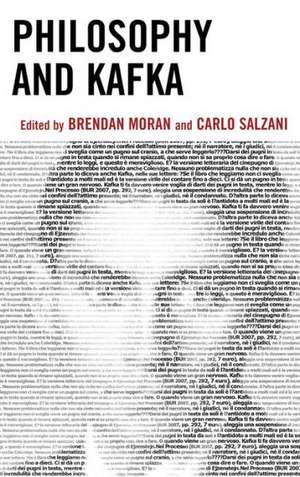
Philosophy and Kafka
Editat de Brendan Moran, Carlo Salzani Contribuţii de Paul Alberts, Ronald Bogue, Chris Danta, Paul Haacke, Rainer Nagele, Brian O'Connor, Andrew R. Russ, Peter Schwenger, Kevin W. Sweeney, Dimitris Vardoulakis, Isak Winkel Holmen Limba Engleză Hardback – 19 apr 2013
The proposed collection brings together essays that interrogate the relationship of philosophy and Kafka, and offer new and original interpretations. The volume obviously cannot claim completeness, but it partially does justice to the multiplicity of philosophical issues and philosophical interpretations at stake.
This variety informs the composition of the volume itself. A number of essays focus on specific philosophical commentaries on Kafka's work, from Adorno's to Agamben's, from Arendt's to Benjamin's, from Deleuze and Guattari's to Derrida's. A number of essays consider the possible relevance of certain philosophical outlooks for examining Kafka's writings: here Kafka's name goes alongside those of Socrates, Kant, Kierkegaard, Nietzsche, Wittgenstein, Buber, Heidegger, Blanchot, and Levinas. Finally, a number of essays consider Kafka's writings in terms of a specific philosophical theme, such as communication and subjectivity, language and meaning, knowledge and truth, the human/animal divide, justice, and freedom. In all contributions to the volume, such themes, motifs, and interpretations arise. To varying degrees, all essays are concerned with the relationship of literature and philosophy, and thus with the philosophical significance of Kafka's writings.
Preț: 565.63 lei
Preț vechi: 864.81 lei
-35%
Puncte Express: 848
Carte tipărită la comandă
Livrare economică 16-30 noiembrie
Livrare prin curier în România Termenul estimat este afișat lângă disponibilitate.
Transport gratuit pentru acest produs Plată online sau ramburs, în funcție de opțiunile comenzii.
Retur gratuit în 14 zile Comandă securizată și suport în română.
Specificații
ISBN-13: 9780739180891
ISBN-10: 0739180894
Pagini: 300
Dimensiuni: 152 x 230 x 24 mm
Greutate: 0.59 kg
Ediția:New.
Editura: Bloomsbury Publishing
Colecția Lexington Books
Locul publicării:New York, United States
ISBN-10: 0739180894
Pagini: 300
Dimensiuni: 152 x 230 x 24 mm
Greutate: 0.59 kg
Ediția:New.
Editura: Bloomsbury Publishing
Colecția Lexington Books
Locul publicării:New York, United States
Cuprins
Introduction
Part 1: Philosophical Investigations
Chapter 1: I Don't Want to Know that I Know: The Inversion of Socratic Ignorance in the Knowledge of the Dogs
Chapter 2: Kafka's Empty Law: Laughter and Freedom in The Trial
Chapter 3: A Kafkan Sublime: Dark Poetics on the Kantian Philosophy
Chapter 4: The Everyday's Fabulous Beyond: Nonsense, Parable, and the Ethics of the Literary in Kafka and Wittgenstein
Chapter 5: You're nobody 'til somebody loves you: Communication and the Social Destruction of Subjectivity in Kafka's Metamorphosis
Chapter 6: Kafka's Insomnia
Part 2: Philosophical Topics
Chapter 7: Animal Bachelors and Animal Brides: Fabulous Metamorphosis in Kafka and Garnett
Chapter 8: Kafka's Political Animals
Chapter 9: The Calamity of the Rightless: Hannah Arendt and Franz Kafka on Monsters and Members
Chapter 10: Knowing Life Before the Law: Kafka, Kelsen, Derrida
Part 3: Philosophical Readings
Chapter 11: Anxiety and Attention: Benjamin and Others
Chapter 12: On the Mimesis of Reification: Adorno's Critical Theoretical Interpretation of Kafka
Chapter 13: "In the Penal Colony" in the Philosophy of Gilles Deleuze
Chapter 14: In a Messianic Gesture: Agamben's Kafka
Index
About the Contributors
Part 1: Philosophical Investigations
Chapter 1: I Don't Want to Know that I Know: The Inversion of Socratic Ignorance in the Knowledge of the Dogs
Chapter 2: Kafka's Empty Law: Laughter and Freedom in The Trial
Chapter 3: A Kafkan Sublime: Dark Poetics on the Kantian Philosophy
Chapter 4: The Everyday's Fabulous Beyond: Nonsense, Parable, and the Ethics of the Literary in Kafka and Wittgenstein
Chapter 5: You're nobody 'til somebody loves you: Communication and the Social Destruction of Subjectivity in Kafka's Metamorphosis
Chapter 6: Kafka's Insomnia
Part 2: Philosophical Topics
Chapter 7: Animal Bachelors and Animal Brides: Fabulous Metamorphosis in Kafka and Garnett
Chapter 8: Kafka's Political Animals
Chapter 9: The Calamity of the Rightless: Hannah Arendt and Franz Kafka on Monsters and Members
Chapter 10: Knowing Life Before the Law: Kafka, Kelsen, Derrida
Part 3: Philosophical Readings
Chapter 11: Anxiety and Attention: Benjamin and Others
Chapter 12: On the Mimesis of Reification: Adorno's Critical Theoretical Interpretation of Kafka
Chapter 13: "In the Penal Colony" in the Philosophy of Gilles Deleuze
Chapter 14: In a Messianic Gesture: Agamben's Kafka
Index
About the Contributors
Recenzii
Several readings are illuminating. ... Philosophy and Kafka contains many valuable insights. ... The illuminating moments of Philosophy and Kafka will reward curious fans of Kafka's work.
These illuminating essays explore some of the ways in which the ideas of philosophers such as Socrates, Spinoza, Kierkegaard, and Kant are at play in Kafka's writing, and the ways in which more recent philosophers such as Adorno, Agamben, Arendt, and Benjamin have considered Kafka's work. What is more, many of the essays collected here shed light on the ways in which Kafka's own thinking can contribute to on-going philosophical debates about issues such as the conditions for identity, the nature of animality, the requirements of justice, and the moral implications and promise of certain forms of writing. Philosophy and Kafka is an important and long overdue contribution to Kafka scholarship as well as to philosophical reflection on a range of pressing issues.
This essay collection - the first of its kind - explores a rich variety of ways in which Kafka's writings are bound to philosophical concerns. It bridges the gap between the philosophical and the literary, highlighting how the two coexist and illuminate one another. From Socrates to Agamben, from Kierkegaard to Wittgenstein, ethics and aesthetics, logic and literature, Kafka's prose resonates, reflects and provokes.
By bringing together scholars from different disciplines, "Philosophy and Kafka" establishes fascinating new paths of enquiry into Kafka's thinking and philosophers' engagement with it. It allows us to understand why we continue to be captured by Kafka's writing, standing as a testament to its relevance, and attesting to the vitality of the research it inspires.
These illuminating essays explore some of the ways in which the ideas of philosophers such as Socrates, Spinoza, Kierkegaard, and Kant are at play in Kafka's writing, and the ways in which more recent philosophers such as Adorno, Agamben, Arendt, and Benjamin have considered Kafka's work. What is more, many of the essays collected here shed light on the ways in which Kafka's own thinking can contribute to on-going philosophical debates about issues such as the conditions for identity, the nature of animality, the requirements of justice, and the moral implications and promise of certain forms of writing. Philosophy and Kafka is an important and long overdue contribution to Kafka scholarship as well as to philosophical reflection on a range of pressing issues.
This essay collection - the first of its kind - explores a rich variety of ways in which Kafka's writings are bound to philosophical concerns. It bridges the gap between the philosophical and the literary, highlighting how the two coexist and illuminate one another. From Socrates to Agamben, from Kierkegaard to Wittgenstein, ethics and aesthetics, logic and literature, Kafka's prose resonates, reflects and provokes.
By bringing together scholars from different disciplines, "Philosophy and Kafka" establishes fascinating new paths of enquiry into Kafka's thinking and philosophers' engagement with it. It allows us to understand why we continue to be captured by Kafka's writing, standing as a testament to its relevance, and attesting to the vitality of the research it inspires.