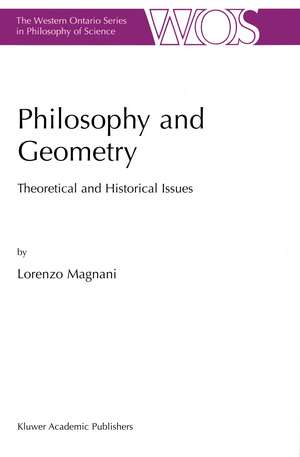
Philosophy and Geometry: Theoretical and Historical Issues: The Western Ontario Series in Philosophy of Science, cartea 66
Autor L. Magnanien Limba Engleză Paperback – 30 noi 2001
Din seria The Western Ontario Series in Philosophy of Science
- 15%
 Preț: 611.34 lei
 - 20%
 Preț: 658.51 lei
 - 18%
 Preț: 950.03 lei
 -
 Preț: 410.49 lei
 - 15%
 Preț: 613.00 lei
 - 18%
 Preț: 978.99 lei
 - 18%
 Preț: 963.80 lei
 - 18%
 Preț: 983.29 lei
 - 15%
 Preț: 662.37 lei
 - 18%
 Preț: 941.04 lei
 - 15%
 Preț: 665.10 lei
 -
 Preț: 374.30 lei
 -
 Preț: 378.58 lei
 - 15%
 Preț: 617.39 lei
 - 18%
 Preț: 907.10 lei
 - 18%
 Preț: 906.64 lei
 - 18%
 Preț: 1262.57 lei
 - 18%
 Preț: 1170.37 lei
 - 18%
 Preț: 910.58 lei
 - 18%
 Preț: 982.36 lei
 -
 Preț: 381.87 lei
 - 18%
 Preț: 912.25 lei
 - 18%
 Preț: 910.58 lei
 - 18%
 Preț: 1263.85 lei
 - 18%
 Preț: 1172.17 lei
 - 15%
 Preț: 659.45 lei
 -
 Preț: 372.96 lei
 - 18%
 Preț: 910.11 lei
 - 15%
 Preț: 619.45 lei
 -
 Preț: 374.34 lei
 - 18%
 Preț: 986.35 lei
 - 18%
 Preț: 913.45 lei
 - 15%
 Preț: 663.58 lei
 - 15%
 Preț: 666.73 lei
 - 15%
 Preț: 616.28 lei
 - 15%
 Preț: 614.60 lei
 - 18%
 Preț: 982.46 lei
 -
 Preț: 384.04 lei
 - 18%
 Preț: 908.00 lei
 - 18%
 Preț: 907.25 lei
 - 18%
 Preț: 1173.25 lei
 - 18%
 Preț: 908.00 lei
Preț: 605.56 lei
Preț vechi: 756.95 lei
-20%
Puncte Express: 908
Carte tipărită la comandă
Livrare economică 17-23 noiembrie
Livrare prin curier în România Termenul estimat este afișat lângă disponibilitate.
Transport gratuit pentru acest produs Plată online sau ramburs, în funcție de opțiunile comenzii.
Retur gratuit în 14 zile Comandă securizată și suport în română.
Specificații
ISBN-13: 9781402002410
ISBN-10: 1402002416
Pagini: 276
Ilustrații: XX, 256 p.
Dimensiuni: 155 x 235 x 14 mm
Greutate: 0.41 kg
Ediția:Softcover reprint of the original 1st ed. 2001
Editura: SPRINGER NETHERLANDS
Colecția Springer
Seria The Western Ontario Series in Philosophy of Science
Locul publicării:Dordrecht, Netherlands
ISBN-10: 1402002416
Pagini: 276
Ilustrații: XX, 256 p.
Dimensiuni: 155 x 235 x 14 mm
Greutate: 0.41 kg
Ediția:Softcover reprint of the original 1st ed. 2001
Editura: SPRINGER NETHERLANDS
Colecția Springer
Seria The Western Ontario Series in Philosophy of Science
Locul publicării:Dordrecht, Netherlands
V-ar putea interesa
-
 -19%Preț: 132.82 lei164.44 lei
 -
 Visual Cultures in Science and Technology: A Comparative HistoryKlaus Hentschel-32%Preț: 817.98 lei1205.99 lei
 -
 Preț: 376.87 lei
 -
 What is This Thing Called Science?Alan Chalmers-27%Preț: 199.81 lei273.20 lei
 -
 Does Santa Exist?Eric Kaplan-28%Preț: 66.18 lei91.32 lei
 -
 Rationality and ScienceTriggPreț: 398.79 lei
 -
 Re-Thinking ScienceHelga NowotnyPreț: 266.39 lei
 -
 Science Set FreeRupert SheldrakePreț: 100.43 lei
 -
 -19%Preț: 421.66 lei520.57 lei
 -
 Naturalism and PragmatismJay SchulkinPreț: 390.86 lei
 -
 NewtonAndrew JaniakPreț: 147.40 lei
 -
 -16%Preț: 196.36 lei233.92 lei
 -
 Philosophical Chemistry: Genealogy of a Scientific FieldProfessor Manuel DeLanda-23%Preț: 367.29 lei474.53 lei
 -
 Preț: 97.04 lei
 -
 Genes, Cells, and BrainsHilary RosePreț: 103.84 lei
 -
 World of Our GrandchildrenBert Koene-11%Preț: 126.85 lei143.25 lei
Public țintă
ResearchCuprins
1 At the Origins of Geometrical Knowledge.- 1. Conceptual space, mental spatial models, latent geometry.- 2. Figures, symbols, and the Greek origins of geometry.- 3. The ritual origin of geometry.- 2 Geometry: the Model of Knowledge.- 1. Sensibility.- 2. Imagination.- 3. Understanding.- 4. Pure apprehension and geometry.- 5. Empirical apprehension and empirical schematism.- 6. Geometrical schemata and constructions: models of philosophy.- 7. Space as the object of geometry.- 3 Constructions, Logic, Categories.- 1. Space and logic.- 2. Intuition, construction, and the logic of singular terms.- 3. Pure and applied geometry.- 4. Why is geometry synthetic?.- 5. Categories and Axioms of Intuition.- 6. Mathematical schematism.- 4 The ???????? in Ancient Geometrical Knowledge.- 1. Geometry, drawing, and writing.- 2. Mathematical objects.- 3. Geometrical reasoning.- 4. The science that studies shapes: geometry.- 5. “History of geometry” and “elements” of geometry.- 5 Geometry and Convention.- 1. Crude facts, relations, conventions.- 2. Pure and applied geometry.- 3. Sensible, geometric, and physical space.- 4. Geometrical intuition.- 5. Geometrical apriorism and empiricism.- 6. The genesis of geometry.- 7. The interchangeability of geometries.- 8. Withdrawing conventions.- 9. Withdrawing principles of coordination.- 6 Geometry, Problem Solving, Abduction.- 1. Geometrical constructions and problem solving.- 2. Model-based and manipulative abduction.- 3. Geometrical construction is a kind of manipulative abduction.- 4. Diagrams, abduction, and deductive reasoning.- 7 Geometry and Cognition.- 1. Geometry of visibles, protogeometry, manipulations.- 2. At the origins of geometrical knowledge II.- 3. Non-conceptual and spatial abilities.- 4. Computational geometricalconstructions.- 5. Spatial imagery.- 6. Logical models of diagrammatic reasoning.- References.- Author Index.