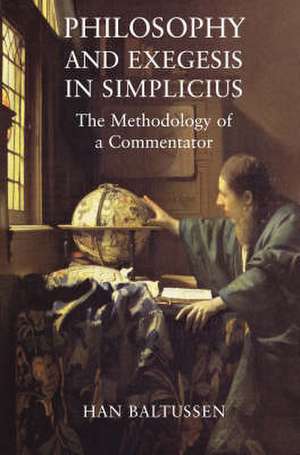
Philosophy and Exegesis in Simplicius: The Methodology of a Commentator
Autor Han Baltussenen Limba Engleză Hardback – 14 aug 2008
Preț: 923.04 lei
Preț vechi: 1297.55 lei
-29%
Puncte Express: 1385
Carte tipărită la comandă
Livrare economică 08-22 iunie
Specificații
ISBN-13: 9780715635001
ISBN-10: 071563500X
Pagini: 224
Dimensiuni: 156 x 234 x 30 mm
Greutate: 0.61 kg
Editura: Bloomsbury Publishing
Colecția Bristol Classical Press
Locul publicării:London, United Kingdom
ISBN-10: 071563500X
Pagini: 224
Dimensiuni: 156 x 234 x 30 mm
Greutate: 0.61 kg
Editura: Bloomsbury Publishing
Colecția Bristol Classical Press
Locul publicării:London, United Kingdom
V-ar putea interesa
-
 The Complete EssaysMichel Montaigne-31%Preț: 129.79 lei188.11 lei
 -
 -21%Preț: 107.06 lei135.96 lei
 -
 Recreative Minds: Imagination in Philosophy and PsychologyGregory Currie-11%Preț: 353.87 lei397.60 lei
 -
 Philosophy of Mental RepresentationHugh Clapin-14%Preț: 355.36 lei414.34 lei
 -
 Aquinas's Theory of Natural Law: An Analytic ReconstructionAnthony J. Lisska-24%Preț: 387.06 lei510.30 lei
 -
 -18%Preț: 100.64 lei122.88 lei
 -
 The Emotions: A Philosophical ExplorationPeter Goldie-5%Preț: 343.45 lei360.35 lei
 -
 Selected Philosophical WritingsThomas Aquinas-19%Preț: 67.68 lei83.47 lei
 -
 Francis Bacon: The Major WorksFrancis Bacon-17%Preț: 82.46 lei99.49 lei
 -
 Augustine and the Limits of PoliticsJean Bethke ElshtainPreț: 122.84 lei
 -
 On WaitingHarold SchweizerPreț: 211.43 lei
 -
 Ockham ExplainedRondo KeelePreț: 125.72 lei
 -
 Disputed Questions on VirtueThomas Aquinas-17%Preț: 174.49 lei210.26 lei
 -
 The Great Humanists: An IntroductionJonathan Arnold-22%Preț: 179.83 lei230.16 lei
 -
 Medieval Philosophy: A Beginner's GuideSharon M. KayePreț: 75.50 lei
 -
 How To Read MachiavelliMaurizio ViroliPreț: 73.94 lei
Cuprins
Contents
Abbreviations
Preface
Introduction. Simplicius of Cilicia and Philosophy in Late Antiquity
0.1 Philosophy in Late Antiquity: eclecticism, syncretism and 'post-classicism'
0.2 Simplicius of Cilicia: life and works
0.3 Method and outline of this study
1. The Scholar and His Books
1.1 The author: philosophical and intellectual context
1.2 Scholarly pursuits: exegetical objectives and practices
1.3 A puzzle about location
1.4 Of books and men: Simplicius' scholarly method
2. Rethinking Early Greek Philosophy? Origins of Ancient Wisdom
2.1 What we have thanks to Simplicius
2.2 Two views on unity and plurality: Parmenides and Empedocles
2.3 A special case: Anaxagoras
2.4 The unity of Greek philosophy
3. Towards a Canon: the Early Peripatetics
3.1 Succeeding Aristotle, understanding Aristotle
3.2 Teaching Aristotle: Theophrastus and Eudemus
3.3 Simplicius and the early Peripatetics
4. Ghost in the Machine? The Role of Alexander of Aphrodisias
4.1 Two commentators, two traditions
4.2 Alexander the pioneer: exegetical format and style
4.3 Simplicius' use of Alexander
4.4 Disagreeing with Alexander
4.5 The ghost in the machine and the making of commentary
5. Platonist Commentators: Sources and Inspiration
5.1 A new Platonism: Plotinus
5.2 Harmonising strategies: from Porphyry to Proclus
5.3 Simplicius' teachers
5.4 Two outsiders: Galen and Themistius
5.5 Platonist exegesis from Plotinus to Simplicius
6. Polemic and Exegesis in Simplicius: Defending Pagan Theology
6.1 Polemic and philosophy: a very brief history
6.2 Against the Christian Philoponus: defending Platonism or paganism?
6.3 Extensive quotation and disagreement: Alexander revisited
6.4 The rhetoric of interpretation
Epilogue. Simplicius and Greek Philosophy: The Last Pagan Gospel?
7.1 The commentator's craft
7.2 Simplicius on Simplicius: self-image and self-presentation
7.3 Exegesis and philosophy: a complex relationship
7.4 The methodology of a commentator: a final appraisal
Appendix I The 'Library' of Simplicius
Appendix II A. New Evidence on Alexander
B. Distribution of Alexander References in in Phys.
Appendix III Sumphônia in Simplicius
Notes
Bibliography
Index Locorum
Index of Names
Subject Index
Abbreviations
Preface
Introduction. Simplicius of Cilicia and Philosophy in Late Antiquity
0.1 Philosophy in Late Antiquity: eclecticism, syncretism and 'post-classicism'
0.2 Simplicius of Cilicia: life and works
0.3 Method and outline of this study
1. The Scholar and His Books
1.1 The author: philosophical and intellectual context
1.2 Scholarly pursuits: exegetical objectives and practices
1.3 A puzzle about location
1.4 Of books and men: Simplicius' scholarly method
2. Rethinking Early Greek Philosophy? Origins of Ancient Wisdom
2.1 What we have thanks to Simplicius
2.2 Two views on unity and plurality: Parmenides and Empedocles
2.3 A special case: Anaxagoras
2.4 The unity of Greek philosophy
3. Towards a Canon: the Early Peripatetics
3.1 Succeeding Aristotle, understanding Aristotle
3.2 Teaching Aristotle: Theophrastus and Eudemus
3.3 Simplicius and the early Peripatetics
4. Ghost in the Machine? The Role of Alexander of Aphrodisias
4.1 Two commentators, two traditions
4.2 Alexander the pioneer: exegetical format and style
4.3 Simplicius' use of Alexander
4.4 Disagreeing with Alexander
4.5 The ghost in the machine and the making of commentary
5. Platonist Commentators: Sources and Inspiration
5.1 A new Platonism: Plotinus
5.2 Harmonising strategies: from Porphyry to Proclus
5.3 Simplicius' teachers
5.4 Two outsiders: Galen and Themistius
5.5 Platonist exegesis from Plotinus to Simplicius
6. Polemic and Exegesis in Simplicius: Defending Pagan Theology
6.1 Polemic and philosophy: a very brief history
6.2 Against the Christian Philoponus: defending Platonism or paganism?
6.3 Extensive quotation and disagreement: Alexander revisited
6.4 The rhetoric of interpretation
Epilogue. Simplicius and Greek Philosophy: The Last Pagan Gospel?
7.1 The commentator's craft
7.2 Simplicius on Simplicius: self-image and self-presentation
7.3 Exegesis and philosophy: a complex relationship
7.4 The methodology of a commentator: a final appraisal
Appendix I The 'Library' of Simplicius
Appendix II A. New Evidence on Alexander
B. Distribution of Alexander References in in Phys.
Appendix III Sumphônia in Simplicius
Notes
Bibliography
Index Locorum
Index of Names
Subject Index
Recenzii
'impressive introduction to Simplicius and a new model for how scholarship on the late antique commentary tradition can be done'