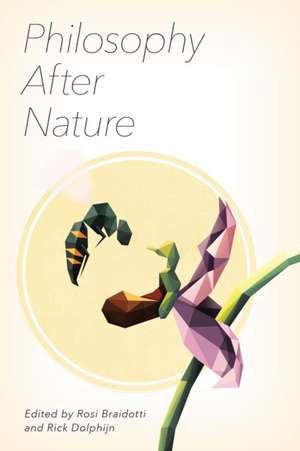
Philosophy After Nature
Editat de Rosi Braidotti, Rick Dolphijnen Limba Engleză Paperback – 19 iun 2017
Technology occupies a central place in the shift towards a nature-cultural continuum, but it is not the only factor. The consequences of economic globalization, notably the global spread of digital mediation, also account for this change of perspective. Last but not least the climate change issue and a renewed urgency around the state of the environmental crisis also contribute to bring the 'natural' much closer to home. Digital mediation has by now become a standard way to live and interact. The electronic frontier has altered dramatically the practice of education and research, especially in the Humanities and social sciences, with direct consequences for the institutional practice and the methodology of these disciplinary fields. This book aims to explore the implications of these complex shifts for the practice of critical thinking.
Preț: 329.49 lei
Preț vechi: 426.44 lei
-23%
Puncte Express: 494
Carte tipărită la comandă
Livrare economică 19 noiembrie-03 decembrie
Livrare prin curier în România Termenul estimat este afișat lângă disponibilitate.
Transport gratuit de la 400.00 lei Plată online sau ramburs, în funcție de opțiunile comenzii.
Retur gratuit în 14 zile Comandă securizată și suport în română.
Specificații
ISBN-13: 9781786603869
ISBN-10: 1786603861
Pagini: 208
Dimensiuni: 150 x 226 x 18 mm
Greutate: 0.36 kg
Editura: Bloomsbury Publishing
Colecția Rowman & Littlefield
Locul publicării:New York, United States
ISBN-10: 1786603861
Pagini: 208
Dimensiuni: 150 x 226 x 18 mm
Greutate: 0.36 kg
Editura: Bloomsbury Publishing
Colecția Rowman & Littlefield
Locul publicării:New York, United States
V-ar putea interesa
-
 Hegel's Development: Night Thoughts (Jena 1801-1806)H. S. Harris-32%Preț: 797.83 lei1177.51 lei
 -
 -12%Preț: 373.32 lei422.17 lei
 -
 Mind, Method, and Morality: Essays in Honour of Anthony KennyJohn Cottingham-31%Preț: 871.14 lei1264.02 lei
 -
 Genius: A Very Short IntroductionAndrew Robinson-20%Preț: 55.78 lei70.14 lei
 -
 Reality: A Very Short IntroductionJan Westerhoff-21%Preț: 55.29 lei69.84 lei
 -
 David Hume: A Treatise of Human Nature: Two-volume setDavid Fate Norton-21%Preț: 512.38 lei645.71 lei
 -
 -28%Preț: 362.88 lei504.95 lei
 -
 An Intellectual History of CannibalismC¿t¿lin AvramescuPreț: 274.45 lei
 -
 MetamorphosesRosi BraidottiPreț: 201.21 lei
 -
 The PosthumanRosi BraidottiPreț: 132.77 lei
 -
 The I in WeAxel HonnethPreț: 217.82 lei
 -
 Preț: 164.39 lei
 -
 Just the ArgumentsMichael BrucePreț: 144.92 lei
 -
 Agamben and Indifference: A Critical OverviewWilliam Watkin-22%Preț: 339.39 lei437.24 lei
 -
 Introducing Slavoj ZizekChristopher Kul-WantPreț: 56.58 lei
 -
 You Kant Make it Up!Gary HaydenPreț: 78.47 lei
Cuprins
1. Introduction: Nature, and After... Rosi Braidotti and Rick Dolphijn / Part I: After Matter / 2. Information and Thought, Michel Serres / 3. Die Natur ist nur Einmal da, Francoise Balibar / 4. Generic Mediality, Post-Alphabetical?, Vera Buhlmann / 5. The Nature of Ideas: On Stones, Feelings and the Ecology of Form, Rick Dolphijn / Part II: After Machines / 6. Media Entangled Phenomenology, Mark Hansen / 7. On Reason and Spectral Machines: Robert Brandom and Bounded Posthumanism, David Roden / 8. Circuits of Desire: Cybernetics and the Post-natural According to Lyotard and Stiegler, Ashley Woodward / 9. History as an Ecological Niche: Beyond Benjamin's Nature, Damiano Roberi / 10. Individuation, Cosmogenesis and Technology: Sri Aurobindo and Gilbert Simondon, Debashish Banerji / Part III: After Man / 11. Being without Life: On the Trace of Organic Chauvinism with Derrida and DeLanda, Richard Iveseon / 12. Returning to Text: Deconstructive Paradigms and Posthumanism, Danielle Sands / 13. Primary and Secondary
Recenzii
What have we done? Why did we do it? Against cynicism, the philosophers in this volume stand out for the originality of their analyses of our ties to nature. They encourage us to seek solutions beyond greed, spectacle and division. The strongest thread running through this impressive collection is that we can think innovatively; we can work together with nature.
Philosophy after Nature provides an indispensable introduction and guide to current transformative thinking about nature today. In the context of climate change, globalization and a logic of advanced capitalism, it brings together a number of outstanding contributions, in which components from the history of philosophy are retrieved from neglect. These components are then deployed to help make sense of an unprecedented crisis in the relation between human beings and the context they have become used to thinking of as 'natural'.
When philosophy talks about nature, too often it is only through its own idea of nature - the physical, living, world is forced to fit the ends of philosophy. In Philosophy After Nature, we see a radical inversion being performed, one where the idea must follow nature, where philosophy is forced to think alongside matter in all its vital unruliness.
Philosophy after Nature provides an indispensable introduction and guide to current transformative thinking about nature today. In the context of climate change, globalization and a logic of advanced capitalism, it brings together a number of outstanding contributions, in which components from the history of philosophy are retrieved from neglect. These components are then deployed to help make sense of an unprecedented crisis in the relation between human beings and the context they have become used to thinking of as 'natural'.
When philosophy talks about nature, too often it is only through its own idea of nature - the physical, living, world is forced to fit the ends of philosophy. In Philosophy After Nature, we see a radical inversion being performed, one where the idea must follow nature, where philosophy is forced to think alongside matter in all its vital unruliness.