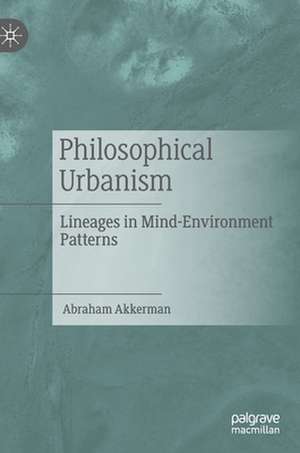
Philosophical Urbanism
Autor Abraham Akkermanen Limba Engleză Hardback – 28 oct 2019
This book expands on the thought of Walter Benjamin by exploring the notion of modern mind, pointing to the mutual and ongoing feedback between mind and city-form. Since the Neolithic Age, volumes and voids have been the founding constituents of built environments as projections of gender—as spatial allegories of the masculine and the feminine. While these allegories had been largely in balance throughout the early history of the city, increasingly during modernity, volume has overcome void in city-form. This volume investigates the pattern of Benjamin's thinking and extends it to the larger psycho-cultural and urban contexts of various time periods, pointing to environ/mental progression in the unfolding of modernity.
Preț: 481.11 lei
Preț vechi: 566.01 lei
-15%
Puncte Express: 722
Carte tipărită la comandă
Livrare economică 23 noiembrie-07 decembrie
Livrare prin curier în România Termenul estimat este afișat lângă disponibilitate.
Transport gratuit pentru acest produs Plată online sau ramburs, în funcție de opțiunile comenzii.
Retur gratuit în 14 zile Comandă securizată și suport în română.
Specificații
ISBN-13: 9783030290849
ISBN-10: 3030290840
Pagini: 212
Ilustrații: XV, 193 p. 14 illus.
Dimensiuni: 153 x 216 x 17 mm
Greutate: 0.39 kg
Ediția:1st ed. 2019
Editura: Palgrave MacMillan
Locul publicării:Cham, Switzerland
ISBN-10: 3030290840
Pagini: 212
Ilustrații: XV, 193 p. 14 illus.
Dimensiuni: 153 x 216 x 17 mm
Greutate: 0.39 kg
Ediția:1st ed. 2019
Editura: Palgrave MacMillan
Locul publicării:Cham, Switzerland
Cuprins
1. Philosophical Urbanism of Walter Benjamin.- 2.Sky and Gender Myths in the Founding of Early Built Environments.- 3. Aristotelian Streetscapes in the Rise of Modernity.- 4. From Body Without Organs to City Without Streets.- 5. LIA and the Iron Age Cold Epoch: Similitudes and Sequels.
Notă biografică
Abraham Akkerman is Professor in the Department of Geography and Planning and the Department of Philosophy at the University of Saskatchewan, Canada.
Textul de pe ultima copertă
This book expands on the thought of Walter Benjamin by exploring the notion of modern mind, pointing to the mutual and ongoing feedback between mind and city-form. Since the Neolithic Age, volumes and voids have been the founding constituents of built environments as projections of gender—as spatial allegories of the masculine and the feminine. While these allegories had been largely in balance throughout the early history of the city, increasingly during modernity, volume has overcome void in city-form. This volume investigates the pattern of Benjamin's thinking and extends it to the larger psycho-cultural and urban contexts of various time periods, pointing to environ/mental progression in the unfolding of modernity.
Caracteristici
Constitutes foundational bridge between philosophy and urban geography/planning Examines Walter Benjamin’s reflection upon modernity as mind-city interaction Observes gender imprints in the built environment