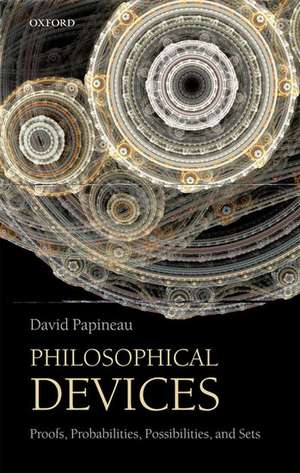
Philosophical Devices: Proofs, Probabilities, Possibilities, and Sets
Autor David Papineauen Limba Engleză Hardback – 4 oct 2012
Preț: 463.06 lei
Preț vechi: 590.60 lei
-22%
Puncte Express: 695
Carte tipărită la comandă
Livrare economică 19-25 noiembrie
Livrare prin curier în România Termenul estimat este afișat lângă disponibilitate.
Transport gratuit pentru acest produs Plată online sau ramburs, în funcție de opțiunile comenzii.
Retur gratuit în 14 zile Comandă securizată și suport în română.
Specificații
ISBN-13: 9780199651726
ISBN-10: 0199651728
Pagini: 214
Ilustrații: line-drawings
Dimensiuni: 153 x 210 x 19 mm
Greutate: 0.36 kg
Editura: OUP OXFORD
Colecția OUP Oxford
Locul publicării:Oxford, United Kingdom
ISBN-10: 0199651728
Pagini: 214
Ilustrații: line-drawings
Dimensiuni: 153 x 210 x 19 mm
Greutate: 0.36 kg
Editura: OUP OXFORD
Colecția OUP Oxford
Locul publicării:Oxford, United Kingdom
V-ar putea interesa
-
 The Consolations of PhilosophyAlain de Botton-19%Preț: 75.25 lei93.15 lei
 -
 -21%Preț: 351.05 lei446.94 lei
 -
 Theory and MeaningDavid Papineau-21%Preț: 366.33 lei464.42 lei
 -
 Kant's Metaphysics of Morals: Interpretative EssaysMark Timmons-28%Preț: 501.61 lei698.43 lei
 -
 The Conception of ValuePaul Grice-29%Preț: 369.34 lei517.76 lei
 -
 Essays on Actions and Events: Philosophical Essays Volume 1Donald Davidson-13%Preț: 303.68 lei348.07 lei
 -
 -28%Preț: 406.73 lei566.82 lei
 -
 Understanding Human Knowledge: Philosophical EssaysBarry Stroud-19%Preț: 379.14 lei470.34 lei
 -
 The Oxford Companion to PhilosophyTed Honderich-17%Preț: 257.68 lei309.73 lei
 -
 TeleosemanticsGraham Macdonald-20%Preț: 364.30 lei453.27 lei
 -
 Bayesian EpistemologyLuc Bovens-18%Preț: 359.62 lei438.12 lei
 -
 Thinking about ConsciousnessDavid Papineau-28%Preț: 411.98 lei574.98 lei
 -
 Hume VariationsJerry A. Fodor-13%Preț: 365.08 lei421.06 lei
 -
 -27%Preț: 352.74 lei483.96 lei
 -
 Perceptual ExperienceTamar Szabó Gendler-28%Preț: 459.76 lei635.90 lei
 -
 Expressionism in PhilosophyGilles DeleuzePreț: 232.43 lei
 -
 Preț: 131.47 lei
 -
 LacanSlavoj ZizekPreț: 274.41 lei
 -
 Introducing ConsciousnessDavid PapineauPreț: 63.53 lei
Recenzii
an engaging, genuinely expository text. It is hard to imagine a better execution of the project of introducing the basics of technical philosophy non-technically. ... an invaluable addition to undergraduate reading lists, and I certainly will make use of it in my teaching.
Papineau has written a suprising book. Though small in size it can serve as a template for a variety of undergraduate philosophy courses as instructors choose to emphasize various parts of the presentation. The text is clearly and accurately written. The pedagogy sets out concepts in a sequential order that works well. This is a highly recommended text.
This is a very good book for students learning about philosophical methods. The sections are concise, easily accessible and well well-written. I've been looking for a book like this on philosophical methods for a while now and this is one of the few that I've found so it is covering a needed gap in the market. I will definitely be recommending it to my library for purchase and to students.
Papineau has written a suprising book. Though small in size it can serve as a template for a variety of undergraduate philosophy courses as instructors choose to emphasize various parts of the presentation. The text is clearly and accurately written. The pedagogy sets out concepts in a sequential order that works well. This is a highly recommended text.
This is a very good book for students learning about philosophical methods. The sections are concise, easily accessible and well well-written. I've been looking for a book like this on philosophical methods for a while now and this is one of the few that I've found so it is covering a needed gap in the market. I will definitely be recommending it to my library for purchase and to students.
Notă biografică
David Papineau was educated in Trinidad, England, and South Africa. He has a BSc in mathematics from the University of KwaZulu-Natal and a BA and PhD in philosophy from Cambridge. He has lectured at Reading University, Macquarie University, Birkbeck College London, and Cambridge University. Since 1990 he has been Professor of Philosophy at King's College London.He was President of the British Society for the Philosophy of Science from 1993 to 1995. In 1999-2000 he was a Leverhulme Research Fellow and in 2007 a Mind Fellow. He was President of the Mind Association for 2009-10. In 2010 he gave the Rudolf Carnap Lectures in Bochum, Germany and in 2011 the Gottlob Frege Lectures in Tartu, Estonia.