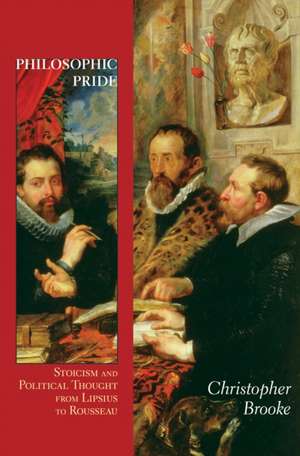
Philosophic Pride
Autor Christopher Brookeen Limba Engleză Hardback – 8 apr 2012
France, and the Netherlands, the book considers how political writers of the period engaged with the ideas of the Roman and Greek Stoics that they found in works by Cicero, Seneca, Epictetus, and Marcus Aurelius. Christopher Brooke examines key texts in their historical context, paying special
attention to the history of classical scholarship and the historiography of philosophy.Brooke delves into the persisting tension between Stoicism and the tradition of Augustinian anti-Stoic criticism, which held Stoicism to be a philosophy for the proud who denied their fallen condition.
Concentrating on arguments in moral psychology surrounding the foundations of human sociability and self-love, Philosophic Pride details how the engagement with Roman Stoicism shaped early modern political philosophy and offers significant new interpretations of Lipsius and Rousseau together with
fresh perspectives on the political thought of Hugo Grotius and Thomas Hobbes.Philosophic Pride shows how the legacy of the Stoics played a vital role in European intellectual life in the early modern era.
Preț: 478.47 lei
Puncte Express: 718
Carte tipărită la comandă
Livrare economică 20 noiembrie-04 decembrie
Livrare prin curier în România Termenul estimat este afișat lângă disponibilitate.
Transport gratuit pentru acest produs Plată online sau ramburs, în funcție de opțiunile comenzii.
Retur gratuit în 14 zile Comandă securizată și suport în română.
Specificații
ISBN-13: 9780691152080
ISBN-10: 069115208X
Pagini: 306
Dimensiuni: 161 x 240 x 23 mm
Greutate: 0.68 kg
Editura: Princeton University Press
Locul publicării:Princeton, United States
ISBN-10: 069115208X
Pagini: 306
Dimensiuni: 161 x 240 x 23 mm
Greutate: 0.68 kg
Editura: Princeton University Press
Locul publicării:Princeton, United States
Descriere
Concentrating on arguments in moral psychology surrounding the foundations of human sociability and self-love, this book details how the engagement with Roman Stoicism shaped early modern political philosophy. It offers interpretations of Lipsius and Rousseau.