
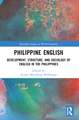
Philippine English: Development, Structure, and Sociology of English in the Philippines: Routledge Studies in World Englishes
Editat de Ariane Macalinga Borlonganen Limba Engleză Hardback – 19 sep 2022
The chapters offer detailed descriptions of Philippine English at various linguistic levels in addition to examining the psychosociolinguistic factors which shaped the language. Offering discussions of practice, language policy, language education, language teaching, and the relevance of English in various social phenomena in the Philippines, readers will find everything they need to know on theory, methodology, and application in the study of Philippine English.
Din seria Routledge Studies in World Englishes
-
 Preț: 438.65 lei
 -
 Preț: 450.95 lei
 -
 Preț: 437.63 lei
 -
 Preț: 437.93 lei
 -
 Preț: 437.08 lei
 -
 Preț: 416.38 lei
 -
 Preț: 447.00 lei
 -
 Preț: 450.95 lei
 -
 Preț: 458.62 lei
 -
 Preț: 450.95 lei
 -
 Preț: 442.18 lei
 -
 Preț: 415.20 lei
 -
 Preț: 429.94 lei
 -
 Preț: 415.54 lei
 -
 Preț: 440.15 lei
 -
 Preț: 430.70 lei
 -
 Preț: 387.90 lei
 -
 Preț: 404.98 lei
 -
 Preț: 443.26 lei
 -
 Preț: 437.63 lei
 -
 Preț: 437.63 lei
 -
 Preț: 398.68 lei
 - 11%
 Preț: 376.87 lei
 - 18%
 Preț: 1119.70 lei
 - nou
 Preț: 1349.95 lei
Preț: 1432.59 lei
Preț vechi: 1747.06 lei
-18%
Puncte Express: 2149
Carte tipărită la comandă
Livrare economică 20 noiembrie-04 decembrie
Livrare prin curier în România Termenul estimat este afișat lângă disponibilitate.
Transport gratuit pentru acest produs Plată online sau ramburs, în funcție de opțiunile comenzii.
Retur gratuit în 14 zile Comandă securizată și suport în română.
Specificații
ISBN-13: 9781138370760
ISBN-10: 1138370762
Pagini: 424
Ilustrații: 32 Tables, black and white; 20 Line drawings, black and white; 20 Illustrations, black and white
Dimensiuni: 156 x 234 x 24 mm
Greutate: 1.02 kg
Ediția:1
Editura: Taylor & Francis
Colecția Routledge
Seria Routledge Studies in World Englishes
Locul publicării:Oxford, United Kingdom
ISBN-10: 1138370762
Pagini: 424
Ilustrații: 32 Tables, black and white; 20 Line drawings, black and white; 20 Illustrations, black and white
Dimensiuni: 156 x 234 x 24 mm
Greutate: 1.02 kg
Ediția:1
Editura: Taylor & Francis
Colecția Routledge
Seria Routledge Studies in World Englishes
Locul publicării:Oxford, United Kingdom
Public țintă
PostgraduateCuprins
Preface Deconstructing Ma. Lourdes Bautista: A Non-Linguist’s Perspective Prologue: Philippine English in the ‘Concerto’ of World Englishes Part 1: Introduction 1. Conspectus 2. History and Development 3. Resources Special Feature: Ma. Lourdes Bautista and Philippine English Part 2: Linguistic Structure 4. Phonology 5. Lexicon 6. Grammar 7. Discourse 8. Spelling and Punctuation Part 3: Sociolinguistic Variation and Change 10. Internal Variation 11. Diachronic Change 12. Philippine English in Relation to American English 13. Contact with Other Languages 14. Hybridization Part 4: Linguistic and Literary Canon 15. Lexicography 16. Standard Philippine English 17. Philippine Literature in English Part 5: Psychosociolinguistic Dimensions 17. Intelligibility 18. Attitudes 19. Multilingualism 20. Language and Policy Part 6: Learning and Teaching 21. Acquisition and Learning 22. Language Teaching 23. Language Testing 24. Teacher Education Part 7: Contemporary Issues 25. Internet 26. Migration 27. Outsourced Call Centers 28. Teaching English as a Foreign Language in the Philippines Teaching English as a Foreign Language in the Philippines Special Feature: World Englishes and Social Change Epilogue: Contemporary Concerns and Future Directions
Notă biografică
Ariane Macalinga Borlongan’s education and experience across the world have inspired him to passionately work with English speakers in non-Anglo-American contexts. As a sociolinguist, he has analyzed variation, change, and standardization across Englishes. He earned his Ph.D. in Applied Linguistics at age 23 via a competitive accelerated program in De La Salle University (Manila, the Philippines) and is presently Associate Professor of Sociolinguistics at the Tokyo University of Foreign Studies (Japan).
Descriere
This book is a reference on the history, sociology, and linguistic structure of Philippine English. It offers readers access to a synthesis of the last fifty years of research on Philippine English and also offers a new and better understanding of the nativization of English in the Philippines.