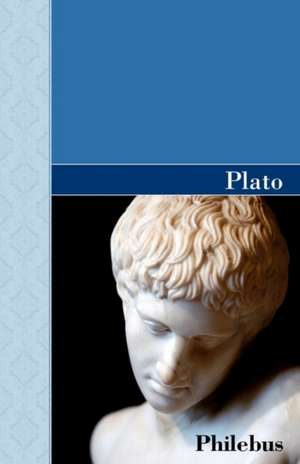
Philebus
Autor Platoen Limba Engleză Paperback – 12 noi 2009
Preț: 103.59 lei
Puncte Express: 155
Carte disponibilă
Livrare economică 06-20 noiembrie
Livrare prin curier în România Termenul estimat este afișat lângă disponibilitate.
Transport gratuit de la 400.00 lei Plată online sau ramburs, în funcție de opțiunile comenzii.
Retur gratuit în 14 zile Comandă securizată și suport în română.
Specificații
ISBN-13: 9781605125343
ISBN-10: 1605125342
Pagini: 176
Dimensiuni: 140 x 216 x 10 mm
Greutate: 0.23 kg
Editura: Akasha Publishing, LLC
ISBN-10: 1605125342
Pagini: 176
Dimensiuni: 140 x 216 x 10 mm
Greutate: 0.23 kg
Editura: Akasha Publishing, LLC
V-ar putea interesa
-
 RepublicPlatoPreț: 30.76 lei
 -
 -26%Preț: 58.55 lei78.87 lei
 -
 -25%Preț: 218.86 lei290.91 lei
 -
 MeditationsMarcus AureliusPreț: 34.00 lei
 -
 Six Great DialoguesPlatoPreț: 50.88 lei
 -
 Preț: 229.26 lei
 -
 Preț: 224.20 lei
 -
 -14%Preț: 515.26 lei599.14 lei
 -
 The Pocket Book of PlatoMichael MoorePreț: 72.54 lei
 -
 Preț: 64.96 lei
 -
 Why Plato Matters NowAngie Hobbs-25%Preț: 92.15 lei122.47 lei
 -
 PhaedrusPlatoPreț: 43.00 lei
 -
 ParmenidesPlatoPreț: 43.40 lei
 -
 ProtagorasPlatoPreț: 39.22 lei
 -
 TheaetetusPlatoPreț: 46.76 lei
 -
 PhaedoPlatoPreț: 43.59 lei
 -
 Nicomachean EthicsAristotlePreț: 44.60 lei
 -
 Preț: 58.13 lei
Descriere
Descriere de la o altă ediție sau format:
The Philebus is the only Platonic dialogue that takes as its central theme the fundamental Socratic question of the good, understood as that which makes for the best or happiest life. It offers an extended psychological and epistemological investigation of such topics as sensation, memory, desire, anticipation, the truth and falsity of pleasures, and the types and gradations of knowledge, as well as a methodological exposition of dialectic and a metaphysical schema—found nowhere else in the dialogues—that is intended to illuminate the nature of mixture. In its interweaving of ethical, metaphysical, and epistemological issues, the Philebus offers a unique opportunity to assess the relation of these topics in Plato’s mature thought and so to gain insight into his philosophical vision as a whole. This edition also includes parallel passages from other Platonic dialogues and related material from Aristotle, the Stoics, and Epicurus.
The Philebus is the only Platonic dialogue that takes as its central theme the fundamental Socratic question of the good, understood as that which makes for the best or happiest life. It offers an extended psychological and epistemological investigation of such topics as sensation, memory, desire, anticipation, the truth and falsity of pleasures, and the types and gradations of knowledge, as well as a methodological exposition of dialectic and a metaphysical schema—found nowhere else in the dialogues—that is intended to illuminate the nature of mixture. In its interweaving of ethical, metaphysical, and epistemological issues, the Philebus offers a unique opportunity to assess the relation of these topics in Plato’s mature thought and so to gain insight into his philosophical vision as a whole. This edition also includes parallel passages from other Platonic dialogues and related material from Aristotle, the Stoics, and Epicurus.
Recenzii
The Philebus is the only Platonic dialogue that takes as its central theme the fundamental Socratic question of the good, understood as that which makes for the best or happiest life. It offers an extended psychological and epistemological investigation of such topics as sensation, memory, desire, anticipation, the truth and falsity of pleasures, and the types and gradations of knowledge, as well as a methodological exposition of dialectic and a metaphysical schema—found nowhere else in the dialogues—that is intended to illuminate the nature of mixture. In its interweaving of ethical, metaphysical, and epistemological issues, the Philebus offers a unique opportunity to assess the relation of these topics in Plato’s mature thought and so to gain insight into his philosophical vision as a whole. This edition also includes parallel passages from other Platonic dialogues and related material from Aristotle, the Stoics, and Epicurus.
“James L. Wood has devoted himself to understanding and explaining the Philebus. The result is this accomplished translation, together with plentiful explanatory notes about Plato’s language and argument, and a series of appendices containing long quotes from Plato and Aristotle on topics related to those covered in this dialogue. The translation has an engaging near-literal quality that can give surprisingly transparent glimpses into Plato’s Greek, in a way reminiscent of Allan Bloom’s Republic. A lot of people will want to have this book, both newcomers to Plato and his long-time readers.” — Nickolas Pappas, Executive Officer, Philosophy, CUNY Graduate Center
“James Wood’s translation of, and commentary on, Plato’s Philebus is a valuable resource for anyone who has the intellectual stamina to tackle one of the more difficult works in the history of Greek Philosophy. His introduction is lucid and engaging, and his translation succeeds in achieving his goal of striking ‘a balance between faithfulness and readability, with an emphasis on the former.’ His series of appendices provides companion texts, not only from Plato, but also from Aristotle, Epicurus and the Stoics. These help the reader to see the issues addressed in the Philebus—the good life, pleasure, knowledge and the metaphysical framework that holds them all together—in a broader context. In sum, Wood’s book is a fine piece of work.” — David Roochnik, Maria Stata Professor of Classical Greek Studies, Boston University
“James L. Wood has devoted himself to understanding and explaining the Philebus. The result is this accomplished translation, together with plentiful explanatory notes about Plato’s language and argument, and a series of appendices containing long quotes from Plato and Aristotle on topics related to those covered in this dialogue. The translation has an engaging near-literal quality that can give surprisingly transparent glimpses into Plato’s Greek, in a way reminiscent of Allan Bloom’s Republic. A lot of people will want to have this book, both newcomers to Plato and his long-time readers.” — Nickolas Pappas, Executive Officer, Philosophy, CUNY Graduate Center
“James Wood’s translation of, and commentary on, Plato’s Philebus is a valuable resource for anyone who has the intellectual stamina to tackle one of the more difficult works in the history of Greek Philosophy. His introduction is lucid and engaging, and his translation succeeds in achieving his goal of striking ‘a balance between faithfulness and readability, with an emphasis on the former.’ His series of appendices provides companion texts, not only from Plato, but also from Aristotle, Epicurus and the Stoics. These help the reader to see the issues addressed in the Philebus—the good life, pleasure, knowledge and the metaphysical framework that holds them all together—in a broader context. In sum, Wood’s book is a fine piece of work.” — David Roochnik, Maria Stata Professor of Classical Greek Studies, Boston University
Notă biografică
Plato was an ancient Greek philosopher born in Athens during the Classical period in Ancient Greece. In Athens, Plato founded the Academy, a philosophical school where he taught the philosophical doctrines that would later become known as Platonism. Plato (or Platon) was a pen name derived, apparently, from the nickname given to him by his wrestling coach - allegedly a reference to his physical broadness. According to Alexander of Miletus quoted by Diogenes of Sinope his actual name was Aristocles, son of Ariston, of the deme Collytus (Collytus being a district of Athens).Plato was an innovator of the written dialogue and dialectic forms in philosophy. He raised problems for what later became all the major areas of both theoretical philosophy and practical philosophy. His most famous contribution is the Theory of forms, which has been interpreted as advancing a solution to what is now known as the problem of universals. He is also the namesake of Platonic love and the Platonic solids.His own most decisive philosophical influences are usually thought to have been, along with Socrates, the pre-Socratics Pythagoras, Heraclitus, and Parmenides, although few of his predecessors' works remain extant and much of what we know about these figures today derives from Plato himself.[a]Along with his teacher, Socrates, and his student, Aristotle, Plato is a central figure in the history of philosophy.[b] Unlike the work of nearly all of his contemporaries, Plato's entire body of work is believed to have survived intact for over 2,400 years.[6] Although their popularity has fluctuated, Plato's works have consistently been read and studied. Through Neoplatonism Plato also greatly influenced both Christian and Islamic philosophy (through e.g. Al-Farabi). In modern times, Alfred North Whitehead famously said: "the safest general characterization of the European philosophical tradition is that it consists of a series of footnotes to Plato.
Cuprins
Acknowledgements
Introduction
Plato, Socrates, and Their Time: A Brief Chronology
A Note on the Text
Philebus
Appendix A: Plato on the Good as Pleasure or Wisdom
Introduction
Plato, Socrates, and Their Time: A Brief Chronology
A Note on the Text
Philebus
Appendix A: Plato on the Good as Pleasure or Wisdom
- Republic 505a–505d
- Republic 475e–476d
- Timaeus 27d–28a
- Symposium 210e–211b
- Parmenides 130a–135c
- Republic 505d–509b
- Republic 531e–534d
- Sophist 253a–254b, 259d–e
- Timaeus 29d–30c, 46c–e, 47e–52d
- Phaedo 97b–99c
- Republic 580d–587a
- Republic 558d–559c
- Protagoras 351b–358a
- Gorgias 491d–495b
- Nicomachean Ethics X.2–5
- Metaphysics I.6
- From Diogenes Laertius, “Letter to Menoeceus,” Lives of Eminent Philosophers, X.121–132
- From Diogenes Laertius, Lives of Eminent Philosophers, VII.134–156