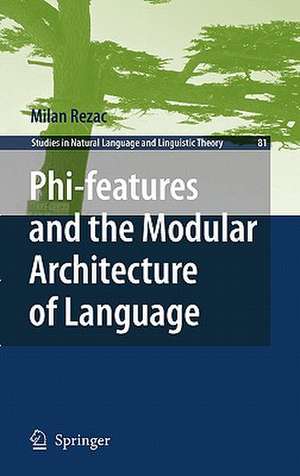
Phi-Features and the Modular Architecture of Language
Autor Milan Rezacen Limba Engleză Hardback – 30 noi 2010
| Toate formatele și edițiile | Preț | Express |
|---|---|---|
| Paperback (1) | 618.03 lei 6-8 săpt. | |
| SPRINGER NETHERLANDS – 2 ian 2013 | 618.03 lei 6-8 săpt. | |
| Hardback (1) | 623.74 lei 6-8 săpt. | |
| Springer – 30 noi 2010 | 623.74 lei 6-8 săpt. |
Preț: 623.74 lei
Preț vechi: 733.81 lei
-15%
Puncte Express: 936
Preț estimativ în valută:
110.27€ • 130.81$ • 95.48£
110.27€ • 130.81$ • 95.48£
Carte tipărită la comandă
Livrare economică 18 martie-01 aprilie
Specificații
ISBN-13: 9789048196975
ISBN-10: 9048196973
Pagini: 326
Ilustrații: XVII, 326 p.
Dimensiuni: 164 x 244 x 29 mm
Greutate: 0.65 kg
Ediția:2011 edition
Editura: Springer
Locul publicării:Dordrecht, Netherlands
ISBN-10: 9048196973
Pagini: 326
Ilustrații: XVII, 326 p.
Dimensiuni: 164 x 244 x 29 mm
Greutate: 0.65 kg
Ediția:2011 edition
Editura: Springer
Locul publicării:Dordrecht, Netherlands
V-ar putea interesa
-
 The English Language: A Guided Tour of the LanguageDavid Crystal-20%Preț: 60.15 lei75.48 lei
 -
 Preț: 105.04 lei
 -
 -10%Preț: 107.60 lei119.66 lei
 -
 -22%Preț: 178.73 lei229.19 lei
 -
 The Language of PoetryJohn McRaePreț: 228.69 lei
 -
 Language Evolution: The Windows ApproachRudolf Botha-27%Preț: 171.18 lei233.31 lei
 -
 Language MattersLaurie BauerPreț: 332.60 lei
 -
 Preț: 103.45 lei
 -
 -28%Preț: 64.75 lei89.37 lei
 -
 -20%Preț: 66.08 lei82.68 lei
 -
 Lingo: A Language Spotter's Guide to EuropeGaston Dorren-21%Preț: 64.85 lei81.91 lei
Public țintă
ResearchCuprins
Acknowledgments.- Conventions and glosses.- Preface.- 1 Modularity, phi-features, and repairs.- 2 Phi-features in realizational morphology.- 3 Person Hierarchy interactions in syntax.- 4 Person Case Constraint repairs in French.- 5 Repairs and uninterpretable features.- 6 Phi in syntax and phi interpretation.- Name and Subject index.
Recenzii
From the reviews:
“Rezac certainly presents an impressive contribution to syntactic theorizing using what are often seen as problematic data. This monograph presents a novel mechanism for PCC and related effects in a number of languages. The work is well organized and contains substantial references. In sum, Rezac’s book is important for anyone interested in the architecture of grammar, minimalism, or Romance syntax.” (Michael Barrie, LINGUIST List 23.4397)
“Rezac certainly presents an impressive contribution to syntactic theorizing using what are often seen as problematic data. This monograph presents a novel mechanism for PCC and related effects in a number of languages. The work is well organized and contains substantial references. In sum, Rezac’s book is important for anyone interested in the architecture of grammar, minimalism, or Romance syntax.” (Michael Barrie, LINGUIST List 23.4397)
Textul de pe ultima copertă
This monograph investigates the modular architecture of language through the nature of "uninterpretable" phi-features: person, number, gender, and Case. It provides new tools and evidence for the modular architecture of the human language faculty, a foundational topic of linguistic research. At the same time it develops a new theory for one of the core issues posed by the Minimalist Program: the relationship of syntax to its interfaces and the nature of uninterpretable features. The work sets out to establish a new cross-linguistic phenomenon to study the foregoing, person-governed last-resort repairs, which provides new insights into the nature of ergative/accusative Case and of Case licensing itself. This is the first monograph that explicitly addresses the syntactic vs. morphological status of uninterpretable phi-features and their relationship to interface systems in a similar way, drawing on person-based interactions among arguments as key data-base.
Caracteristici
Provides new tools and evidence for the modular architecture of the human language faculty. Develops a new theory for one of the core issues posed by the Minimalist Program: the relationship of syntax to its interfaces and the nature of uninterpretable features. Establishes a new cross-linguistic phenomenon to study the foregoing, person-governed last-resort repairs, providing new insights into the nature of ergative/accusative Case and of Case licensing itself.