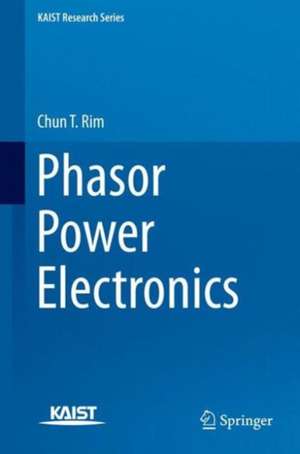
Phasor Power Electronics: KAIST Research Series
Autor Chun T. Rimen Limba Engleză Hardback – 11 apr 2016
Complementar volumului Dynamic Phasors in Energy Processing Systems de Hanoch Lev-Ari, care se concentrează pe reprezentarea semnalelor în sistemele energetice, Phasor Power Electronics acoperă zona analizei structurale a convertoarelor prin transformarea acestora în circuite echivalente invariante în timp. Subliniem faptul că abordarea autorului Chun T. Rim simplifică drastic natura variabilă în timp a convertoarelor cu comutație, eliminând necesitatea manipulărilor matriceale greoaie sau a ecuațiilor diferențiale complexe care apar adesea în lucrări precum Dynamics and Control of Switched Electronic Systems.
Structura volumului este organizată riguros în șase părți, facilitând o tranziție logică de la filozofia electronicii de putere către aplicații avansate. Notăm cu interes progresia de la modelul transformatorului comutat, aplicabil oricărui tip de convertor DC-DC, către tehnici de transformare fazorială aplicate sistemelor AC. Partea a III-a și a IV-a tratează specific circuitele monofazate și multifazate prin transformări DQ, în timp ce partea a cincea introduce o transformare fazorială generală unificată, utilizând transformata Laplace pentru a caracteriza dinamica sistemelor de transfer de energie prin inducție. Suntem de părere că această metodologie oferă o alternativă practică la modelele liniare pe porțiuni, care devin frecvent prea complicate pentru utilizarea în proiectarea reală. Finalul cărții extinde cadrul teoretic către domenii de actualitate, precum procesarea semnalelor și energiile regenerabile, demonstrând versatilitatea transformărilor fazoriale în ingineria electrică modernă.



Preț: 915.89 lei
Preț vechi: 1116.95 lei
-18%
Carte disponibilă
Livrare economică 27 mai-10 iunie
Specificații
ISBN-10: 9811005354
Pagini: 249
Ilustrații: XIV, 249 p. 193 illus., 54 illus. in color.
Dimensiuni: 155 x 235 x 19 mm
Greutate: 0.66 kg
Ediția:1st ed. 2016
Editura: Springer Nature Singapore
Colecția Springer
Seria KAIST Research Series
Locul publicării:Singapore, Singapore
V-ar putea interesa
-
 Schaum's Outline of Basic Electricity, Second EditionMilton Gussow-18%Preț: 117.38 lei142.50 lei
 -
 -11%Preț: 113.56 lei126.96 lei
 -
 Power ElectronicsMuhammad H. Rashid-23%Preț: 1603.35 lei2082.27 lei
 -
 Powers and Compensation in Circuits with Nonsinusoidal CurrentLeszek S. Czarnecki-10%Preț: 349.44 lei387.36 lei
 -
 Power Electronics HandbookMuhammad H. Rashid-31%Preț: 1225.36 lei1767.65 lei
 -
 -8%Preț: 478.01 lei519.58 lei
 -
 Power ElectronicsNed Mohan-23%Preț: 1849.39 lei2401.81 lei
 -
 The Art of ElectronicsPaul Horowitz-9%Preț: 685.30 lei753.08 lei
 -
 Power System Dynamics with Computer-Based Modeling and AnalysisKazuyuki Kameda-23%Preț: 1091.22 lei1417.17 lei
 -
 Engineering Circuit Analysis, International AdaptationJ. David Irwin-19%Preț: 405.42 lei500.51 lei
 -
 POWER SYSTEMS ANALYSIS (SI)John Grainger-27%Preț: 363.77 lei498.89 lei
 -
 ISE Fundamentals of Electric CircuitsCharles Alexander-8%Preț: 464.77 lei505.18 lei
 -
 Principles and Applications of Electrical Engineering ISEGiorgio Rizzoni-27%Preț: 371.98 lei506.73 lei
 -
 Electrical Machines, Drives and Power SystemsTheodore Wildi-15%Preț: 675.30 lei794.47 lei
 -
 Hughes Electrical and Electronic TechnologyEdward Hughes-13%Preț: 615.63 lei707.61 lei
 -
 Storey, N: ElectronicsNeil Storey-13%Preț: 543.48 lei624.69 lei
 -
 -15%Preț: 677.49 lei797.05 lei
 -
 Analysis of Electric Machinery and Drive SystemsPaul C Krause-23%Preț: 697.30 lei905.59 lei
 -
 Foundations of Analog and Digital Electronic CircuitsAnant Agarwal-29%Preț: 511.04 lei718.84 lei
 -
 Advanced Topics in Electric CircuitsZdzislaw Trzaska-18%Preț: 922.68 lei1125.22 lei
De ce să citești această carte
Suntem de părere că această lucrare este esențială pentru inginerii care caută o metodă analitică mai simplă pentru proiectarea convertoarelor. Cititorul câștigă o perspectivă inovatoare asupra transformării fazoriale, care reduce complexitatea matematică a sistemelor cu comutație. Este un instrument practic pentru cercetătorii din domeniul transferului de energie wireless și al sistemelor de energie regenerabilă, oferind modele matematice direct aplicabile în designul de circuit.
Despre autor
Chun T. Rim este un cercetător recunoscut în domeniul ingineriei electrice, afiliat prestigiosului Institut Avansat de Știință și Tehnologie din Coreea (KAIST). Expertiza sa în electronica de putere se concentrează pe simplificarea modelării matematice a sistemelor complexe. Prin contribuția sa în cadrul KAIST Research Series, autorul aduce în prim-plan tehnici avansate de transformare fazorială și concepte precum transformatorul comutat, fundamentând soluții teoretice care optimizează eficiența transferului de energie și designul convertoarelor moderne.
Descriere scurtă
The book starts with an introduction to the philosophy and fundamental principles of power electronics. The switched transformer concept, which is applicable to any switching converter, is introduced, and it is shown how DC-DC converters analyses are then so straightforward that very little equational manipulation is needed. Then the phasor transformation techniques are comprehensively explained over three parts. Single phase and multi-phase AC systems are dealt with through the single phase phasor transformation and circuit DQ transformation, respectively. A general unified phasor transformation is then introduced for the static and dynamic cases. The final part of the book considers current and potential extensions of the technique in various fields of application, including wireless power transfer, signal processing, power systems and renewable energy.
The book avoids the piece-wise linear circuit models used in other titles, with which the mathematical results become too complicated to be used in practice. No cumbersome equations or matrix manipulations are needed with the phasor transformation techniques introduced in this book. It will be a valuable reference source for engineering students and practising researchers in power electronics and related areas.
Cuprins
Recenzii
Notă biografică
Since 2007, he has been an associate professor of Nuclear and Quantum Engineering at KAIST. He has been developing various wireless power technologies including inductive power transfer systems for On-Line Electrical Vehicles. From 1990 to 1995, he was a military officer at the Ministry of National Defense in Korea. From 1995 to 2003, he was a senior researcher at the Agency for Defense Development, Daejeon, and from 1997 to 1999, he was with Astrium in Portsmouth, U.K. From 2003 to 2007, he was a senior director at the Presidential Office, Seoul, Korea. He was involved in developing Korea’s first airborne and spaceborne synthetic aperture radars. His research areas include wireless electric vehicles, wireless power systems for robots, mobiles, wearables and IoT, andgeneral unified modeling of power electronics. He has authored or coauthored 142 technical papers, written eight books, and holds 141 patents (awarded and pending). He won numerous awards including the Best Paper Award of IEEE Power Electronics Transactions in 2015 (wireless power) and three prizes by the Korean government. He was the chair of Wireless Power Committee of KIPE from 2010 to 2015 and the chair of EV Charger Committee of KIEE since 2011, respectively.
He is now an associate editor of IEEE Transactions on Power Electronics and the Journal of Emerging and Selected Topics in Power Electronics (J-ESTPE), a guest editor of the Special Issue on Wireless Power Transfer of the IEEE Transactions on Power Electronics, IEEE Transactions on Industrial Electronics, and J-ESTPE, and the general chair of the 2014 IEEE VTC-Workshop on Wireless power (WoW), 2015 IEEE WoW, and 2016 IEEE WoW.