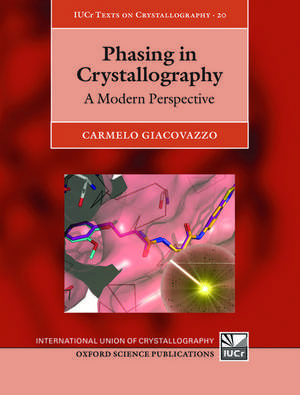
Phasing in Crystallography: A Modern Perspective
Autor Carmelo Giacovazzoen Limba Engleză Hardback – 12 dec 2013
Preț: 767.66 lei
Preț vechi: 1007.38 lei
-24%
Puncte Express: 1151
Carte tipărită la comandă
Livrare economică 27 noiembrie-02 decembrie
Livrare prin curier în România Termenul estimat este afișat lângă disponibilitate.
Transport gratuit pentru acest produs Plată online sau ramburs, în funcție de opțiunile comenzii.
Retur gratuit în 14 zile Comandă securizată și suport în română.
Specificații
ISBN-13: 9780199686995
ISBN-10: 0199686998
Pagini: 434
Ilustrații: 181 b/w illustrations
Dimensiuni: 197 x 247 x 25 mm
Greutate: 1.08 kg
Editura: Oxford University Press
Colecția OUP Oxford
Locul publicării:Oxford, United Kingdom
ISBN-10: 0199686998
Pagini: 434
Ilustrații: 181 b/w illustrations
Dimensiuni: 197 x 247 x 25 mm
Greutate: 1.08 kg
Editura: Oxford University Press
Colecția OUP Oxford
Locul publicării:Oxford, United Kingdom
V-ar putea interesa
-
 Direct Phasing in Crystallography: Fundamentals and ApplicationsCarmelo Giacovazzo-33%Preț: 1704.47 lei2531.10 lei
 -
 Introductory Statistical MechanicsRoger Bowley-21%Preț: 403.00 lei509.21 lei
 -
 The Solid StateH. M. Rosenberg-22%Preț: 509.89 lei650.15 lei
 -
 Dislocations, Mesoscale Simulations and Plastic FlowLadislas Kubin-31%Preț: 793.05 lei1148.84 lei
 -
 The Physics of Rubber ElasticityL.R.G Treloar-31%Preț: 646.05 lei937.47 lei
 -
 -20%Preț: 504.08 lei632.97 lei
 -
 -12%Preț: 337.21 lei383.32 lei
 -
 Modern Theory of ThermoelectricityVeljko Zlatic-31%Preț: 713.31 lei1032.56 lei
 -
 Granular PatternsIgor Aranson-28%Preț: 365.62 lei504.71 lei
 -
 Excitations in Organic SolidsVladimir M. Agranovich-21%Preț: 537.82 lei680.31 lei
 -
 Novel Superfluids: Volume 2Karl-Heinz Bennemann-31%Preț: 1061.69 lei1528.97 lei
 -
 Advances in the Casimir EffectMichael Bordag-21%Preț: 520.35 lei661.43 lei
 -
 Fundamentals of CrystallographyCarmelo Giacovazzo-32%Preț: 1180.87 lei1734.12 lei
 -
 Fundamentals of CrystallographyCarmelo Giacovazzo-23%Preț: 551.58 lei719.02 lei
 -
 An Introduction to Statistical Mechanics and ThermodynamicsRobert H. Swendsen-19%Preț: 541.22 lei670.31 lei
 -
 Soft Matter PhysicsMasao Doi-21%Preț: 513.21 lei647.17 lei
 -
 Quasicrystals: A PrimerChristian Janot-28%Preț: 540.60 lei753.87 lei
 -
 -34%Preț: 688.10 lei1036.36 lei
 -
 -27%Preț: 528.79 lei725.22 lei
 -
 Tribology in Sheet Rolling TechnologyAkira Azushima-19%Preț: 649.16 lei801.43 lei
Recenzii
This textbook is recommended to those interested in direct methods of solving the "Phase Problem" in order to find the three-dimensional arrangement of atoms within a crystal by use of data from its X-ray diffraction pattern. It explains how best to assess the relative phase of each diffracted beam essential input for the calculation of an electron-density map of a crystal and how to do it correctly and efficiently. Methods used for macromolecules are also discussed. The book contains many excellent well thought-out illustrations and the mathematical equations are also clearly explained in the text.
Active researchers will find the book extremely useful in order to understand the historical developments, advantages, and limitations of the conceptually different methods for crystallographic phasing. Newcomers and students will find it a clarifying introduction and overview of the tools and trends available in modern crystallographic research. There is no doubt that the volume will soon be another landmark text in the world of crystallography.
This book by Carmelo Giacovazzo is indeed a modern perspective of phasing in crystallography, as its title claims. In many parts of this work the author is asking provocative questions and provides well substantiated answers, while keeping the mathematics in the text to a minimum and deferring complicated derivations to carefully constructed appendices. Details of related theoretical works of the author and other writers are skipped wherever possible. This book is very likely to be appreciated by crystallographers interested in the principles of direct methods of phase determination as well as by those who would also like to see the mathematical material involved.
This textbook of basic to advanced material is by one of the foremost experts on phasing methods in crystallography. Joint winner of the IUCr 2011 Ewald Medal and Prize, Carmelo Giacovazzo presents a coherent synthesis of mathematical methods for crystal structures of all molecule sizes as well as current practice in the discipline. The author describes what works today, within a helpful historical context, making it a book for our time.
Clear and well written [] An excellent book aimed at those wishing to know the present state of phasing in crystallography.
Active researchers will find the book extremely useful in order to understand the historical developments, advantages, and limitations of the conceptually different methods for crystallographic phasing. Newcomers and students will find it a clarifying introduction and overview of the tools and trends available in modern crystallographic research. There is no doubt that the volume will soon be another landmark text in the world of crystallography.
This book by Carmelo Giacovazzo is indeed a modern perspective of phasing in crystallography, as its title claims. In many parts of this work the author is asking provocative questions and provides well substantiated answers, while keeping the mathematics in the text to a minimum and deferring complicated derivations to carefully constructed appendices. Details of related theoretical works of the author and other writers are skipped wherever possible. This book is very likely to be appreciated by crystallographers interested in the principles of direct methods of phase determination as well as by those who would also like to see the mathematical material involved.
This textbook of basic to advanced material is by one of the foremost experts on phasing methods in crystallography. Joint winner of the IUCr 2011 Ewald Medal and Prize, Carmelo Giacovazzo presents a coherent synthesis of mathematical methods for crystal structures of all molecule sizes as well as current practice in the discipline. The author describes what works today, within a helpful historical context, making it a book for our time.
Clear and well written [] An excellent book aimed at those wishing to know the present state of phasing in crystallography.
Notă biografică
Carmelo Giacovazzo, Professor of Crystallography, Bari University. Director of CNR - IC Institute from 1992 to 2008. President of the European Crystallographic Association from 1997 to 2000. Winner of the European Prize Italgas 1996 for Scientific Research and Innovation; European Crystallographic Association Prize 2003. Editor of the international reviews: Zeitschrift fur Kristallographie and Croatica Chemica Acta. Scientific research: about 300 scientific papers on phasing methods, oriented both to small and to macromolecules. Some of his contributions were quoted in the Nobel Lecture by Herbert Hauptman (1985) as relevant for the solution of the phase problem for small molecules.His theoretical developments allowed to extend to about 2Å the limit of the ab initio crystal structure solution of proteins, and allowed a powerful combination of traditional molecular replacement, isomorphous replacement and anomalous dispersion techniques with suitably designed probabilistic approaches.