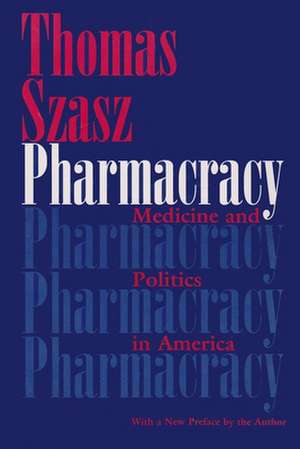
Pharmacracy
Autor Thomas Szaszen Limba Engleză Paperback – sep 2003
The modern penchant for transforming human problems into "diseases" and judicial sanctions into "treatments," replacing the rule of law with the rule of medical discretion, leads to a type of government social critic Thomas Szasz calls "pharmacracy." He warns that the creeping substitution of democracy for pharmacracy--private personal concerns increasingly perceived as requiring a medical-political response--inexorably erodes personal freedom and dignity.
Preț: 109.50 lei
Preț vechi: 115.26 lei
-5%
Carte disponibilă
Livrare economică 09-23 noiembrie
Specificații
ISBN-10: 0815607636
Pagini: 248
Dimensiuni: 142 x 239 x 17 mm
Greutate: 0.36 kg
Ediția:Syracuse Univ P.
Editura: Syracuse University Press
V-ar putea interesa
-
 How Not to Die (Too Soon)Devi SridharPreț: 159.77 lei
 -
 Our MaladyTimothy SnyderPreț: 78.71 lei
 -
 One Man's FreedomNicholas BuccolaPreț: 224.97 lei
 -
 Our Right to DrugsThomas SzaszPreț: 112.44 lei
 -
 Psychiatric SlaveryThomas SzaszPreț: 58.99 lei
 -
 Why Government Is the ProblemMilton FriedmanPreț: 32.71 lei
 -
 -29%Preț: 86.91 lei123.03 lei
 -
 One Nation Under the InfluenceKevin A SabetPreț: 170.25 lei
 -
 PornocracyJo BartoschPreț: 141.38 lei
 -
 Not Your Victim: How our Obsession with Race Entra ps and Divides UsMarie Kawthar DaoudaPreț: 143.00 lei
 -
 Trauma Industrial ComplexDarren McgarveyPreț: 159.17 lei
 -
 Preț: 88.30 lei
 -
 The Preventive StateAlan DershowitzPreț: 170.27 lei
 -
 In the ArenaDavid S BrownPreț: 196.68 lei
 -
 -17%Preț: 67.27 lei80.83 lei
 -
 Can We Be Great Again?Jeremy HuntPreț: 184.48 lei
 -
 The New CensorshipAyala PanievskyPreț: 141.53 lei
 -
 Doc or Quack: Science and Anti-Science in Modern MedicineSander L. Gilman-5%Preț: 140.44 lei147.83 lei
 -
 We Hold These TruthsCasey Burgat-23%Preț: 76.39 lei99.05 lei
Notă biografică
Thomas Szasz is professor emeritus of psychiatry at State University of New York Upstate Medical University in Syracuse. His books include The Manufacture of Madness: A Comparative Study of the Inquisition and the Mental Health Movement; The Meaning of Mind: Language, Morality, and Neuroscience; and Fatal Freedom: The Ethics and Politics of Suicide, all published by Syracuse University Press.
Descriere
In recent decades, American medicine has become increasingly politicized and politics has become increasingly medicalized. Behaviors previously seen as virtuous or wicked, wise or unwise are now dealt with as healthy or sick--unwanted behaviors to be controlled as if they were health issues. The modern penchant for transforming human problems into diseases and judicial sanctions into treatments, replacing the rule of law with the rule of medical discretion, leads to the creation of a type of government social critic Thomas Szasz calls pharmacracy.
Medicalizing troublesome behaviors and social problems is tempting to voters and politicians alike: it panders to the people by promising to satisfy their needs for dependence on medical authority and offers easy self-aggrandizement to politicians as the dispensers of more and better health care. Thus, the people gain a convenient scapegoat, enabling them to avoid personal responsibility for their behavior. The government gains a rationale for endless and politically expedient wars against social problems defined as public health emergencies. The health care system gains prestige, funding, and bureaucratic power that only an alliance with the political system can provide.
However, Szasz warns, the creeping substitution of pharmacracy for democracy--private medical concerns increasingly perceived as requiring a political response--inexorably erodes personal freedom and dignity. Pharmacracy: Medicine and Politics in America is a clear and convincing presentation of this hidden danger, all too often ignored in our health care debates and avoided in our political contests.
Cuprins
List of Abbreviations
Introduction: What Counts as Disease?
Medicine: From Gnostic Healing to Empirical Science
Scientific Medicine: Disease
Clinical Medicine: Diagnosis
Certifying Medicine: Disability
Psychiatric Medicine: Disorder
Philosophical Medicine: Critique or Ratification?
Political Medicine: The Therapeutic State
Epilogue
Notes
Bibliography
Index