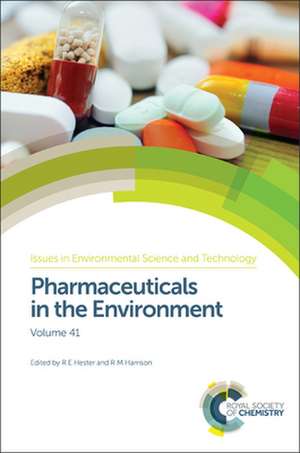
Pharmaceuticals in the Environment
Editat de R. E. Hester, R. M. Harrisonen Limba Engleză Hardback – 15 sep 2015
Preț: 561.17 lei
Preț vechi: 630.52 lei
-11%
Puncte Express: 842
Carte disponibilă
Livrare economică 02-16 noiembrie
Livrare prin curier în România Termenul estimat este afișat lângă disponibilitate.
Transport gratuit pentru acest produs Plată online sau ramburs, în funcție de opțiunile comenzii.
Retur gratuit în 14 zile Comandă securizată și suport în română.
Specificații
ISBN-13: 9781782621898
ISBN-10: 178262189X
Pagini: 294
Ilustrații: NO
Dimensiuni: 164 x 245 x 24 mm
Greutate: 0.65 kg
Editura: RSC Publishing
ISBN-10: 178262189X
Pagini: 294
Ilustrații: NO
Dimensiuni: 164 x 245 x 24 mm
Greutate: 0.65 kg
Editura: RSC Publishing
V-ar putea interesa
-
 High-Resolution Electron MicroscopyJohn C. H. Spence-31%Preț: 1003.53 lei1458.33 lei
 -
 -19%Preț: 321.35 lei398.29 lei
 -
 Solvent Extraction: Classical and Novel ApproachesVladimir S Kislik-31%Preț: 919.07 lei1326.24 lei
 -
 -8%Preț: 414.90 lei450.97 lei
 -
 Flavonoid PharmacokineticsDavies-9%Preț: 802.20 lei881.54 lei
 -
 -9%Preț: 1048.76 lei1152.48 lei
 -
 Spectroscopy for Surface ScienceR J H Clark-9%Preț: 4900.19 lei5384.83 lei
 -
 LimsA S Nakagawa-11%Preț: 493.46 lei554.45 lei
 -
 Volatile Organic Compounds in the AtmosphereR. M. HarrisonPreț: 211.69 lei
 -
 Risk Assessment and Risk ManagementR. E. HesterPreț: 260.91 lei
 -
 Developments and Applications in SolubilityTrevor M Letcher-14%Preț: 1125.57 lei1308.80 lei
 -
 Chemical Vapour DepositionAnthony C Jones-14%Preț: 1568.20 lei1823.49 lei
 -
 Chemistry and Physics of CoatingsAlistair R MarrionPreț: 390.76 lei
 -
 Nanotechnology in ConstructionPeter J M Bartos-14%Preț: 791.42 lei920.26 lei
 -
 Progressive Development of Practical Skills in ChemistryStuart W BennettPreț: 152.28 lei
 -
 Airborne Particulate MatterR. M. Harrison-11%Preț: 565.02 lei634.85 lei
 -
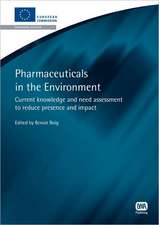 Pharmaceuticals in the EnvironmentBenoit Roig-23%Preț: 850.38 lei1104.39 lei
 -
 Ecosystem ServicesR. M. Harrison-11%Preț: 492.88 lei553.80 lei
 -
 Life-Cycle Analysis of Energy SystemsBent Sørensen-14%Preț: 1093.72 lei1271.76 lei
 -
 Water Specialists' PackageUlrich Borchers-14%Preț: 5680.00 lei6604.66 lei
 -
 Modern Chemical TechniquesBen FaustPreț: 198.48 lei
Textul de pe ultima copertă
Medicines play an important role in the treatment and prevention of disease in humans and animals, but residues from these medicines can be released into the environment through a number of routes during their manufacture, use and disposal. It is only recently that the potential environmental impacts of this exposure to pharmaceuticals are being considered.
The book explores where pharmaceutical residues can be found, e.g. in surface waters, drinking water, sediments and the marine environment; the sources of these residues, from manufacture through to disposal of unused medicines; how these residues break down; and how this all impacts on wildlife and human health.
In reviewing the current position and examining further possible impacts, this book is an important reference for researchers working in the pharmaceutical industry, as well as for environmentalists, policy makers and students on pharmacy and environmental science courses wanting to better understand the impacts of pharmaceuticals on the environment.
The book explores where pharmaceutical residues can be found, e.g. in surface waters, drinking water, sediments and the marine environment; the sources of these residues, from manufacture through to disposal of unused medicines; how these residues break down; and how this all impacts on wildlife and human health.
In reviewing the current position and examining further possible impacts, this book is an important reference for researchers working in the pharmaceutical industry, as well as for environmentalists, policy makers and students on pharmacy and environmental science courses wanting to better understand the impacts of pharmaceuticals on the environment.