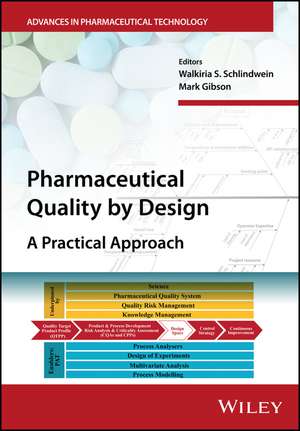
Pharmaceutical Quality by Design
Editat de Walkiria S Schlindwein, Mark Gibsonen Limba Engleză Hardback – 26 mar 2018
Preț: 691.80 lei
Preț vechi: 751.96 lei
-8%
Puncte Express: 1038
Carte tipărită la comandă
Livrare economică 04-18 decembrie
Livrare prin curier în România Termenul estimat este afișat lângă disponibilitate.
Transport gratuit pentru acest produs Plată online sau ramburs, în funcție de opțiunile comenzii.
Retur gratuit în 14 zile Comandă securizată și suport în română.
Specificații
ISBN-13: 9781118895207
ISBN-10: 1118895207
Pagini: 384
Dimensiuni: 175 x 250 x 25 mm
Greutate: 0.83 kg
Editura: Wiley
Locul publicării:Chichester, United Kingdom
ISBN-10: 1118895207
Pagini: 384
Dimensiuni: 175 x 250 x 25 mm
Greutate: 0.83 kg
Editura: Wiley
Locul publicării:Chichester, United Kingdom
V-ar putea interesa
-
 Food and SocietyMark Gibson-30%Preț: 775.26 lei1101.87 lei
-
 -11%Preț: 314.13 lei352.88 lei
-
 Romance Phonetics and PhonologyMark Gibson-21%Preț: 859.47 lei1083.06 lei
-
 Plant Chemical BiologyAudenaert-9%Preț: 835.42 lei918.05 lei
-
 Air Dispersion ModelingAlex De Visscher-9%Preț: 847.56 lei931.39 lei
-
 -9%Preț: 1092.11 lei1200.12 lei
-
 -15%Preț: 434.24 lei510.88 lei
-
 -18%Preț: 2023.92 lei2468.20 lei
-
 The In-Between LandMark GibsonPreț: 90.42 lei
-
 Translational Immunology in Asia-OceaniaNarinder K Mehra-5%Preț: 951.14 lei1001.20 lei
-
 Chemie für Ingenieure für DummiesUwe BöhmePreț: 184.84 lei
-
 -19%Preț: 433.08 lei534.66 lei
-
 L'oxyapatite silicatée: matériau d'avenir pour la pile SOFC?Stéphane Célérier-15%Preț: 513.74 lei604.41 lei
-
 Preț: 452.35 lei
-
 -19%Preț: 445.19 lei549.62 lei
Notă biografică
Editors Walkiria S. Schlindwein is Associate Professor of Pharmaceutics at the School of Pharmacy, De Montfort University. Walkiria is the programme leader of two Postgraduate courses in Pharmaceutical Quality by Design. Mark Gibson is Director of AM PharmaServices Ltd. He is a practicing Pharmaceutical Consultant and was formerly with AstraZeneca.
Cuprins
List of Figures xiii
List of Tables xix
List of Contributors xxi
Series Preface xxiii
Preface xxv
1 Introduction to Quality by Design (QbD) 1
Bruce Davis and Walkiria S. Schlindwein
1.1 Introduction 1
1.2 Background 2
1.3 Science- and Risk-Based Approaches 4
1.4 ICH Q8-Q12 5
1.5 QbD Terminology 6
1.6 QbD Framework 7
1.7 QbD Application and Benefits 7
1.8 Regulatory Aspects 8
1.9 Summary 9
1.10 References 9
2 Quality Risk Management (QRM) 11
Noel Baker
2.1 Introduction 11
2.2 Overview of ICH Q9 13
2.3 Risk Management Tools 17
2.4 Practical Examples of Use for QbD 22
2.5 Concluding Remarks 36
2.6 References 44
3 Quality Systems and Knowledge Management 47
Siegfried Schmitt
3.1 Introduction to Pharmaceutical Quality System 47
3.2 The Regulatory Framework 48
3.3 The Documentation Challenge 51
3.4 From Data to Knowledge: An Example 56
3.5 Data Integrity 58
3.6 Quality Systems and Knowledge Management: Common Factors for Success 58
3.7 Summary 59
3.8 References 60
4 Quality by Design (QbD) and the Development and Manufacture of Drug Substance 61
Gerry Steele
4.1 Introduction 61
4.2 ICH Q11 and Drug Substance Quality 62
4.3 Linear and Convergent Synthetic Chemistry Routes 65
4.4 Registered Starting Materials (RSMs) 67
4.5 Definition of an Appropriate Manufacturing Process 68
4.6 In-Line Process Analytical Technology and Crystallization Processes 78
4.7 Applying the QbD Process 82
4.8 Design of Experiments (DoE) 87
4.9 Critical Process Parameters (CPPs) 88
4.10 Design Space 88
4.11 Control Strategy 89
4.12 References 91
5 The Role of Excipients in Quality by Design (QbD) 97
Brian Carlin
5.1 Introduction 97
5.2 Quality of Design (QbD) 98
5.3 Design of Experiments (DoE) 100
5.4 Excipient Complexity 102
5.5 Composition 105
5.6 Drivers of Functionality or Performance 105
5.7 Limited Utility of Pharmacopoeial Attributes 106
5.8 Other Unspecified Attributes 107
5.9 Variability 107
5.10 Criticalities or Latent Conditions in the Finished Product 108
5.11 Direct or Indirect Impact of Excipient Variability 110
5.12 Control Strategy 111
5.13 Communication with Suppliers 112
5.14 Build in Compensatory Flexibility 113
5.15 Risk Assessment 113
5.16 Contingencies 114
5.17 References 114
6 Development and Manufacture of Drug Product 117
Mark Gibson, Alan Carmody, and Roger Weaver
6.1 Introduction 117
6.2 Applying QbD to Pharmaceutical Drug Product Development 119
6.3 Product Design Intent and the Target Product Profile (TPP) 120
6.4 The Quality Target Product Profile (QTPP) 126
6.5 Identifying the Critical Quality Attributes (CQAs) 128
6.6 Product Design and Identifying the Critical Material Attributes (CMAs) 133
6.7 Process Design and Identifying the Critical Process Parameters (CPPs) 136
6.8 Product and Process Optimisation 139
6.9 Design Space 145
6.10 Control Strategy 150
6.11 Continuous Improvement 153
6.12 Acknowledgements 154
6.13 References 154
7 Design of Experiments 157
Martin Owen and Ian Cox
7.1 Introduction 157
7.2 Experimental Design in Action 158
7.3 The Curse of Variation 158
7.4 Fitting a Model 161
7.5 Parameter Estimates 165
7.6 Analysis of Variance 166
7.7 'To Boldly Go' - An Introduction to Managing Resource Constraints using DoE 169
7.8 The Motivation for DoE 170
7.9 Classical Designs 173
7.10 Practical Workshop Design 174
7.11 How Does This Work? The Underpinning of Statistical Models for Variation 184
7.12 DoE and Cycles of Learning 187
7.13 Sequential Classical Designs and Definitive Screening Designs 189
7.14 Building a Simulation 190
7.15 Conclusion 197
7.16 Acknowledgements 198
7.17 References 198
8 Multivariate Data Analysis (MVDA) 201
Claire Beckett, Lennart Eriksson, Erik Johansson, and Conny Wikström
8.1 Introduction 201
8.2 Principal Component Analysis (PCA) 202
8.3 PCA Case Study: Raw Material Characterization using Particle Size Distribution Curves 204
8.4 Partial Least Squares Projections to Latent Structures (PLS) 208
8.5 PLS Case Study: A Process Optimization Model 210
8.6 Orthogonal PLS (OPLS Multivariate Software) 217
8.7 Orthogonal PLS (OPLS Multivariate Software) Case Study - Batch Evolution Modeling of a Chemical Batch
Reaction 218
8.8 Discussion 220
8.9 References 224
9 Process Analytical Technology (PAT) 227
Line Lundsberg-Nielsen, Walkiria S. Schlindwein, and Andreas Berghaus
9.1 Introduction 227
9.2 How PAT Enables Quality by Design (QbD) 229
9.3 The PAT Toolbox 229
9.4 Process Sensors and Process Analysers 229
9.5 Analyser Selection 240
9.6 Regulatory Requirements Related to PAT Applications 240
9.7 PAT Used in Development 242
9.8 PAT Used in Manufacturing 243
9.9 PAT and Real Time Release Testing (RTRT) 245
9.10 PAT Implementation 245
9.11 Data Management 246
9.12 In-Line Process Monitoring with UV-Vis Spectroscopy: Case Study Example 247
9.13 References 253
10 Analytical Method Design, Development, and Lifecycle Management 257
Joe de Sousa, David Holt, and Paul A. Butterworth
10.1 Introduction 257
10.2 Comparison of the Traditional Approach and the Enhanced QbD Approach 258
10.3 Details of the Enhanced QbD Approach 260
10.4 Defining Method Requirements 262
10.5 Designing and Developing the Method 264
10.6 Understanding the Impact of Method Parameters on Performance 266
10.7 Defining the Method Control Strategy and Validating the Method 267
10.8 Monitoring Routine Method Performance for Continual Improvement 268
10.9 Summary 269
10.10 Example Case Studies 270
10.11 References 278
11 Manufacturing and Process Controls 281
Mark Gibson
11.1 Introduction to Manufacturing and Facilities 281
11.2 Validation of Facilities and Equipment 282
11.3 Drug Product Process Validation: A Lifecycle Approach 292
11.4 The Impact of QbD on Process Equipment Design and Pharmaceutical Manufacturing Processes 300
11.5 Introduction to Process Control in Pharmaceutical Manufacturing 302
11.6 Advanced Process Controls (APC) and Control Strategy 305
11.7 The Establishment of Continuous Manufacture 309
11.8 The Tablet Press as Part of a Continuous Tableting Line 312
11.9 Real-Time Release Testing and Continuous Quality Verification 316
11.10 Acknowledgments 317
11.11 References 317
12 Regulatory Guidance 321
Siegfried Schmitt and Mustafa A. Zaman
12.1 Introduction 321
12.2 The Common Technical Document (CTD) Format 322
12.3 Essential Reading 328
12.4 What Is Not Written, or Hidden, in the Guidance Documents? 329
12.5 Post-Approval Change 330
12.6 Summary 331
12.7 References 332
Index 335