
Pharmaceutical Computer Systems Validation: Volume 2 - Real Life Case Studies: Drugs and the Pharmaceutical Sciences
Editat de Guy Wingateen Limba Engleză Hardback – 14 iun 2026
Key Features
- Covers governance framework, roles and responsibilities, quality culture, project lifecycle, operational compliance, risk management, electronic records/signatures, supplier management, practical troubleshooting, handling regulatory inspections, metrics, and the opportunity for performance improvement
- Provides a set of 22 new and updated case studies by industry experts, demonstrating how these computer system validation principles are put into practice
- Focuses on GxP regulatory requirements covering GCPs, GLPs, GMPs, and GDPs—complete with observations from inspections by the US FDA and other regulators
- Discusses industry regulations and guidance, including current thinking of the US FDA on computer software assurance, the latest guidance from the US FDA/EU/MHRA on data integrity, and the newly published ISPE GAMP 5 Guide (Second Edition)
- Shares the practical experience and advice from a group of leading computer validation and compliance international experts
Din seria Drugs and the Pharmaceutical Sciences
- 23%
 Preț: 1547.56 lei
 -
 Preț: 438.29 lei
 -
 Preț: 432.49 lei
 - 9%
 Preț: 1848.87 lei
 - 15%
 Preț: 649.35 lei
 - 18%
 Preț: 1118.30 lei
 - 15%
 Preț: 575.67 lei
 - 18%
 Preț: 2096.82 lei
 - 18%
 Preț: 1471.36 lei
 -
 Preț: 457.50 lei
 - 18%
 Preț: 1725.85 lei
 - 15%
 Preț: 465.18 lei
 - 15%
 Preț: 426.16 lei
 - 5%
 Preț: 3076.70 lei
 - 5%
 Preț: 769.77 lei
 - 18%
 Preț: 1494.88 lei
 - 15%
 Preț: 530.47 lei
 - 18%
 Preț: 1483.25 lei
 - 15%
 Preț: 527.36 lei
 - 5%
 Preț: 1955.00 lei
 - 18%
 Preț: 1574.34 lei
 - 5%
 Preț: 580.23 lei
 - 18%
 Preț: 1998.26 lei
 - 18%
 Preț: 1496.27 lei
 - 5%
 Preț: 892.31 lei
 - 18%
 Preț: 1488.77 lei
 - 5%
 Preț: 791.00 lei
 - 18%
 Preț: 1425.47 lei
 - 18%
 Preț: 1407.78 lei
 - 18%
 Preț: 2797.39 lei
 - 18%
 Preț: 1802.80 lei
 - 18%
 Preț: 1391.31 lei
 - 18%
 Preț: 895.69 lei
 - 18%
 Preț: 1486.15 lei
 - 18%
 Preț: 1428.54 lei
 - 18%
 Preț: 1685.04 lei
 - 18%
 Preț: 1640.03 lei
 - 18%
 Preț: 1418.36 lei
 - 18%
 Preț: 1021.31 lei
 - 18%
 Preț: 1487.20 lei
 -
 Preț: 477.59 lei
 - 18%
 Preț: 1956.90 lei
 - 18%
 Preț: 1478.51 lei
 - 5%
 Preț: 2574.27 lei
 - 18%
 Preț: 1734.23 lei
Preț: 1883.86 lei
Preț vechi: 1983.00 lei
-5%
Puncte Express: 2826
Carte tipărită la comandă
Livrare economică 25 noiembrie-09 decembrie
Livrare prin curier în România Termenul estimat este afișat lângă disponibilitate.
Transport gratuit pentru acest produs Plată online sau ramburs, în funcție de opțiunile comenzii.
Retur gratuit în 14 zile Comandă securizată și suport în română.
Specificații
ISBN-13: 9781041371151
ISBN-10: 1041371152
Pagini: 514
Ilustrații: 228
Dimensiuni: 178 x 254 mm
Greutate: 1.11 kg
Ediția:3
Editura: CRC Press
Colecția CRC Press
Seria Drugs and the Pharmaceutical Sciences
ISBN-10: 1041371152
Pagini: 514
Ilustrații: 228
Dimensiuni: 178 x 254 mm
Greutate: 1.11 kg
Ediția:3
Editura: CRC Press
Colecția CRC Press
Seria Drugs and the Pharmaceutical Sciences
V-ar putea interesa
-
 Systems Science and Population HealthAbdulrahman M. El-Sayed-26%Preț: 523.94 lei709.68 lei
 -
 Epidemiology by Design: A Causal Approach to the Health SciencesDaniel Westreich-21%Preț: 390.52 lei496.77 lei
 -
 Smoking and Hormone-Related DisordersNicholas Wald-26%Preț: 762.02 lei1032.67 lei
 -
 Effects of Smoking on the Fetus, Neonate and ChildDavid Poswillo-25%Preț: 417.76 lei560.27 lei
 -
 Presenting Medical Statistics from Proposal to PublicationJanet L. Peacock-21%Preț: 414.43 lei527.21 lei
 -
 -28%Preț: 341.15 lei475.85 lei
 -
 Individual Participant Data Meta-AnalysisRichard D Riley-5%Preț: 600.63 lei632.24 lei
 -
 Preț: 389.14 lei
 -
 Regimento Proveitoso Contra a PestenencaJose Barbosa Machado-5%Preț: 59.04 lei62.15 lei
 -
 EbolaMarc M. Maxmeister Phd-5%Preț: 55.94 lei58.89 lei
 -
 Drug SafetyDr Ravi N. Humbarwadi-5%Preț: 661.94 lei696.78 lei
 -
 Vaccinations and Vaccine Myth ExposedDaniel Birk-5%Preț: 51.85 lei54.58 lei
 -
 USMLE Step 2 Ck Epidemiology in Your PocketGregory Fernandez-5%Preț: 80.62 lei84.86 lei
 -
 Careers in EpidemiologyInstitute for Career Research-5%Preț: 58.90 lei61.99 lei
 -
 -18%Preț: 1492.43 lei1820.03 lei
 -
 -5%Preț: 433.78 lei456.61 lei
 -
 Preț: 79.76 lei
 -
 Wetter und PflanzenkrankheitenHarald Schrödter-5%Preț: 399.42 lei420.45 lei
 -
 -5%Preț: 679.84 lei715.63 lei
 -
 Epidemiology and Management of Root DiseasesC. Lee Campbell-5%Preț: 723.61 lei761.69 lei
 -
 -5%Preț: 796.78 lei838.72 lei
Public țintă
Postgraduate, Professional Practice & Development, Professional Reference, and Undergraduate AdvancedCuprins
Foreword. Preface. List of Contributors. About The Editor. Abbreviations. Chapter 1: Case Study 1: Clinical Systems. Chapter 2: Case Study 2: Computerized Analytical Laboratory Systems. Chapter 3: Case Study 3: Chromatography Data Systems. Chapter 4: Case Study 4: Laboratory Information Management Systems. Chapter 5: Case Study 5: Process Instrumentation. Chapter 6: Case Study 6: Process Control Systems (Operational Technologies: OT). Chapter 7: Case Study 7: Process Analytical Technology. Chapter 8: Case Study 8: Manufacturing Execution Systems and Electronic Batch Records. Chapter 9: Case Study 9: Building Management Systems. Chapter 10: Case Study 10: Spreadsheets. Chapter 11: Case Study 11: Database Applications. Chapter 12: Case Study 12: Electronic Document Management Systems. Chapter 13: Case Study 13: Enterprise Resource Planning Systems. Chapter 14: Case Study 14: Marketing and Supply Applications. Chapter 15: Case Study 15: IT Infrastructure and Associated Services. Chapter 16: Case Study 16: Big Data Management. Chapter 17: Case Study 17: Web-based Applications. Chapter 18: Case Study 18: Blockchain. Chapter 19: Case Study 19: Mobile Devices. Chapter 20: Case Study 20: Medical Devices and Their Automated Manufacture. Chapter 21: Case Study 21: AI-enabled Computerized System. Chapter 22: Case Study 22: Blood Establishment Computer Systems. Glossary. Index
Notă biografică
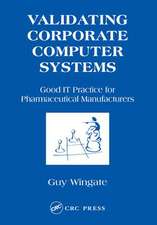
Guy Wingate, Ph.D., was Vice‑President of Compliance and before that Director of Global Computer Validation at GlaxoSmithKline until his recent retirement. A well‑known speaker on computer validation, he has over 30 years of experience in the pharmaceutical industry. He has been a visiting lecturer at the University of Manchester’s M.Sc. in Pharmaceutical Engineering Advanced Training program and the Dublin Institute of Technology’s accredited M.Sc. in Validation Science program. He is an active member of the ISPE and served as Chair of the GAMP® Council for 10 years, which is responsible for the internationally recognized suite of GAMP® Guides on computer compliance. Guy led the teams who produced the original GAMP®5 Guide: A Risk Based Approach to Compliant GxP Computerized Systems and the GAMP® Good Practice Guide: A Risk-Based Approach to Compliant Electronic Records and Signatures. His extensive list of published work also includes the books Validating Automated Manufacturing and Laroratoty Applications, Validating Corporate Computer Systems and previous editions of this book, Pharmaceutical Computer Systems Validation.
Recenzii
This book’s strong emphasis on governance, management oversight, and maintaining control throughout the operational life cycle [of computer systems used in the pharmaceutical industry] is both timely and necessary.
A key challenge for today’s organizations today is the shift from validating systems at a point in time to assuring them continuously throughout their life. Modern development and delivery approaches, such as Agile and DevOps, can support this goal, but only when the supporting controls are designed deliberately and applied consistently. Clear intent of requirements, risk‐based decision‐making, appropriate testing strategies for high‐risk functions, robust release and configuration management, and effective supplier oversight remain essential. Several chapters in the book address these realities directly, focusing on the areas where compliance most often degrades: operation, maintenance, and change.
At the same time, the regulatory and compliance landscape continues to evolve. There is sustained global focus on data governance and data integrity, including expectations for effective investigation, remediation, and prevention of recurrence. Cybersecurity, data availability, and business continuity are receiving increased attention, reflecting their direct impact on product quality and patient safety. Regulators also increasingly expect organizations to understand, control, and justify the use of emerging technologies, particularly where these technologies influence GxP decisions, regulated records, or regulatory submissions.
What is particularly welcome about this book is its practical orientation. While regulations and guidance are widely available, many organizations struggle to translate high‐level principles into consistent execution across diverse system types and life cycle stages. This work helps to bridge that gap. Through its structured approach and breadth of examples, from laboratory and manufacturing systems to enterprise platforms, infrastructure, cloud services, and data‐intensive digital architectures, it provides practitioners with a coherent framework grounded in real operational experience.
I would encourage readers to approach this book not simply as a compliance manual, but as a guide to building organizational capability. Capability means being able to explain, with confidence, how and why controls are proportionate to risk; demonstrating that systems are fit for their intended use; evidencing that data remain complete, consistent, and trustworthy throughout the data life cycle; and showing that the organization learns through effective management review, meaningful metrics, and a culture that treats issues as opportunities for improvement rather than occasions for blame.
In an era of increasing digital dependence, this capability is not optional. It is fundamental to protecting patients, safeguarding product quality, and maintaining trust in the organizations responsible for both. I commend this book to practitioners, managers, and auditors alike, and I hope it serves as a practical companion in building the right environment, technical, procedural, and cultural, for robust computer compliance and data integrity.
Tracy Moore
Former Expert GMP Inspector, UK Medicines & Healthcare products Regulatory Agency (MHRA)
A key challenge for today’s organizations today is the shift from validating systems at a point in time to assuring them continuously throughout their life. Modern development and delivery approaches, such as Agile and DevOps, can support this goal, but only when the supporting controls are designed deliberately and applied consistently. Clear intent of requirements, risk‐based decision‐making, appropriate testing strategies for high‐risk functions, robust release and configuration management, and effective supplier oversight remain essential. Several chapters in the book address these realities directly, focusing on the areas where compliance most often degrades: operation, maintenance, and change.
At the same time, the regulatory and compliance landscape continues to evolve. There is sustained global focus on data governance and data integrity, including expectations for effective investigation, remediation, and prevention of recurrence. Cybersecurity, data availability, and business continuity are receiving increased attention, reflecting their direct impact on product quality and patient safety. Regulators also increasingly expect organizations to understand, control, and justify the use of emerging technologies, particularly where these technologies influence GxP decisions, regulated records, or regulatory submissions.
What is particularly welcome about this book is its practical orientation. While regulations and guidance are widely available, many organizations struggle to translate high‐level principles into consistent execution across diverse system types and life cycle stages. This work helps to bridge that gap. Through its structured approach and breadth of examples, from laboratory and manufacturing systems to enterprise platforms, infrastructure, cloud services, and data‐intensive digital architectures, it provides practitioners with a coherent framework grounded in real operational experience.
I would encourage readers to approach this book not simply as a compliance manual, but as a guide to building organizational capability. Capability means being able to explain, with confidence, how and why controls are proportionate to risk; demonstrating that systems are fit for their intended use; evidencing that data remain complete, consistent, and trustworthy throughout the data life cycle; and showing that the organization learns through effective management review, meaningful metrics, and a culture that treats issues as opportunities for improvement rather than occasions for blame.
In an era of increasing digital dependence, this capability is not optional. It is fundamental to protecting patients, safeguarding product quality, and maintaining trust in the organizations responsible for both. I commend this book to practitioners, managers, and auditors alike, and I hope it serves as a practical companion in building the right environment, technical, procedural, and cultural, for robust computer compliance and data integrity.
Tracy Moore
Former Expert GMP Inspector, UK Medicines & Healthcare products Regulatory Agency (MHRA)
Descriere
This new edition deals with validation, compliance and software in the pharmaceutical, healthcare and medical device industries. The first volume provides a walk-through of lifecycle and development methodologies, and the second volume comprises a set of refreshed case studies spanning laboratory, manufacturing and supply chain systems.