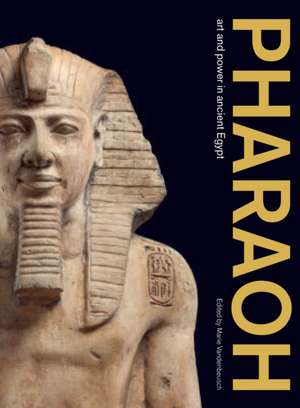
Pharaoh
Editat de Marie Vandenbeuschen Limba Engleză Paperback – 22 oct 2024
Destinat studenților în istorie antică, cercetătorilor și pasionaților de egiptologie, volumul Pharaoh: art and power in ancient Egypt oferă o analiză riguroasă a ideologiei puterii regale. Observăm o abordare care depășește mitizarea monarhului, concentrându-se pe mecanismele administrative și religioase care au susținut civilizația egipteană timp de trei milenii. Structura lucrării ghidează cititorul de la descifrarea iconografiei și a regaliilor, până la exercitarea concretă a autorității în diplomație și război. Ne-a atras atenția modul în care Marie Vandenbeusch integrează obiectele din colecția British Museum pentru a ilustra tensiunea dintre imaginea ideală propagată de faraoni și provocările politice reale, precum uzurparea tronului sau ștergerea oficială a memoriei anumitor conducători. Această perspectivă analitică reflectă rigoarea academică prezentă și în lucrările anterioare ale editorului, cum este Sur les pas de l'âne dans la religion égyptienne, unde aceasta explora simbolistica religioasă prin prisma surselor economice și arheologice. În peisajul editorial actual, volumul completează perspectiva oferită de Monarchs of the Nile de Aidan Dodson. În timp ce Dodson oferă o cronică biografică succinctă a celor mai importanți suverani, lucrarea editată de Marie Vandenbeusch adaugă o profunzime tematică esențială, explicând fundamentul teologic și simbolic al puterii, nu doar succesiunea cronologică. De asemenea, spre deosebire de abordarea narativă din The Good Kings de Kara Cooney, care caută paralele moderne, acest titlu rămâne ancorat strict în contextul arheologic și istoric original, oferind o resursă vizuală și documentară de excepție prin ilustrațiile color și datele recente de cercetare.
Preț: 424.92 lei
Carte disponibilă
Livrare economică 02-16 decembrie
Specificații
ISBN-10: 1512827215
Pagini: 256
Dimensiuni: 189 x 254 x 20 mm
Greutate: 0.99 kg
Editura: University of Pennsylvania Press
V-ar putea interesa
-
 RamessesJoyce TyldesleyPreț: 115.23 lei
-
 The Oxford History of Ancient EgyptIan Shaw-16%Preț: 95.12 lei113.39 lei
-
 Ancient EgyptDavid P SilvermanPreț: 184.96 lei
-
 -18%Preț: 58.37 lei71.42 lei
-
 -15%Preț: 83.66 lei98.19 lei
-
 -23%Preț: 73.60 lei95.79 lei
-
 The Thames & Hudson Dictionary of Ancient EgyptToby WilkinsonPreț: 127.63 lei
-
 Great Kingdoms of AfricaJohn Parker-22%Preț: 152.44 lei194.54 lei
-
 Lives of the Ancient EgyptiansToby Wilkinson-18%Preț: 77.41 lei93.84 lei
-
 Preț: 121.89 lei
-
 -26%Preț: 68.00 lei92.50 lei
-
 The Rise and Fall of Ancient EgyptToby Wilkinson-22%Preț: 97.60 lei125.92 lei
-
 The Good KingsKara CooneyPreț: 166.06 lei
-
 -24%Preț: 55.10 lei72.72 lei
-
 Thutmose III and Hatshepsut, Pharaohs of EgyptAidan DodsonPreț: 271.66 lei
-
 Ramses the GreatCharlotte Booth-31%Preț: 44.64 lei64.69 lei
-
 House of Two PharaohsWilbur SmithPreț: 157.95 lei
-
 PharaohsPhyllis G Jestice-14%Preț: 128.36 lei149.82 lei
De ce să citești această carte
Această lucrare este esențială pentru cei care doresc să înțeleagă Egiptul Antic dincolo de piramide. Cititorul câștigă o înțelegere clară a modului în care arta a fost utilizată ca instrument politic și religios. Este o resursă academică valoroasă datorită accesului la piesele-cheie din British Museum, explicând cum un lider reușea să mențină ordinea (Maat) într-o lume marcată frecvent de conflicte și influențe străine.
Descriere scurtă
The rulers of ancient Egypt were not always male, nor always Egyptian. At times, Egypt was divided by civil war, conquered by foreign powers or ruled by competing kings. While some kings were revered ¿ such as Thutmose III who expanded Egypt¿s empire to its largest extent ¿ the memory of others was officially erased. Many of the objects surviving from ancient Egypt project the image the pharaoh wanted us to see ¿ however this book explores the reality and the many challenges of ruling one of the greatest civilisations the world has ever seen.
After an introduction into the historic and geographic timeframe of the ancient Pharaohs, the book explores royal iconography, decoding the insignia worn and held by the king, or the names and titles covering most royal monuments. The core of the book investigates the main roles of the king, as high priest, as the head of the royal family, as the administrative ruler of the country and as the leader of the army and diplomat. Following an investigation into the preparation for the king¿s eternal life, from the rituals to the building of a tomb, the book closes on a contemporary perspective from Egypt and how the notion of the Pharaoh still resonates today.
The book covers 3,000 years of history ¿ highlighting research on key pieces from the British Museum¿s outstanding collection of Egyptian antiquities.
Notă biografică
Marie Vandenbeusch is Curator, Funerary Culture of the Nile Valley at the British Museum.
Contributors
Julie R. Anderson, British Museum
Andrew Connor, Centre for Ancient Cultures, Monash University
Amanda Dunsmore, National Gallery of Victoria
Ikram Ghabriel, Independent Researcher, London
Thomas Kiely, British Museum
Giuseppina Lenzo, University of Lausanne
Margaret Maitland, National Museums Scotland
Marcel Marée, British Museum
Youssef Rakha, novelist, poet and essayist, Cairo Sahar Saleem, Cairo University
Chiara Salvador, University Paul-Valéry Montpellier 3
Neal Spencer, Fitzwilliam Museum
Anna Stevens, Centre for Ancient Cultures, Monash University
John H. Taylor, previously British Museum
Cuprins
Chronology
Introduction - The time of the Pharaohs (Marie Vandenbeusch)
In focus: The British Museum collection (Marie Vandenbeusch)
1. Pharaoh and gods in myths (Margaret Maitland)
In focus: Maat and the cosmic balance (Ikram Ghabriel)
Symbols of power (Marcel Marée)
In focus: Female Pharaohs (Chiara Salvador)
2. Pharaoh as High Priest (Marie Vandenbeusch)
In focus: Statues of the lion goddess Sekhmet (Marcel Marée)
In focus: Statue caches (Neal Spencer)
3. The royal family: queens, princes and princesses (Amanda Dunsmore)
In focus: Royal palaces (Anna Stevens)
In focus: Women in power - the Divine Adoratrices (Giuseppina Lenzo)
4. Ruling Egypt (Marie Vandenbeusch)
In focus: People, the example of Deir el-Medina (Amanda Dunsmore)
In focus: The mastaba of Urirenptah (Marie Vandenbeusch)
Ancient Egyptian jewellery (Aurélia Masson-Berghoff)
5. Egypt and the world (Marie Vandenbeusch)
In focus: Foreign pharaohs (Andrew Connor)
The world and Egypt (Julie Anderson and Thomas Kiely)
In focus: The Levant and beyond (Marie Vandenbeusch)
6. An eternal life (Marie Vandenbeusch)
In focus: Royal mummification (Sahar Saleem)
The posthumous life of kings (John Taylor)
Inheriting roles (Youssef Rakha)
Notes and selected reading
Acknowledgements, picture credits, index