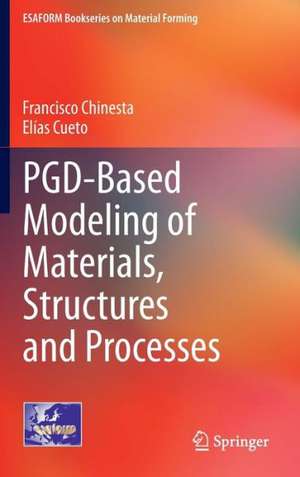
PGD-Based Modeling of Materials, Structures and Processes: ESAFORM Bookseries on Material Forming
Autor Francisco Chinesta, Elías Cuetoen Limba Engleză Hardback – 12 mai 2014
Preț: 666.56 lei
Preț vechi: 784.18 lei
-15%
Puncte Express: 1000
Carte tipărită la comandă
Livrare economică 21 noiembrie-05 decembrie
Livrare prin curier în România Termenul estimat este afișat lângă disponibilitate.
Transport gratuit pentru acest produs Plată online sau ramburs, în funcție de opțiunile comenzii.
Retur gratuit în 14 zile Comandă securizată și suport în română.
Specificații
ISBN-13: 9783319061818
ISBN-10: 331906181X
Pagini: 240
Ilustrații: XVII, 219 p. 84 illus.
Dimensiuni: 160 x 241 x 19 mm
Greutate: 0.48 kg
Ediția:2014
Editura: Springer
Colecția ESAFORM Bookseries on Material Forming
Seria ESAFORM Bookseries on Material Forming
Locul publicării:Cham, Switzerland
ISBN-10: 331906181X
Pagini: 240
Ilustrații: XVII, 219 p. 84 illus.
Dimensiuni: 160 x 241 x 19 mm
Greutate: 0.48 kg
Ediția:2014
Editura: Springer
Colecția ESAFORM Bookseries on Material Forming
Seria ESAFORM Bookseries on Material Forming
Locul publicării:Cham, Switzerland
V-ar putea interesa
-
 Cryptography: A Very Short IntroductionFred PiperPreț: 65.28 lei
 -
 -22%Preț: 519.99 lei670.41 lei
 -
 Fundamentals of Weather and ClimateRobin McIlveen-20%Preț: 490.84 lei613.71 lei
 -
 Mathematical Models of Biological SystemsHugo van den Berg-22%Preț: 480.97 lei619.62 lei
 -
 Model Selection and Multimodel InferenceDavid R. Anderson-23%Preț: 1072.91 lei1393.39 lei
 -
 Empirical Model BuildingJames R Thompson-9%Preț: 915.82 lei1006.39 lei
 -
 Modeling and Simulation in Medicine and the Life SciencesFrank C. HoppensteadtPreț: 495.58 lei
 -
 Waves in Neural MediaPaul C. Bressloff-15%Preț: 709.30 lei834.48 lei
 -
 -18%Preț: 1136.11 lei1385.49 lei
 -
 Reduced Order Methods for Modeling and Computational ReductionAlfio Quarteroni-15%Preț: 672.46 lei791.13 lei
 -
 Optimization with PDE ConstraintsRonald Hoppe-15%Preț: 676.61 lei796.01 lei
 -
 Topology OptimizationMartin Philip Bendsoe-18%Preț: 898.67 lei1095.94 lei
 -
 Dispersal, Individual Movement and Spatial EcologyMark A. LewisPreț: 397.70 lei
Public țintă
ResearchCuprins
1 Introduction.- 1.1 Recurrent issues in numerical simulation.- 1.2 Model reduction: information versus relevant information.- 1.3 PGD at a glance.- 1.4 Revisiting the simulation challenges.- 1.5 A brief state of the art on PGD-based model order reduction.- 2 Multiscale modelling.- 2.1 From quantum mechanics to kinetic theory.- 2.2 Advanced solvers for multi-dimensional models.- 2.3 Numerical examples.- 2.4 Conclusions.- 3 Homogenization.- 3.1 Homogenization of linear heterogenous models.- 3.2 Non-concurrent nonlinear homogenization.- 3.3 Numerical examples.- 3.4 Conclusions.- 4 Coupled models.- 4.1 Efficient coupling of global and local models.- 4.2 Fully globalized local models.- 4.3 Heterogeneous time integration.- 4.4 Numerical example.- 4.5 Discussion.- 5 Parametric models in evolving domains.- 5.1 Evolving domains issues.- 5.2 PGD in evolving domains.- 5.3 Separated representation constructor.- 5.4 Numerical test.- 5.5 Towards parametric modeling in evolving domains.- 5.6 Numerical test involving parametric modeling.- 5.7 Conclusions.- 6 Space separation.- 6.1 In-plane/out-of-plane separated representation.- 6.2 Laminates.- 6.3 Conclusions.- 7 Process optimization.- 7.1 Parametric boundary conditions.- 7.2 Parametric modeling of pultrusion.- 7.3 Optimization strategy.- 7.4 Conclusion 8 Shape optimization.- 8.1 Introduction.- 8.2 Geometrical parameters as extra-coordinates.- 8.3 Numerical results.- 8.4 Conclusions.- 9 DDDAS.- 9.1 Introduction to DDDAS.- 9.2 PGD solution of a flowing process.- 9.3 Simulating a breakdown scenario.- 9.4 Post-processing in a smartphone.- 9.5 Conclusions.- 10 Inverse analysis.- 10.1 PGD based parameter identification.- 10.2 PGD based Cauchy’s problem.- 10.3 Parameter identification examples.- 10.4 Cauchy’s problem example.- 10.5 Conclusions.- 11 Tape placement.- 11.1 Parametric modeling.- 11.2 ATP thermal model.- 11.3 ATP mechanical modeling.- 11.4 Numerical results.- 11.5 Conclusions.- 12 Augmented learning.- 12.1 Towards augmented learning.- 12.2 Examples of augmented learning.- 12.3 Conclusions.- References.- Index.
Textul de pe ultima copertă
This book focuses on the development of a new simulation paradigm allowing for the solution of models that up to now have never been resolved and which result in spectacular CPU time savings (in the order of millions) that, combined with supercomputing, could revolutionize future ICT (information and communication technologies) at the heart of science and technology. The authors have recently proposed a new paradigm for simulation-based engineering sciences called Proper Generalized Decomposition, PGD, which has proved a tremendous potential in many aspects of forming process simulation. In this book a review of the basics of the technique is made, together with different examples of application.
Caracteristici
Deals with the appealing field of model order reduction applied to material forming Covers a wide range of disciplines in the field of material forming Will have an important impact on the community and stimulate further development in the field Includes supplementary material: sn.pub/extras
Notă biografică
Francisco Chinesta – Professor of Computational Physics at Arts et Métiers Institute of Technology, Paris and programme director at CNRS@CREATE, Singapore. His research focuses on computational physics, model order reduction, and hybrid artificial intelligence. Elias Cueto – Professor of Continuum Mechanics at Universidad de Zaragoza. His research covers model order reduction, artificial intelligence and computational mechanics. Victor Champaney – Researcher at Arts et Métiers Institute of Technology, Paris. His work specializes in model order reduction, hybrid modeling and frugal AI techniques. Chady Ghnatios – Professor of Mechanical Engineering at University of North Florida, USA. His research focuses on model order reduction, advanced simulation, machine learning and hybrid modeling. Amine Ammar – Professor of Computational Mechanics at Arts et Métiers Institute of Technology, Angers. His expertise lies in kinetic theory models, model reduction, and computational material forming. Nicolas Hascoët – Associate Professor at Arts et Métiers Institute of Technology, Paris. His research focuses on machine learning and data science for industrial applications. David Gonzalez – Professor of Continuum Mechanics at Universidad de Zaragoza. His research interests include model reduction, real-time computational simulations, and physics-informed AI. Icíar Alfaro – Associate Professor at Universidad de Zaragoza. She specializes in numerical methods, solid mechanics, and physics-informed neural networks. Daniele Di Lorenzo – Researcher at Arts et Métiers Institute of Technology, Paris. His research focuses on inverse analysis, hybrid modeling, and digital twins for structural health monitoring. Angelo Pasquale – Researcher in Computational Mechanics at Arts et Métiers Institute of Technology, Paris. He specializes in AI-enhanced simulations, model order reduction and multiscale modeling. Dominique Baillargeat – Professor at the University of Limoges and Director of CNRS@CREATE at Singapore. His research focuses on high-frequency electronics, nanotechnologies, and advanced modeling and simulation techniques using Hybrid-AI.