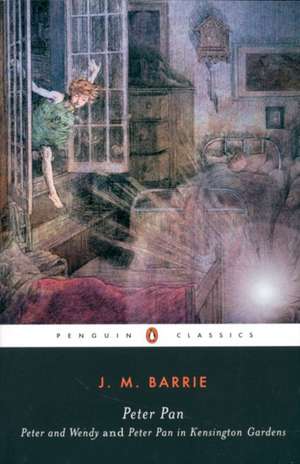
Peter Pan
Autor J. M. Barrieen Limba Engleză Paperback – dec 2005
Evoluția literaturii pentru copii de la simple povești moralizatoare la explorări psihologice complexe găsește un punct de referință în opera lui J. M. Barrie. Remarcăm că această ediție din seria Collins Classics nu este doar o simplă republicare a poveștii băiatului care refuză să crească, ci o compilație critică ce urmărește metamorfoza personajului pe parcursul a peste două decenii. Subliniem importanța structurii volumului, care include nu doar textul canonic Peter and Wendy, ci și formele sale incipiente: piesa de teatru din 1904 și nuvela Peter Pan in Kensington Gardens. Această abordare permite cititorului să observe cum „sângerarea” dintre realitate și fantezie — o temă recurentă în opera lui Barrie — s-a rafinat în timp. Față de edițiile standard, precum The Adventures of Peter Pan, care se concentrează strict pe narațiunea de aventură, volumul de față completează perspectiva adăugând un aparat critic valoros: recenzii contemporane din publicații precum The New York Times și fragmente de manuscris care dezvăluie procesul de scriere. Merită menționat că progresia conținutului, de la cronologia vieții autorului până la anexele cu materiale de arhivă, transformă lectura dintr-o experiență nostalgică într-un studiu literar riguros. Această ediție reușește să ancoreze magia din Neverland în contextul social și personal al lui Barrie, oferind o viziune completă asupra unui mit modern care, spre deosebire de protagonistul său, continuă să se maturizeze în relevanță.
Preț: 42.14 lei
Preț vechi: 51.06 lei
-17%
Carte disponibilă
Livrare economică 06-18 noiembrie
Livrare express 23-29 octombrie pentru 28.03 lei
Specificații
ISBN-10: 014243793X
Pagini: 352
Ilustrații: illustrations
Dimensiuni: 128 x 195 x 17 mm
Greutate: 0.2 kg
Editura: Penguin Books
Colecția Penguin Classics
Locul publicării:London, United Kingdom
V-ar putea interesa
-
 The Adventures Of Huckleberry FinnMark TwainPreț: 28.01 lei
 -
 A Promised LandBarack ObamaPreț: 233.02 lei
 -
 When You Reach MeRebecca SteadPreț: 57.00 lei
 -
 And Still I RiseDr Maya Angelou-28%Preț: 55.77 lei77.57 lei
 -
 They Both Die at the End: TikTok made me buy it!Adam SilveraPreț: 54.77 lei
 -
 Silver the Contrary FairyJudith OlufsenPreț: 131.02 lei
 -
 Afia the Ashanti PrincessCrystal BoatengPreț: 136.09 lei
 -
 The Little PrinceAntoine De Saint-Exupery-26%Preț: 48.22 lei65.32 lei
 -
 Little WomenLouisa May AlcottPreț: 74.38 lei
 -
 The Secret GardenFrances Eliza Hodgson BurnettPreț: 73.96 lei
 -
 Alice in WonderlandLewis CarrollPreț: 72.16 lei
 -
 A Christmas CarolCharles DickensPreț: 71.86 lei
 -
 The Jungle BookRudyard KiplingPreț: 73.06 lei
 -
 Anne of Green GablesLucy Maud MontgomeryPreț: 74.61 lei
 -
 The Railway ChildrenEdith NesbitPreț: 73.73 lei
 -
 EmmaJane AustenPreț: 74.71 lei
 -
 Sense and SensibilityJane AustenPreț: 73.73 lei
 -
 Great ExpectationsCharles DickensPreț: 75.48 lei
 -
 The Memoirs of Sherlock HolmesArthur Conan DoylePreț: 72.75 lei
 -
 The Adventures of Sherlock HolmesArthur Conan DoylePreț: 73.33 lei
 -
 -16%Preț: 49.73 lei59.26 lei
 -
 Mitchelhill, B: Run Rabbit RunBarbara MitchelhillPreț: 49.26 lei
 -
 Un viaje peligroso de una niñaReji LaberjePreț: 73.60 lei
 -
 The GrumpireC. T. WalshPreț: 102.39 lei
 -
 The Woodcarver and the BearsGordon GilhulyPreț: 125.93 lei
 -
 The Fairy PrincessAudree Tara SahotaPreț: 147.89 lei
 -
 Cautionary Tales For ChildrenHilaire BellocPreț: 124.29 lei
De ce să citești această carte
Această ediție este esențială pentru cei care doresc să descopere profunzimea din spatele mitului. Dincolo de aventura cu pirați și zâne, cititorul câștigă acces la documente istorice și recenzii de epocă ce explică impactul cultural al lucrării. Este recomandarea ideală pentru studenții la litere sau pentru colecționarii care caută o variantă academică, dar accesibilă, a operelor lui J. M. Barrie.
Despre autor
Sir James Matthew Barrie (1860–1937) a fost un romancier și dramaturg scoțian, a cărui carieră a fost marcată de un succes imens în epoca victoriană și eduardiană. Deși a scris numeroase piese cu substrat social, precum 'The Admirable Crichton', numele său rămâne indisolubil legat de crearea lui Peter Pan. Inspirația pentru personaj a venit din prietenia sa cu băieții familiei Llewelyn Davies, pe care i-a adoptat neoficial după moartea părinților lor. Traumatizat în copilărie de pierderea fratelui său mai mare, Barrie a explorat obsesiv în scrierile sale temele inocenței pierdute și ale refuzului maturizării.
Notă biografică
Descriere scurtă
When Peter Pan and his fairy companion Tinker Bell fly in through the window of Wendy's nursery one night, it is the beginning of an adventure that whisks Wendy and her brothers Michael and John off to Neverland. There they will find mermaids, fairies, pirates led by the sinister Captain Hook, and the crocodile who bit off his leg - and still pursues him in hope of the rest! Peter Pan originally appeared as a baby living a magical life among birds and fairies in J.M. Barrie's sequence of stories, Peter Pan in Kensington Gardens. His adventures capture the spirit of childhood - and of rebellion against the role of adulthood in conventional society.
This edition includes the novel and the stories, and reproduces the original illustrations by Francis Donkin Bedford and Arthur Rackham. In his introduction, Jack Zipes sifts through the psychological interpretations that have engaged critics, explores the cultural and literary contexts in which we can appreciate Barrie's enduring creation, and shows why Peter Pan is fundamentally a work that urges adults to reconnect with their own imagination.
James Matthew Barrie (1860-1937) was born in Scotland, the son of a weaver. In 1885, he moved to London to pursue a literary career. Peter Pan, with its flying and theatrical devices, was a huge success and continues to be performed today; in 1911 Barrie rewrote the play as a novel. On his death in 1937 Barrie gifted copyright of the play Peter Pan to Great Ormond Street hospital.
If you enjoyed Peter Pan you might like Lewis Carroll's Alice's Adventures in Wonderland and Through the Looking Glass, also available in Penguin Classics.
'One of the classic children's stories of all time'
Daily Mail
'Intensely moving as well as enchanting in its evocation of childhood, the heartlessness of youth and parental grief as children grow older'
Daily Telegraph
Descriere
Relive the magic of finding Neverland in this beautiful Painted Edition of Peter Pan. This classic tale of never growing up and found family will delight new readers and old as they follow Wendy, Michael and John on this timeless adventure. Featuring beautiful cover art from artist Laci Fowler in this exclusive collector's edition.
This magical classic tale of childhood is now available in an exclusive collector's edition, featuring beautiful cover art from artist Laci Fowler and decorative interior pages, making it ideal for fiction lovers and book collectors alike.
Beloved by fans around the world Peter Pan is the story of a little boy who doesn't want to grow up. This time-honored classic is now available as an exclusive collector's edition.
Whether you're buying it as a gift or for yourself, this remarkable edition features:
- A beautiful, high-end hardcover featuring Laci Fowler's distinctive hand-painted art and high-end embossing/debossing treatments to bring the art to life
- Embossed cover art and gold foiling
- Details of the story are incorporated into the cover art as surprise finds
- Decorative interior pages featuring pull quotes throughout
- Matching ribbon marker and gold page edges
- Part of a 4-volume collection including Anne of Green Gables,?The Secret Garden, and?Winnie the Pooh
- An excellent gift for teachers, librarians, or children's classic collectors
When Wendy and her brothers journey with Peter to Neverland and meet his ageless band of Lost Boys, they realize Neverland isn't as perfect as it seems when they meet the evil Captain Hook.
Exploring the time-honored themes of the magic of imagination, courage, and the beauty of parental love, this unique collector’s edition presents J. M. Barrie's beloved tale of friendship, memory, and family in a giftable new way.
Extras
Peter Breaks Through
ALL CHILDREN, except one, grow up. They soon know that they will grow up, and the way Wendy knew was this. One day when she was two years old she was playing in a garden, and she plucked another flower and ran with it to her mother. I suppose she must have looked rather delightful, for Mrs. Darling put her hand to her heart and cried, "Oh, why can't you remain like this for ever!" This was all that passed between them on the subject, but henceforth Wendy knew that she must grow up. You always know after you are two. Two is the beginning of the end.
Of course they lived at 14, and until Wendy came her mother was the chief one. She was a lovely lady, with a romantic mind and such a sweet mocking mouth. Her romantic mind was like the tiny boxes, one within the other, that come from the puzzling East, however many you discover there is always one more; and her sweet mocking mouth had one kiss on it that Wendy could never get, though there it was, perfectly conspicuous in the righthand corner.
The way Mr. Darling won her was this: the many gentlemen who had been boys when she was a girl discovered simultaneously that they loved her, and they all ran to her house to propose to her except Mr. Darling, who took a cab and nipped in first, and so he got her. He got all of her, except the innermost box and the kiss. He never knew about the box, and in time he gave up trying for the kiss. Wendy thought Napoleon could have got it, but I can picture him trying, and then going off in a passion, slamming the door.
Mr. Darling used to boast to Wendy that her mother not only loved him but respected him. He was one of those deep ones who know about stocks and shares. Of course no one really knows, but he quite seemed to know, and he often said stocks were up and shares were down in a way that would have made any woman respect him.
Mrs. Darling was married in white, and at first she kept the books perfectly, almost gleefully, as if it were a game, not so much as a brussels sprout was missing; but by and by whole cauliflowers dropped out, and instead of them there were pictures of babies without faces. She drew them when she should have been totting up. They were Mrs. Darling's guesses.
Wendy came first, then John, then Michael.
For a week or two after Wendy came it was doubtful whether they would be able to keep her, as she was another mouth to feed. Mr. Darling was frightfully proud of her, but he was very honourable, and he sat on the edge of Mrs. Darling's bed, holding her hand and calculating expenses, while she looked at him imploringly. She wanted to risk it, come what might, but that was not his way; his way was with a pencil and a piece of paper, and if she confused him with suggestions he had to begin at the beginning again.
"Now don't interrupt," he would beg of her. "I have one pound seventeen here, and two and six at the office; I can cut off my coffee at the office, say ten shillings, making two nine and six, with your eighteen and three makes three nine seven, with five naught naught in my cheque-book makes eight nine seven-who is that moving?-eight nine seven, dot and carry seven-don't speak, my own-and the pound you lent to that man who came to the door-quiet, child-dot and carry child-there, you've done it!-did I say nine nine seven? yes, I said nine nine seven; the question is, can we try it for a year on nine nine seven?"
"Of course we can, George," she cried. But she was prejudiced in Wendy's favour, and he was really the grander character of the two.
"Remember mumps," he warned her almost threateningly, and off he went again. "Mumps one pound, that is what I have put down, but I daresay it will be more like thirty shillings-don't speak-measles one five, German measles half a guinea, makes two fifteen six-don't waggle your finger-whooping-cough, say fifteen shillings"-and so on it went, and it added up differently each time; but at last Wendy just got through, with mumps reduced to twelve six, and the two kinds of measles treated as one.
There was the same excitement over John, and Michael had even a narrower squeak; but both were kept, and soon you might have seen the three of them going in a row to Miss Fulsom's Kindergarten school, accompanied by their nurse.
Mrs. Darling loved to have everything just so, and Mr. Darling had a passion for being exactly like his neighbours; so, of course, they had a nurse. As they were poor, owing to the amount of milk the children drank, this nurse was a prim Newfoundland dog, called Nana who had belonged to no one in particular until the Darlings engaged her. She had always thought children important, however, and the Darlings had become acquainted with her in Kensington Gardens, where she spent most of her spare time peeping into perambulators, and was much hated by careless nursemaids, whom she followed to their homes and complained of to their mistresses. She proved to be quite a treasure of a nurse. How thorough she was at bath-time; and up at any moment of the night if one of her charges made the slightest cry. Of course, her kennel was in the nursery. She had a genius for knowing when a cough is a thing to have no patience with and when it needs stocking around your throat. She believed to her last day in old-fashioned remedies like rhubarb leaf, and made sounds of contempt over all this new-fangled talk about germs, and so on. It was a lesson in propriety to see her escorting the children to school, walking sedately by their side when they were well behaved, and butting them back into line if they strayed. On John's soccer days she never once forgot his sweater, and she usually carried an umbrella in her mouth in case of rain. There is a room in the basement of Miss Fulsom's school where the nurses wait. They sat on forms, while Nana lay on the floor, but that was the only difference. They affected to ignore her as of an inferior social status to themselves, and she despised their light talk. She resented visits to the nursery from Mrs. Darling's friends, but if they did come she first whipped off Michael's pinafore and put him into the one with blue braiding, and smoothed out Wendy and made a dash at John's hair.
No nursery could possibly have been conducted more correctly, and Mr. Darling knew it, yet he sometimes wondered uneasily whether the neighbours talked.
He had his position in the city to consider.
Nana also troubled him in another way. He had sometimes a feeling that she did not admire him. "I know she admires you tremendously, George," Mrs. Darling would assure him, and then she would sign to the children to be specially nice to father. Lovely dances followed, in which the only other servant, Liza, was sometimes allowed to join. Such a midget she looked in her long skirt and maid's cap, though she had sworn, when engaged, that she would never see ten again. The gaiety of these romps! And gayest of all was Mrs. Darling, who would pirouette so wildly that all you could see of her was the kiss, and then if you had dashed at her you might have got it. There never was a simpler happier family until the coming of Peter Pan.
Mrs. Darling first heard of Peter when she was tidying up her children's minds. It is the nightly custom of every good mother after her children are asleep to rummage in their minds and put things straight for next morning, repacking into their proper places the many articles that have wandered during the day. If you could keep awake (but of course you can't) you would see your own mother doing this, and you would find it very interesting to watch her. It is quite like tidying up drawers. You would see her on her knees, I expect, lingering humorously over some of your contents, wondering where on earth you had picked this thing up, making discoveries sweet and not so sweet, pressing this to her cheek as if it were as nice as a kitten, and hurriedly stowing that out of sight. When you wake in the morning, the naughtiness and evil passions with which you went to bed have been folded up small and placed at the bottom of your mind; and on the top, beautifully aired, are spread out your prettier thoughts, ready for you to put on.
I don't know whether you have ever seen a map of a person's mind. Doctors sometimes draw maps of other parts of you, and your own map can become intensely interesting, but catch them trying to draw a map of a child's mind, which is not only confused, but keeps going round all the time. There are zigzag lines on it, just like your temperature on a card, and these are probably roads in the island; for the Neverland is always more or less an island, with astonishing splashes of colour here and there, and coral reefs and rakish-looking craft in the offing, and savages and lonely lairs, and gnomes who are mostly tailors, and caves through which a river runs, and princes with six elder brothers, and a hut fast going to decay, and one very small old lady with a hooked nose. It would be an easy map if that were all; but there is also first day at school, religion, fathers, the round pond, needlework, murders, hangings, verbs that take the dative, chocolate pudding day, getting into braces, say ninety-nine, three-pence for pulling out your tooth yourself, and so on; and either these are part of the island or they are another map showing through, and it is all rather confusing, especially as nothing will stand still.
Of course the Neverlands vary a good deal. John's, for instance, had a lagoon with flamingoes flying over it at which John was shooting, while Michael, who was very small, had a flamingo with lagoons flying over it. John lived in a boat turned upside down on the sands, Michael in a wigwam, Wendy in a house of leaves deftly sewn together. John had no friends, Michael had friends at night, Wendy had a pet wolf forsaken by its parents; but on the whole the Neverlands have a family resemblance, and if they stood in a row you could say of them that they have each other's nose, and so forth. On these magic shores children at play are for ever beaching their coracles. We too have been there; we can still hear the sound of the surf, though we shall land no more.
Of all delectable islands the Neverland is the snuggest and most compact; not large and sprawly, you know, with tedious distance between one adventure and another, but nicely crammed. When you play at it by day with the chairs and table-cloth, it is not in the least alarming, but in the two minutes before you go to sleep it becomes very nearly real. That is why there are night-lights.
Occasionally in her travels through her children's minds Mrs. Darling found things she could not understand, and of these quite the most perplexing was the word Peter. She knew of no Peter, and yet he was here and there in John and Michael's minds, while Wendy's began to be scrawled all over with him. The name stood out in bolder letters than any of the other words, and as Mrs. Darling gazed she felt that it had an oddly cocky appearance.
"Yes, he is rather cocky," Wendy admitted with regret. Her mother had been questioning her.
"But who is he, my pet?"
"He is Peter Pan, you know, mother."
At first Mrs. Darling did not know, but after thinking back into her childhood she just remembered a Peter Pan who was said to live with the fairies. There were odd stories about him; as that when children died he went part of the way with them, so that they should not be frightened. She had believed in him at the time, but now that she was married and full of sense she quite doubted whether there was any such person.
"Besides," she said to Wendy, "he would be grown up by this time."
"Oh no, he isn't grown up," Wendy assured her confidently, "and he is just my size." She meant that he was her size in both mind and body; she didn't know how she knew it, she just knew it.
Mrs. Darling consulted Mr. Darling, but he smiled pooh-pooh. "Mark my words," he said, "it is some nonsense Nana has been putting into their heads; just the sort of idea a dog would have. Leave it alone, and it will blow over."
But it would not blow over; and soon the troublesome boy gave Mrs. Darling quite a shock.
Children have the strangest adventures without being troubled by them. For instance, they may remember to mention, a week after the event happened, that when they were in the wood they met their dead father and had a game with him. It was in this casual way that Wendy one morning made a disquieting revelation. Some leaves of a tree had been found on the nursery floor, which certainly were not there when the children went to bed, and Mrs. Darling was puzzling over them when Wendy said with a tolerant smile:
"I do believe it is that Peter again!"
"Whatever do you mean, Wendy?"
"It is so naughty of him not to wipe," Wendy said, sighing. She was a tidy child.
She explained in quite a matter-of-fact way that she thought Peter sometimes came to the nursery in the night and sat on the foot of her bed and played on his pipes to her. Unfortunately she never woke, so she didn't know how she knew, she just knew.
"What nonsense you talk, precious. No one can get into the house without knocking."
"I think he comes in by the window," she said.
"My love, it is three floors up."
"Were not the leaves at the foot of the window, mother?"
It was quite true; the leaves had been found very near the window.
Mrs. Darling did not know what to think, for it all seemed so natural to Wendy that you could not dismiss it by saying she had been dreaming.
"My child," the mother cried, "why did you not tell me of this before?"
"I forgot," said Wendy lightly. She was in a hurry to get her breakfast.
Oh, surely she must have been dreaming.
Recenzii
Appendices include materials from Barrie’s personal writings and contemporary reviews and illustrations.
“A unique achievement—the bringing together of Barrie’s various and scattered Peter Pan texts within a single volume. As such it is an absolute gift to Peter Pan devotees, containing as it does much material that is otherwise unavailable to the general reader. An added bonus is the inclusion of numerous contemporary reviews for both the play of 1904 and the later novelization of 1911.” — Andrew Birkin, author of J.M. Barrie and The Lost Boys
“This edition of Peter Pan is an exemplary work of scholarship, giving us not only the 1911 edition of the full novelization of this much edited and reproduced story, but also the 1904 slim pantomime version never before published, “An Afterthought” (1908), and the 1906 novella Peter Pan in Kensington Gardens. The reader has in this edition a thorough exposure to this complicated text. Alton has chosen the Appendices carefully and wisely. Her Introduction meticulously covers the complicated history of the writing, editing, performing, and publishing of this famous story. And she provides us with a review of the major critical responses to the story. This edition of Peter Pan is simply the best we have.” — Roderick McGillis, The University of Calgary
Textul de pe ultima copertă
Cuprins
Introduction
J.M. Barrie: A Brief Chronology
A Note on the Text
Primary Text:
Peter and Wendy
Formative Texts:
Peter Pan, or the Boy who Wouldn’t Grow Up
“An After-Thought”
Peter Pan in Kensington Gardens
Appendix A: Contemporary Reviews (Plays)
- Peter Pan, or the Boy who Wouldn’t Grow Up
- The New York Times (28 December 1904)
- The Times (28 December 1904)
- The Saturday Review (7 January 1905)
- The New York Times (12 November 1905)
- The New York Times (10 June 1906)
- “An After-Thought”
- The New York Times (15 March 1908)
- Peter Pan in Kensington Gardens
- The New York Times (4 December 1910)
- The New York Times (4 December 1910)
- Peter and Wendy
- The New York Times (22 October 1911)
- The Literary Digest (19 November 1911)
- Barrie’s Manuscript Page of “Fairy” (1903)
- “Davy Jones’ Locker” (1904)
- Frank Gillette’s Costume Designs for 1905 London Production of Peter Pan, or the Boy who Wouldn’t Grow Up (1905)
- Maude Adams from the 1905 New York Production of Peter Pan, or the Boy who Wouldn’t Grow Up (1905)
- Pauline Chase from the 1907 Playbill Touring Production Poster of Peter Pan, or the Boy whoWouldn’t Grow Up (1907)
- Preface to The Coral Island (1913)
- “Captain Hook at Eton” (1927)
- “To the Five” (1928)
- “The Child’s Map of Kensington Gardens.” Illustration by Henry Justice Ford from The Little White Bird (1902)
- “Peter Pan’s Map of Kensington Gardens.” Illustration by Arthur Rackham from Peter Pan in Kensington Gardens (1906)
- J.M. Barrie’s Key to Kensington Gardens (1903)
- “We Feel Dancey.” Illustration by Arthur Rackham from Peter Pan in Kensington Gardens (1906)
- “Title Page.” Illustration by Francis Donkin Bedford from first edition of Peter and Wendy (1911)
- “Peter Flew In.” Illustration by Francis Donkin Bedford from first edition of Peter and Wendy (1911)
- “Peter Pan Playing Pipes” and “Wendy on Rock.” Illustrations by Mabel Lucie Attwell from Peter Pan and Wendy (1921)
- Diarmuid Byron-O’Connor’s Sculpture of Peter Pan at GOSH (2000)