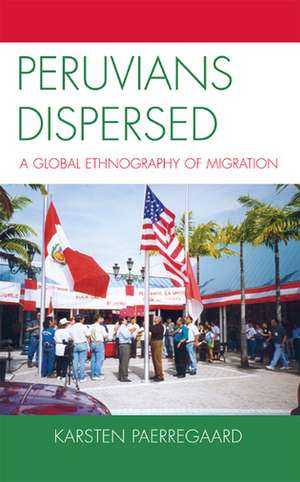
Peruvians Dispersed
Autor Karsten Paerregaarden Limba Engleză Hardback – dec 2007
| Toate formatele și edițiile | Preț | Express |
|---|---|---|
| Paperback (1) | 329.46 lei 6-8 săpt. | |
| Bloomsbury Publishing – 20 noi 2009 | 329.46 lei 6-8 săpt. | |
| Hardback (1) | 757.43 lei 6-8 săpt. | |
| Bloomsbury Publishing – dec 2007 | 757.43 lei 6-8 săpt. |
Preț: 757.43 lei
Preț vechi: 1037.57 lei
-27%
Puncte Express: 1136
Preț estimativ în valută:
133.92€ • 158.03$ • 117.28£
133.92€ • 158.03$ • 117.28£
Carte tipărită la comandă
Livrare economică 14-28 aprilie
Specificații
ISBN-13: 9780739118375
ISBN-10: 0739118374
Pagini: 288
Dimensiuni: 157 x 235 x 22 mm
Greutate: 0.62 kg
Editura: Bloomsbury Publishing
ISBN-10: 0739118374
Pagini: 288
Dimensiuni: 157 x 235 x 22 mm
Greutate: 0.62 kg
Editura: Bloomsbury Publishing
Notă biografică
Karsten Paerregaard is a fellow at the Woodrow Wilson International Center for Scholars and associate professor of anthropology at the University of Copenhagen.
Descriere
Descriere de la o altă ediție sau format:
Peruvians Dispersed presents an anthropological study of transnational migration to the United States, Spain, Japan and Argentina. Karsten Paerregaard spent a total of one year living with Peruvian migrants in four continents which allowed him to make ethnographic in-depth descriptions of Peru's many migrant communities and at the same time discuss how immigration and labor market policies in the Global North both thwart and spur migration from the Global South. The book also offers an innovative contribution to the methodological debate about multi-sited field research, which in recent years has become prominent among scholars studying processes of globalization, transnationalism and multiculturalism. Because of the wide span of social groups in Peru that migrate and the global dispersion of Peruvians in America, Asia and Europe; the study of the Peruvian migration offers a unique opportunity to rethink current attempts to theorize transnational and diasporic migration and develop the methodological and analytical framework for a global ethnography.
Peruvians Dispersed presents an anthropological study of transnational migration to the United States, Spain, Japan and Argentina. Karsten Paerregaard spent a total of one year living with Peruvian migrants in four continents which allowed him to make ethnographic in-depth descriptions of Peru's many migrant communities and at the same time discuss how immigration and labor market policies in the Global North both thwart and spur migration from the Global South. The book also offers an innovative contribution to the methodological debate about multi-sited field research, which in recent years has become prominent among scholars studying processes of globalization, transnationalism and multiculturalism. Because of the wide span of social groups in Peru that migrate and the global dispersion of Peruvians in America, Asia and Europe; the study of the Peruvian migration offers a unique opportunity to rethink current attempts to theorize transnational and diasporic migration and develop the methodological and analytical framework for a global ethnography.
Cuprins
Part 1 Introduction
Chapter 2 The Extended Field
Part 3 Flows and Contexts
Chapter 4 Coming and Going
Chapter 5 Strangers at the Gate
Part 6 Networks and Processes
Chapter 7 The Cat and the Mouse
Chapter 8 Tying the Untied
Chapter 9 Global Secrets
Part 10 Categories and Trajectories
Chapter 11 Home, Bittersweet Home
Chapter 12 Tales from the Shadow
Part 13 Conclusion
Chapter 14 Between Hope and Despair
Chapter 2 The Extended Field
Part 3 Flows and Contexts
Chapter 4 Coming and Going
Chapter 5 Strangers at the Gate
Part 6 Networks and Processes
Chapter 7 The Cat and the Mouse
Chapter 8 Tying the Untied
Chapter 9 Global Secrets
Part 10 Categories and Trajectories
Chapter 11 Home, Bittersweet Home
Chapter 12 Tales from the Shadow
Part 13 Conclusion
Chapter 14 Between Hope and Despair
Recenzii
This important book examines transnational migration from Peru to four of the main receiver nations of Peruvian immigrants. . . . The book's strength lies in the many interviews and case histories that Paerregaard has constructed. The interviews range widely across the immigrant landscape, gender, and class. As such they provide the msot careful study of Peruvians abroad yet written. . . . Paerregaard's research is first rate; he structures his discussion clearly, and he understands well the need for placing this book in a proper historical context.
This rich multi-sited ethnography, and the numerous life-stories it encompasses, provide compelling insights into what Paerregaard refers to as Peruvians' 'life-long struggle to progresar (make progress)', both at home and abroad. Despite power relations that exclude and marginalize them, migrants make use of social networks and sheer existential resourcefulness to improve their lot, albeit at the cost of continuing uncertainty and painful compromise.
This rich multi-sited ethnography, and the numerous life-stories it encompasses, provide compelling insights into what Paerregaard refers to as Peruvians' 'life-long struggle to progresar (make progress)', both at home and abroad. Despite power relations that exclude and marginalize them, migrants make use of social networks and sheer existential resourcefulness to improve their lot, albeit at the cost of continuing uncertainty and painful compromise.