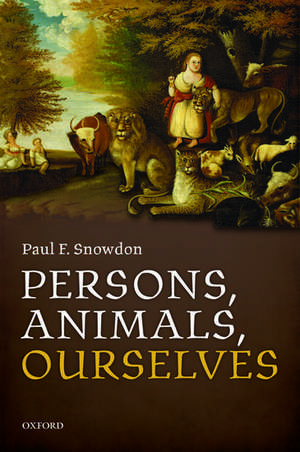
Persons, Animals, Ourselves
Autor Paul F. Snowdonen Limba Engleză Paperback – 30 mar 2017
Preț: 278.75 lei
Preț vechi: 342.05 lei
-19%
Puncte Express: 418
Carte tipărită la comandă
Livrare economică 20-25 noiembrie
Livrare prin curier în România Termenul estimat este afișat lângă disponibilitate.
Transport gratuit de la 400.00 lei Plată online sau ramburs, în funcție de opțiunile comenzii.
Retur gratuit în 14 zile Comandă securizată și suport în română.
Specificații
ISBN-13: 9780198769996
ISBN-10: 0198769997
Pagini: 270
Dimensiuni: 157 x 234 x 15 mm
Greutate: 0.43 kg
Editura: OUP OXFORD
Colecția OUP Oxford
Locul publicării:Oxford, United Kingdom
ISBN-10: 0198769997
Pagini: 270
Dimensiuni: 157 x 234 x 15 mm
Greutate: 0.43 kg
Editura: OUP OXFORD
Colecția OUP Oxford
Locul publicării:Oxford, United Kingdom
V-ar putea interesa
-
 Identity TheoryPeter J. Burke-13%Preț: 287.67 lei329.91 lei
 -
 Extreme: Why some people thrive at the limitsEmma Barrett-19%Preț: 75.17 lei93.00 lei
 -
 -30%Preț: 459.83 lei655.68 lei
 -
 Media PsychologyGayle Brewer-11%Preț: 338.83 lei381.22 lei
 -
 Enough about You, Let's Talk about MeLes CarterPreț: 95.32 lei
 -
 Self-EfficacyAlbert Bandura-15%Preț: 561.15 lei660.17 lei
 -
 The Anatomy of Human DestructivenessErich FrommPreț: 158.94 lei
 -
 Transforming Sexuality: The Archetypal World of Anima and AnimusAnn Belford UlanovPreț: 258.94 lei
 -
 Gifts Differing: Understanding Personality TypeIsabel Briggs MyersPreț: 108.70 lei
 -
 Dabrowski's Theory of Positive DisintegrationSal MendaglioPreț: 209.25 lei
 -
 Alfred Adler's Basic Concepts And ImplicationsRobert W. LundinPreț: 382.34 lei
 -
 Dimensions of PersonalityHans EysenckPreț: 481.46 lei
Recenzii
It is good that Snowdon's arguments and ideas have finally been presented together in a prominent venue. The book offers a valuable treatment of some standard anti-animalist arguments, and it has much to teach anyone thinking about animalism or personal identity.
Notă biografică
Paul F. Snowdon read Philosophy, Politics, and Economics at University College, Oxford, and remained there for the BPhil. He was appointed a lecturer in philosophy at Reading University in 1970, and became a Fellow and Lecturer in Philosophy at Exeter College Oxford a year later. In 2001 he became the Grote Professor in Mind Logic at University College London. He was President of the Aristotelian Society from 2003 to 2004, and has held visiting posts at Williams College in the USA, Umea University in Sweden, and the University of Otago in New Zealand.