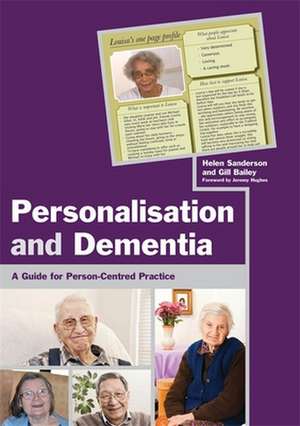
Personalisation and Dementia: A Guide for Person-Centred Practice
Autor Gill Bailey Contribuţii de Martin Routledge Autor Helen Sandersonen Limba Engleză Paperback – 21 oct 2013
This practical guide explains how to deliver personalised services and support for people with dementia through simple, evidence-based person-centred practices. The authors clearly explain personalisation and current person-centred thinking and practice, providing many vivid examples of how it has been achieved in community as well as residential care settings. They guide the reader through using a range of person-centred practices. Strategies for ensuring a good match between the person with dementia and the staff and volunteers supporting them are also described. In the final chapter, the reader is introduced to Progress for Providers, a photocopiable tool for tracking progress in delivering appropriate personalised support for people with dementia living in care homes.
This is essential reading for dementia care practitioners and managers, as well as social and health care workers, community workers and students.
Preț: 191.53 lei
Preț vechi: 269.92 lei
-29%
Puncte Express: 287
Carte disponibilă
Livrare economică 29 octombrie-12 noiembrie
Livrare prin curier în România Termenul estimat este afișat lângă disponibilitate.
Transport gratuit de la 400.00 lei Plată online sau ramburs, în funcție de opțiunile comenzii.
Retur gratuit în 14 zile Comandă securizată și suport în română.
Specificații
ISBN-13: 9781849053792
ISBN-10: 1849053790
Pagini: 168
Ilustrații: 42 black and white graphics
Dimensiuni: 218 x 297 x 10 mm
Greutate: 0.42 kg
Editura: JESSICA KINGSLEY PUBLISHERS
Colecția Jessica Kingsley Publishers
Locul publicării:London, United Kingdom
ISBN-10: 1849053790
Pagini: 168
Ilustrații: 42 black and white graphics
Dimensiuni: 218 x 297 x 10 mm
Greutate: 0.42 kg
Editura: JESSICA KINGSLEY PUBLISHERS
Colecția Jessica Kingsley Publishers
Locul publicării:London, United Kingdom
V-ar putea interesa
-
 The Unexpected JourneyEmma Heming WillisPreț: 139.54 lei
 -
 Residential, Home and Community Aged Care WorkbookCarla Unicomb-31%Preț: 222.83 lei323.94 lei
 -
 Still Me: A neuroscientist's guide to caring for someone with dementiaDr Sabina Brennan-11%Preț: 140.90 lei158.08 lei
 -
 -29%Preț: 64.38 lei90.25 lei
 -
 -5%Preț: 539.94 lei568.35 lei
 -
 -20%Preț: 109.97 lei136.97 lei
 -
 The Creative Dementia Practice Handbook: Arts for Health and WellbeingMaria Pasiecznik Parsons-24%Preț: 137.37 lei181.25 lei
 -
 Human Rights in Dementia Care: A Good Practice GuideSuzanne Cahill-21%Preț: 144.56 lei182.61 lei
 -
 LGBTQ+ People and Dementia: A Good Practice GuideSue Westwood-21%Preț: 141.59 lei179.64 lei
 -
 -20%Preț: 109.43 lei136.92 lei
 -
 What You Really Want to Know About Working with Dementia: Real Issues and Expert AdviceKaren Harrison Dening-24%Preț: 130.25 lei171.88 lei
 -
 -24%Preț: 259.68 lei343.82 lei
 -
 -21%Preț: 113.21 lei143.66 lei
 -
 -25%Preț: 223.64 lei296.51 lei
 -
 Playfulness and Dementia: A Practice GuideRobin Lang-22%Preț: 161.74 lei206.32 lei
 -
 Leadership for Person-Centred Dementia CareBuz Loveday-26%Preț: 176.55 lei239.73 lei
 -
 -20%Preț: 137.42 lei172.08 lei
 -
 -25%Preț: 202.33 lei271.41 lei
 -
 -29%Preț: 172.19 lei243.60 lei
 -
 The Practical Handbook of Living with DementiaIsla ParkerPreț: 261.56 lei
Recenzii
A refreshingly readable book, feels and looks like a text book but reads like a supportive coaching manual. Very in-depth but that doesn't distract from the clarity of the writing style... Too many highlights really including - "one-page profiles", "personalisation" and "person centred practices" because they have resonance across all spheres of Nursing. They make you sit up, think and reflect on your own work.
Chapter 5 "matching staff and clarifying responsibilities" is my highlight. Suggesting how matching staff characteristics with persons living with dementia, develops a win-win relationship... I would like to see everyone involved in elder care have access to a copy of this book. That's not just care staff, but non-care support staff too. It will be appropriate across all levels of nursing from NVQ support staff to ward managers and service providers.
The person-centred practices outlined in this book show how to deliver genuine personalisation, where what is important for the person is balanced with what is important to the person's wellbeing. It is about the stuff that makes a life worth living: each person as an individual with their own needs, wishes, and dreams to be recognised and met... In the current economic climate, it is even more important that we make sure personalisation is about real choice and service. It is not, and must not be seen as, a way of cutting funding. I therefore warmly welcome the timely publication of a book that seeks to ensure we always see the person and not the dementia .
This is a really useful book. All those supporting people with dementia in their own homes or within care homes will find this helpful. The person-centred thinking tools prompt readers to see what is really important to help people live their lives. On the surface level the tools are a format for planning care delivery. They are deceptively simple. They are never more than one page long but on a deeper level they help caring staff ask the sorts of transformational questions that pinpoint what is really important for the person. The worked examples are very real and moving and underscore that this is not just a paper exercise. This is essential reading for all advocates of person-centred care.
Chapter 5 "matching staff and clarifying responsibilities" is my highlight. Suggesting how matching staff characteristics with persons living with dementia, develops a win-win relationship... I would like to see everyone involved in elder care have access to a copy of this book. That's not just care staff, but non-care support staff too. It will be appropriate across all levels of nursing from NVQ support staff to ward managers and service providers.
The person-centred practices outlined in this book show how to deliver genuine personalisation, where what is important for the person is balanced with what is important to the person's wellbeing. It is about the stuff that makes a life worth living: each person as an individual with their own needs, wishes, and dreams to be recognised and met... In the current economic climate, it is even more important that we make sure personalisation is about real choice and service. It is not, and must not be seen as, a way of cutting funding. I therefore warmly welcome the timely publication of a book that seeks to ensure we always see the person and not the dementia .
This is a really useful book. All those supporting people with dementia in their own homes or within care homes will find this helpful. The person-centred thinking tools prompt readers to see what is really important to help people live their lives. On the surface level the tools are a format for planning care delivery. They are deceptively simple. They are never more than one page long but on a deeper level they help caring staff ask the sorts of transformational questions that pinpoint what is really important for the person. The worked examples are very real and moving and underscore that this is not just a paper exercise. This is essential reading for all advocates of person-centred care.
Cuprins
Foreword by Jeremy Hughes. Introduction. 1. About this Book - and Arthur. 2. Personalisation and People Living with Dementia with Martin Routledge, Head of Operations, In Control, UK 3. Knowing the Person - One-Page Profiles. 4. Choice and Control in Practice. 5. Matching Staff and Clarifying Responsibilities. 6. Acting on What is Working and Not Working. 7. Further Reflection, Learning and Action. 8. Past and Future - Life Stories and Future Wishes. 9. Being Part of the Community. 10. Putting it All Together - John's Story. 11. Getting Started and Progress for Providers. Appendix: Progress for Providers: Checking Your Progress in Delivering Personalised Support for People Living with Dementia in Care Homes. References. Index.