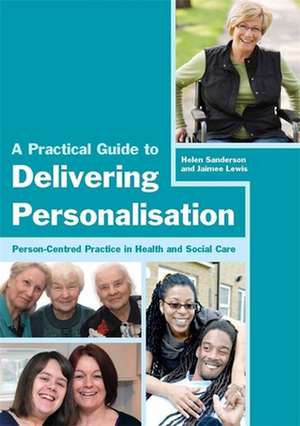
A Practical Guide to Delivering Personalisation: Person-Centred Practice in Health and Social Care
Autor Jaimee Lewis, Helen Sandersonen Limba Engleză Paperback – 15 dec 2011
This book will show how to deliver personalisation through simple, effective and evidence-based person-centred practice that changes people's lives and helps them achieve the outcomes they want. It covers why person-centred practice is relevant to the personalisation agenda and what person-centred thinking and person-centred reviews are, introducing the tools that can help you carry them out. It also explores the relationship between person-centred plans and support plans, and how person-centred practice can be used in the journey of support through adulthood – from prevention or the management of long-term health conditions to reablement, recovery, support in old age and at the end of life. There is also a chapter on taking a person-centred approach to risk.
This is an essential guide for all staff in health and social care including service providers, managers, practitioners and students.
Preț: 225.32 lei
Preț vechi: 296.97 lei
-24%
Puncte Express: 338
Carte disponibilă
Livrare economică 09-23 noiembrie
Livrare prin curier în România Termenul estimat este afișat lângă disponibilitate.
Transport gratuit de la 400.00 lei Plată online sau ramburs, în funcție de opțiunile comenzii.
Retur gratuit în 14 zile Comandă securizată și suport în română.
Specificații
ISBN-13: 9781849051941
ISBN-10: 1849051941
Pagini: 237
Ilustrații: 58 figures
Dimensiuni: 213 x 298 x 14 mm
Greutate: 0.64 kg
Editura: JESSICA KINGSLEY PUBLISHERS
Colecția Jessica Kingsley Publishers
Locul publicării:London, United Kingdom
ISBN-10: 1849051941
Pagini: 237
Ilustrații: 58 figures
Dimensiuni: 213 x 298 x 14 mm
Greutate: 0.64 kg
Editura: JESSICA KINGSLEY PUBLISHERS
Colecția Jessica Kingsley Publishers
Locul publicării:London, United Kingdom
V-ar putea interesa
-
 Social Work: A Very Short IntroductionSally Holland-20%Preț: 56.85 lei70.93 lei
 -
 -28%Preț: 221.80 lei307.27 lei
 -
 Counseling PsychologyRuth Chu-Lien ChaoPreț: 309.88 lei
 -
 Multicultural Social Work PracticeDerald Wing Sue-23%Preț: 599.80 lei778.96 lei
 -
 The Relationship InventoryGodfrey T Barrett-LennardPreț: 404.99 lei
 -
 Applying Theory to Generalist Social Work PracticeCarol L Langer-8%Preț: 422.92 lei459.70 lei
 -
 The Compleat Social WorkerDavid Howe-10%Preț: 170.65 lei189.23 lei
 -
 Counseling Across CulturesPaul B. Pedersen-27%Preț: 965.99 lei1323.28 lei
 -
 -28%Preț: 214.61 lei297.70 lei
 -
 -26%Preț: 213.53 lei287.60 lei
 -
 Social Work with Children and Families: Getting into Practice Third EditionProfessor Ian Butler-25%Preț: 204.20 lei272.59 lei
 -
 -20%Preț: 317.85 lei397.50 lei
 -
 -29%Preț: 191.53 lei269.92 lei
 -
 -20%Preț: 145.70 lei182.93 lei
 -
 -25%Preț: 207.19 lei275.20 lei
 -
 Living With Grief: Children, Adolescents and LossKenneth J. DokaPreț: 235.93 lei
 -
 Forensic Interviews Regarding Child Sexual AbuseWilliam T. O'Donohue-18%Preț: 1271.93 lei1551.14 lei
Recenzii
The guide is indeed a practical guide, packed full of ideas and methods that are directly relevant and applicable in the community of a care home. The design and layout of the book are brilliant and the examples and exercises are realistic and lively.
This well-researched book provides clear practical applicability for managers, practitioners and service providers contending with the somewhat ambiguous nature of enabling individuals to exercise choice in designing and controlling their own support... Sanderson and Lewis convincingly demonstrate the practical contribution person-centred thinking and practice tools can make in delivering personalisation... real congruence between values and practice... Sanderson's reputation to deliver practical focused literature located within an academic, political and ideological context is well deserved.
The tools for person-centred care described in the book are excellent... The tools in this book allow for creative records and less use of standardised assessment forms in a one-size-fits-all system. The many practical and technical obstacles to real personalisation are acknowledged because of the long time needed to embed it in practice and the strong financial pressure on all providers.
The driving ambition for twenty first century support policy and practice is to develop a person-centred approach. What's crucially needed to make this happen are actions and resources which move us from the rhetoric of personalisation to its routine realisation for all. This book provides a key link in that chain by drawing on practical, down-to-earth lived experience to make things real. Every manager and practitioner wanting to work in more person-centred ways should add it to their must-read list.
The publication of this book could not be more timely. Whether the reader is experienced in using or providing personalised services or is completely new to the concept, the material here is invaluable. By setting current ideas about person-centred thinking and practice in both historical and ideological context, the text outlines all there is to know about why personalisation is essential to providing high quality support. More crucially perhaps, it also explains clearly how to make it happen.
‘A Practical Guide to Delivering Personalisation offers an excellent way forward to dementia care… [It] puts forward a range of strategies and techniques that may be applied to people with dementia that will allow them to take control of their life, decide what they want, and navigate them towards ways that will allow them to make this possible. […] Rather than just helping people with dementia gain dignity, respect and a sense of well-being, the book helps people with dementia take optimal control of their life and maximise their place as citizens.’
Helen Sanderson and Jaimee Lewis have written a highly practical and useful guide to what is often a confusing topic for many. It is a user-friendly book that provides an accessible introduction to personalisation. It will be useful for health and social care practitioners seeking to deliver personalisation through person-centred care and for academics and students who want an overview of the issues. It brings together a comprehensive collection of practical tools and examples of person-centred planning.
This book is a reference, a resource, and a toolbox... the book provided a detailed introduction to person-centred practice... Quotations and personal stories are used throughout to bring the text to life and demonstrate good practice. It is a very practical book, aimed at staff 'on the ground'. Every chapter is packed with examples of profiles, charts, action plans, and other tools that the reader can use to facilitate this approach.
This well-researched book provides clear practical applicability for managers, practitioners and service providers contending with the somewhat ambiguous nature of enabling individuals to exercise choice in designing and controlling their own support... Sanderson and Lewis convincingly demonstrate the practical contribution person-centred thinking and practice tools can make in delivering personalisation... real congruence between values and practice... Sanderson's reputation to deliver practical focused literature located within an academic, political and ideological context is well deserved.
The tools for person-centred care described in the book are excellent... The tools in this book allow for creative records and less use of standardised assessment forms in a one-size-fits-all system. The many practical and technical obstacles to real personalisation are acknowledged because of the long time needed to embed it in practice and the strong financial pressure on all providers.
The driving ambition for twenty first century support policy and practice is to develop a person-centred approach. What's crucially needed to make this happen are actions and resources which move us from the rhetoric of personalisation to its routine realisation for all. This book provides a key link in that chain by drawing on practical, down-to-earth lived experience to make things real. Every manager and practitioner wanting to work in more person-centred ways should add it to their must-read list.
The publication of this book could not be more timely. Whether the reader is experienced in using or providing personalised services or is completely new to the concept, the material here is invaluable. By setting current ideas about person-centred thinking and practice in both historical and ideological context, the text outlines all there is to know about why personalisation is essential to providing high quality support. More crucially perhaps, it also explains clearly how to make it happen.
‘A Practical Guide to Delivering Personalisation offers an excellent way forward to dementia care… [It] puts forward a range of strategies and techniques that may be applied to people with dementia that will allow them to take control of their life, decide what they want, and navigate them towards ways that will allow them to make this possible. […] Rather than just helping people with dementia gain dignity, respect and a sense of well-being, the book helps people with dementia take optimal control of their life and maximise their place as citizens.’
Helen Sanderson and Jaimee Lewis have written a highly practical and useful guide to what is often a confusing topic for many. It is a user-friendly book that provides an accessible introduction to personalisation. It will be useful for health and social care practitioners seeking to deliver personalisation through person-centred care and for academics and students who want an overview of the issues. It brings together a comprehensive collection of practical tools and examples of person-centred planning.
This book is a reference, a resource, and a toolbox... the book provided a detailed introduction to person-centred practice... Quotations and personal stories are used throughout to bring the text to life and demonstrate good practice. It is a very practical book, aimed at staff 'on the ground'. Every chapter is packed with examples of profiles, charts, action plans, and other tools that the reader can use to facilitate this approach.
Cuprins
Acknowledgements. Introduction. Part I. Person-Centred Practice: Why This, Why Now? 1. Context: Why Person-Centred Practice Is Important Now. 2. The History of Person-Centred Planning and Thinking. 3. The Values and Principles Underpinning a Person-Centred Approach. Part II. Person-Centred Thinking. 4. Learning and Understanding the Balance Between What Is Important To and For the Person. 5. Person-Centred Thinking Tools that Enhance Voice, Choice and Control. 6. Person-Centred Thinking Tools that Clarify Roles and Responsibilities. 7. Person-Centred Thinking Tools for Analysis and Action. 8. Person-Centred Thinking Tools for Deeper Learning. 9. Deciding which Person-Centred Thinking Tool to Use and How to Build a Detailed Person-Centred Description. Part III. Person-Centred Reviews and Person-Centred Planning. 10. The Person-Centred Review Process. 11. Person-Centred Reviews and the Care Programme Approach. 12. Person-Centred Planning. 13. Person-Centred Thinking, Planning and Support Planning. Part IV. Person-Centred Thinking from Prevention to End of Life. 14. Prevention and Well-Being. 15. Long-Term Conditions. 16. Person-Centred Thinking in Recovery. 17. Person-Centred Thinking and Reablement. 18. Support at Home and in Residential Care. 19. Person-Centred Thinking and End-of-Life Care. 20. A Person-Centred Approach to Risk. Conclusion. Endnotes. About the Authors. Index.