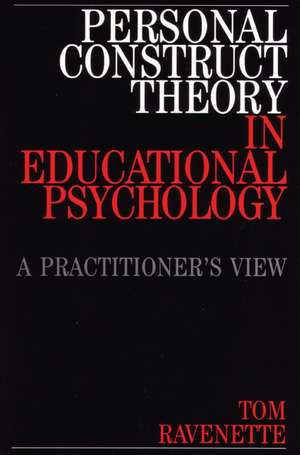
Personal Construct Theory in Educational
Autor Ravenetteen Limba Engleză Paperback – apr 1999
Preț: 451.34 lei
Preț vechi: 586.16 lei
-23%
Puncte Express: 677
Carte tipărită la comandă
Livrare economică 20 noiembrie-04 decembrie
Livrare prin curier în România Termenul estimat este afișat lângă disponibilitate.
Transport gratuit pentru acest produs Plată online sau ramburs, în funcție de opțiunile comenzii.
Retur gratuit în 14 zile Comandă securizată și suport în română.
Specificații
ISBN-13: 9781861561213
ISBN-10: 1861561210
Pagini: 300
Dimensiuni: 152 x 229 x 16 mm
Greutate: 0.44 kg
Editura: Wiley
Locul publicării:Chichester, United Kingdom
ISBN-10: 1861561210
Pagini: 300
Dimensiuni: 152 x 229 x 16 mm
Greutate: 0.44 kg
Editura: Wiley
Locul publicării:Chichester, United Kingdom
V-ar putea interesa
-
 The Healing Power of EmotionDaniel J. SiegelPreț: 382.51 lei
 -
 Systems Theory in ActionShelly Smith-AcuñaPreț: 400.98 lei
 -
 AnnoyingJoe PalcaPreț: 142.47 lei
 -
 Preț: 523.39 lei
 -
 Change Your GamblingHoward ShafferPreț: 107.54 lei
 -
 Disturbances of the MindDouwe Draaisma-5%Preț: 278.08 lei292.71 lei
 -
 Preț: 469.79 lei
 -
 Critical Thinking for PsychologyMark Forshaw-19%Preț: 422.74 lei521.90 lei
Notă biografică
Tom Ravenette is the author of Personal Construct Theory in Educational Psychology: A Practitioner's View, published by Wiley.
Cuprins
Prologue - Everyone his own Scientist or Behaviour is an Experiment. Reading Difficulties and What Else?.
Psychologists.
Teachers and Children - how many Ways to Understand?.
Motivation, Emotional Blocking and Reading Failure - a Unifying Point of View.
Personal Construct Theory - an Approach to The psychological Investigation of Children and Young People.
The Exploration of consciousness - Personal Construct Theory and Change.
Specific Reading difficulties - Appearances and Reality, to Tell a Story, to Invent a Character, to Make a Difference.
"Never, Never, Never Give Advice" - an Essay in professional Practice.
A Drawing and its Opposite - an Application of The notion of The "construct" in The Elicitation of Children' s Drawings.
The recycling of Maladjustment.
Personal Construct Psychology and Practitioners who work With Children.
Personal Construct Psychology in The Practice of an educational Psychologist.
Personal Construct Psychology and The Assessment of young People.
The "one-off" Interview, who are You? - a Structure for exploring a "sense of Self".
Asking Questions Within a Personal Construct framework.
Triadic Elicitation - Academic Exercise or key to Experiencing? A minipaper
Transcending The Obvious and Illuminating The Ordinary - Personal construct Psychology and Consultation in The Practice of Educational psychology.
What Would Happen if? - Personal Construct Psychology and psychological Intervention.
Epilogue - an Answer to a "lifer' s Three questions".
Psychologists.
Teachers and Children - how many Ways to Understand?.
Motivation, Emotional Blocking and Reading Failure - a Unifying Point of View.
Personal Construct Theory - an Approach to The psychological Investigation of Children and Young People.
The Exploration of consciousness - Personal Construct Theory and Change.
Specific Reading difficulties - Appearances and Reality, to Tell a Story, to Invent a Character, to Make a Difference.
"Never, Never, Never Give Advice" - an Essay in professional Practice.
A Drawing and its Opposite - an Application of The notion of The "construct" in The Elicitation of Children' s Drawings.
The recycling of Maladjustment.
Personal Construct Psychology and Practitioners who work With Children.
Personal Construct Psychology in The Practice of an educational Psychologist.
Personal Construct Psychology and The Assessment of young People.
The "one-off" Interview, who are You? - a Structure for exploring a "sense of Self".
Asking Questions Within a Personal Construct framework.
Triadic Elicitation - Academic Exercise or key to Experiencing? A minipaper
Transcending The Obvious and Illuminating The Ordinary - Personal construct Psychology and Consultation in The Practice of Educational psychology.
What Would Happen if? - Personal Construct Psychology and psychological Intervention.
Epilogue - an Answer to a "lifer' s Three questions".
Descriere
This book is a selection of papers by the author, a professional psychologist who operated a school psychological service. They represent the development over some forty years of a psychological practice based on the then relatively unknown Personal Construct Theory of George Kelly.