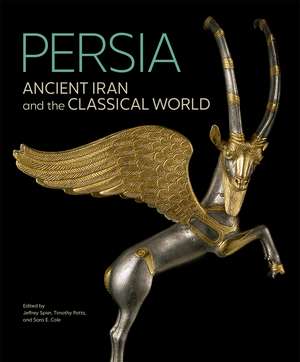
Persia
Editat de Jeffrey Spier, Timothy Potts, Sara E Coleen Limba Engleză Hardback – 26 apr 2022
The founding of the first Persian Empire by the Achaemenid king Cyrus the Great in the sixth century BCE established one of the greatest world powers of antiquity. Extending from the borders of Greece to northern India, Persia was seen by the Greeks as a vastly wealthy and powerful rival and often as an existential threat. When the Macedonian king Alexander the Great finally conquered the Achaemenid Empire in 330 BCE, Greek culture spread throughout the Near East, but local dynasties—first the Parthian (247 BCE–224 CE) and then the Sasanian (224–651 CE)—reestablished themselves. The rise of the Roman Empire as a world power quickly brought it, too, into conflict with Persia, despite the common trade that flowed through their territories.
Persia addresses the political, intellectual, religious, and artistic relations between Persia, Greece, and Rome from the seventh century BCE to the Arab conquest of 651 CE. Essays by international scholars trace interactions and exchanges of influence. With more than three hundred images, this richly illustrated volume features sculpture, jewelry, silver luxury vessels, coins, gems, and inscriptions that reflect the Persian ideology of empire and its impact throughout Persia’s own diverse lands and the Greek and Roman spheres.
This volume is published to accompany an exhibition on view at the J. Paul Getty Museum at the Getty Villa from April 6 to August 8, 2022.
Preț: 446.60 lei
Preț vechi: 485.44 lei
-8% Nou
79.03€ • 92.67$ • 69.40£
Carte disponibilă
Livrare economică 16-30 ianuarie 26
Livrare express 01-07 ianuarie 26 pentru 119.77 lei
Specificații
ISBN-10: 1606066803
Pagini: 432
Ilustrații: 409 color and 7 b-w illustrations, 3 maps
Dimensiuni: 253 x 300 x 40 mm
Greutate: 2.74 kg
Editura: Getty Publications
V-ar putea interesa
-
 The Poetics of Appearance in the Attic KoraiMary StieberPreț: 214.96 lei
 -
 From Pergamon To Sperlonga – Sculpture & ContextNancy T Grummond-23%Preț: 486.44 lei631.73 lei
 -
 Vision and Image in Early Christian EnglandGeorge HendersonPreț: 324.12 lei
 -
 Coins, Bodies, Games, and GoldLeslie Kurke-19%Preț: 517.24 lei638.57 lei
 -
 Preț: 292.23 lei
 -
 The Freedman in Roman Art and Art HistoryLauren Hackworth PetersenPreț: 434.22 lei
 -
 The Female Portrait Statue in the Greek WorldSheila DillonPreț: 413.38 lei
 -
 Preț: 293.54 lei
 -
 Preț: 288.27 lei
 -
 Preț: 337.98 lei
 -
 Preț: 417.36 lei
 -
 Animals, Gods and Men from East to WestLucinda Dirven-8%Preț: 470.10 lei510.98 lei
Notă biografică
Jeffrey Spier is Anissa and Paul John Balson II Senior Curator of Antiquities at the J. Paul Getty Museum.
Timothy Potts is Maria Hummer-Tuttle and Robert Tuttle Director of the J. Paul Getty Museum.
Sara E. Cole is assistant curator of antiquities at the J. Paul Getty Museum.
Recenzii
Descriere
A fascinating study of Persia’s interactions and exchanges of influence with ancient Greece and the Roman Empire.
The founding of the first Persian Empire by the Achaemenid king Cyrus the Great in the sixth century BCE established one of the greatest world powers of antiquity. Extending from the borders of Greece to northern India, Persia was seen by the Greeks as a vastly wealthy and powerful rival and often as an existential threat. When the Macedonian king Alexander the Great finally conquered the Achaemenid Empire in 330 BCE, Greek culture spread throughout the Near East, but local dynasties—first the Parthian (247 BCE–224 CE) and then the Sasanian (224–651 CE)—reestablished themselves. The rise of the Roman Empire as a world power quickly brought it, too, into conflict with Persia, despite the common trade that flowed through their territories.
Persia addresses the political, intellectual, religious, and artistic relations between Persia, Greece, and Rome from the seventh century BCE to the Arab conquest of 651 CE. Essays by international scholars trace interactions and exchanges of influence. With more than three hundred images, this richly illustrated volume features sculpture, jewelry, silver luxury vessels, coins, gems, and inscriptions that reflect the Persian ideology of empire and its impact throughout Persia’s own diverse lands and the Greek and Roman spheres.
This volume is published to accompany an exhibition on view at the J. Paul Getty Museum at the Getty Villa from April 6 to August 8, 2022.