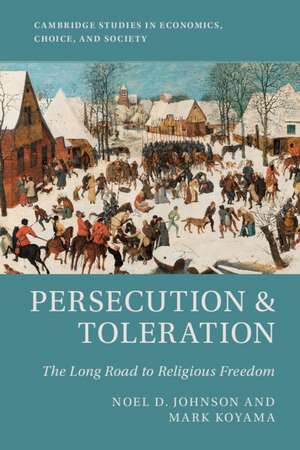
Persecution and Toleration: The Long Road to Religious Freedom: Cambridge Studies in Economics, Choice, and Society
Autor Noel D. Johnson, Mark Koyamaen Limba Engleză Paperback – 13 feb 2019
Structura volumului Persecution and Toleration este construită pe o metodologie interdisciplinară riguroasă, care îmbină analiza economică de tip „choice theory” cu istoriografia politică. Considerăm că forța acestui studiu rezidă în refuzul de a trata libertatea religioasă doar ca pe un triumf al iluminismului sau al ideilor seculare. Autorii Noel D. Johnson și Mark Koyama organizează materialul cronologic, pornind de la prăbușirea Imperiului Roman, pentru a demonstra cum persecuția a servit inițial ca un instrument de legitimare politică și stabilitate fiscală în statele cu o capacitate administrativă redusă.
Descoperim aici o perspectivă pragmatică asupra formării statului modern: tranziția către toleranță nu a fost un parcurs liniar moral, ci unul dictat de necesitatea creșterii economice și de schimbarea stimulentelor pentru elitele politice. Stilul este analitic și dens, specific colecției Cambridge Studies in Economics, Choice, and Society, punând accent pe corelația dintre birocratizarea statului și neutralitatea religioasă. Cititorii familiarizați cu The Political Origins of Religious Liberty de Anthony Gill vor aprecia modul în care acest volum extinde cadrul de analiză, oferind o bază de date istorică mult mai vastă și o examinare mai profundă a „capacității statului” ca variabilă critică. Spre deosebire de lucrările care se concentrează strict pe discursul teologic, precum cele din seria Histories of Religious Pluralism, lucrarea de față prioritizează factorii instituționali și economici, oferind o explicație structurală pentru supraviețuirea sau eșecul pluralismului în diferite contexte europene.
Din seria Cambridge Studies in Economics, Choice, and Society
-
 Preț: 233.97 lei
 -
 Preț: 267.80 lei
 -
 Preț: 207.61 lei
 -
 Preț: 260.44 lei
 -
 Preț: 223.38 lei
 -
 Preț: 367.45 lei
 -
 Preț: 209.46 lei
 -
 Preț: 139.47 lei
 - 14%
 Preț: 713.56 lei
 -
 Preț: 269.61 lei
 -
 Preț: 199.26 lei
 -
 Preț: 266.83 lei
 - 14%
 Preț: 738.98 lei
 -
 Preț: 323.57 lei
 -
 Preț: 202.24 lei
 - 14%
 Preț: 680.73 lei
 - 14%
 Preț: 691.37 lei
 -
 Preț: 224.45 lei
 -
 Preț: 208.39 lei
Preț: 219.14 lei
Carte tipărită la comandă
Livrare economică 05-19 iunie
Specificații
ISBN-10: 1108441165
Pagini: 368
Dimensiuni: 152 x 227 x 21 mm
Greutate: 0.5 kg
Editura: Cambridge University Press
Colecția Cambridge University Press
Seria Cambridge Studies in Economics, Choice, and Society
Locul publicării:New York, United States
De ce să citești această carte
Această lucrare este esențială pentru cercetătorii din științe politice și economie care doresc să înțeleagă rădăcinile instituționale ale libertății. Cititorul câștigă o perspectivă nouă asupra modului în care mecanismele de guvernare și stimulentele fiscale au modelat drepturile omului. Este o recomandare fermă pentru cei care caută o analiză factuală, dincolo de istoria ideilor, despre cum pragmatismul politic a pavat drumul către toleranța religioasă modernă.
Descriere scurtă
Cuprins
Recenzii
'Johnson and Koyama investigate the fascinating intersection of the state and religion in late medieval and early modern Europe. Rather than enduring patterns of religious toleration or persecution, of liberty or tyranny, they tell a rich history of change and variation in rules, institutions, and societies. This is an important and persuasive book.' John Joseph Wallis, Mancur Olson Professor of Economics, University of Maryland, College Park
'Lucidly written, incisively argued, this book shows how religious toleration emerged not only from ideas, but also from institutions which motivated people – especially the powerful – to accept and act on those ideas. A brilliant account of early modern Europe's transition from identity-based privileges to open markets and impartial governance.' Sheilagh Ogilvie, University of Cambridge
'This analysis of the historical process underlying the modern state formation is a fantastic scholarly accomplishment. The implications for the present, in terms of the risks associated to the loss of the core liberal values of modern western states, will not be lost to the careful reader.' Alberto Bisin, New York University