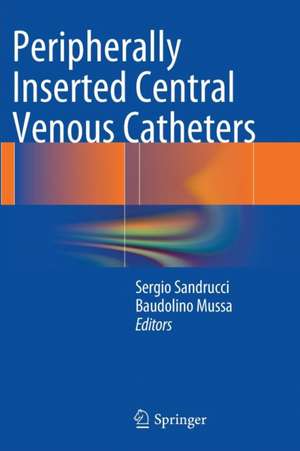
Peripherally Inserted Central Venous Catheters
Editat de Sergio Sandrucci, Baudolino Mussaen Limba Engleză Paperback – 23 aug 2016
Imaginile ecografice și diagramele anatomice ocupă un rol central în Peripherally Inserted Central Venous Catheters, oferind suportul vizual necesar pentru stăpânirea unei tehnici care a transformat medicina de urgență și terapia intensivă. Apreciem modul în care editorii Sergio Sandrucci și Baudolino Mussa fundamentează teoretic fiecare etapă practică, pornind de la anatomia ecografică a venelor periferice și continuând cu protocoale riguroase de venipuncție ghidată. Considerăm că forța acestui volum rezidă în abordarea sa clinică integrată: nu se limitează la tehnica inserției, ci explorează în profunzime managementul complicațiilor, de la tromboze la infecții, și organizarea echipelor dedicate de acces vascular. Structura editorială este una progresivă, ghidând cititorul de la istoricul și alegerea materialelor potrivite către concepte moderne precum „Vessel Health and Preservation”. Un aspect distinctiv este includerea capitolelor despre utilizarea „off-label” a cateterelor PICC și implicațiile legale sau etice ale procedurii, elemente adesea omise în manualele tehnice. Acolo unde Venous Access Made Easy de James Forsyth acoperă bazele practice și instrucțiunile simple pentru începători, acest volum aprofundează rigoarea științifică și protocoalele complexe de evaluare a plasării vârfului cateterului, fiind destinat unui public profesionist care caută o specializare avansată. De asemenea, spre deosebire de Atlas of Ultrasound-Guided Central Venous Catheter Placement, care se concentrează pe abordurile jugulare sau subclaviculare, lucrarea de față prioritizează accesul periferic ca metodă de reducere a riscurilor asociate cateterelor centrale clasice, validând rolul crucial al asistenților medicali specializați în acest proces.
Preț: 713.71 lei
Preț vechi: 751.27 lei
-5%
Carte tipărită la comandă
Livrare economică 07-21 decembrie
Specificații
ISBN-10: 8847058678
Pagini: 200
Ilustrații: XI, 186 p. 63 illus., 55 illus. in color.
Dimensiuni: 155 x 235 x 12 mm
Greutate: 0.31 kg
Ediția:Softcover reprint of the original 1st edition 2014
Editura: Springer
Locul publicării:Milano, Italy
V-ar putea interesa
-
 Oxford Textbook of Advanced Critical Care EchocardiographyAnthony McLean-25%Preț: 1198.15 lei1595.92 lei
 -
 Oxford Handbook of CardiologyPunit RamrakhaPreț: 297.08 leiRecomandat
 -
 -21%Preț: 500.07 lei630.18 lei
 -
 Point of Care UltrasoundNilam J. Soni-28%Preț: 571.63 lei789.29 lei
 -
 Fuhrman and Zimmerman's Pediatric Critical CareJerry J. Zimmerman-26%Preț: 1652.53 lei2220.90 lei
 -
 Textbook of Critical CareJean Louis Vincent-27%Preț: 1568.17 lei2152.60 lei
 -
 The Interventional Cardiac Catheterization HandbookMichael J. Lim-28%Preț: 392.52 lei542.71 lei
 -
 Oh's Intensive Care ManualJonathan M. Handy-28%Preț: 697.98 lei971.29 leiRecomandat
 -
 Kern's Cardiac Catheterization HandbookPaul Sorajja-27%Preț: 396.20 lei545.02 leiRecomandat
 -
 Emergency Ultrasound Made EasyJustin Bowra-31%Preț: 239.36 lei345.01 lei
 -
 -5%Preț: 706.52 lei743.70 lei
 -
 Bedside Procedures in the ICUFlorian Falter-5%Preț: 932.84 lei981.94 lei
 -
 Civetta, Taylor, & Kirby's Critical Care MedicineA. Joseph Layon MD, FACP-24%Preț: 1960.57 lei2593.77 lei
 -
 Marino's The ICU BookPaul L Marino MD, PhD-25%Preț: 537.38 lei714.12 leiRecomandat
 -
 Rogers' Manual of Pediatric Intensive CareWYNNE MORRISON MD, MBE-20%Preț: 616.72 lei774.07 lei
 -
 Marino's The Little ICU BookSamuel M. Galvagno, Jr. DO, PhD, FCCM-24%Preț: 421.54 lei551.76 lei
 -
 Ultrasound Guided Vascular AccessMatthew D. Ostroff-5%Preț: 697.80 lei734.53 lei
 -
 Surgical Intensive Care MedicineJohn M. O'Donnell-5%Preț: 1584.98 lei1668.40 lei
 -
 Transvenous Lead ExtractionMaria Grazia Bongiorni-5%Preț: 619.27 lei651.86 lei
 -
 -57%Preț: 1697.00 lei3908.44 lei
De ce să citești această carte
Recomandăm această lucrare oricărui clinician care activează în terapie intensivă, oncologie sau nutriție parenterală. Cititorul câștigă o înțelegere profundă a tehnicilor de ghidaj ecografic, esențiale pentru reducerea complicațiilor și creșterea siguranței pacientului. Este un instrument indispensabil pentru implementarea unei echipe de acces vascular într-un spital, oferind argumente economice și protocoale clinice bazate pe dovezi pentru utilizarea cateterelor PICC în locul accesului central tradițional.
Cuprins
Recenzii
“This book describes the science and practice of a popular tool in the critical care unit, on the medical/surgical floor, and for homecare -- the peripherally inserted central catheter or PICC. ... Any healthcare providers employing vascular access as a part of their scope of activity are an appropriate audience for this book.” (David J. Dries, Doody’s Book Reviews, October, 2014)
Textul de pe ultima copertă
Peripherally Inserted Central Venous Catheters will be of interest to a wide range of professionals, including nutritionists, oncologists, anesthesiologists, surgeons, registered nurses, nurse practitioners, physicians, physician assistants, and radiologists.