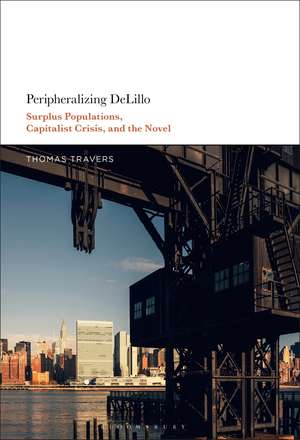
Peripheralizing DeLillo: Surplus Populations, Capitalist Crisis, and the Novel
Autor Dr. Thomas Traversen Limba Engleză Paperback – 27 iul 2023
Drawing on theories that capital, rather than the bourgeoisie, is the displaced subject of the novel, Thomas Travers investigates DeLillo's representation of fully commodified social worlds and re-evaluates Marxist accounts of the novel and its philosophy of history. Deploying an innovative re-periodisation, Travers considers the evolution of DeLillo's aesthetic forms as they register and encode one of the crises of contemporary historicity: the secular dynamics through which a society organised around waged work tends towards conditions of under- and unemployment.
Situating DeLillo within global histories of uneven and combined development, Travers explores how DeLillo's treatment of capital and labour, affect and narration, reconfigures debates around realism and modernism. The DeLillo that emerges from this study is no longer an exemplary postmodern writer, but a composer of capitalist epics, a novelist drawn to peripheral zones of accumulation, zones of social death whose surplus populations his fiction strives to re-historicise, if not re-dialecticise as subjects of history.
Preț: 206.39 lei
Preț vechi: 278.35 lei
-26%
Puncte Express: 310
Carte tipărită la comandă
Livrare economică 06-20 octombrie
Livrare prin curier în România Termenul estimat este afișat lângă disponibilitate.
Transport gratuit de la 400.00 lei Plată online sau ramburs, în funcție de opțiunile comenzii.
Retur gratuit în 14 zile Comandă securizată și suport în română.
Specificații
ISBN-13: 9781501378393
ISBN-10: 1501378392
Pagini: 240
Dimensiuni: 152 x 229 x 25 mm
Greutate: 0.32 kg
Editura: Bloomsbury Publishing
Colecția Bloomsbury Academic
Locul publicării:New York, United States
ISBN-10: 1501378392
Pagini: 240
Dimensiuni: 152 x 229 x 25 mm
Greutate: 0.32 kg
Editura: Bloomsbury Publishing
Colecția Bloomsbury Academic
Locul publicării:New York, United States
V-ar putea interesa
-
 Love Is the Ultimate WinnerRomesh ChopraPreț: 66.13 lei
 -
 Prodigy of ErrorsManisha GuptaPreț: 118.89 lei
 -
 Power Games of LifeSuhas InamdarPreț: 117.96 lei
 -
 Preț: 91.64 lei
 -
 To the MaxMikki ReyPreț: 120.75 lei
 -
 Asuntos TurbiosCarmina GauchiaPreț: 105.03 lei
 -
 LatanyaEd GaskinPreț: 65.80 lei
 -
 Married to the MobTreasure MalianPreț: 56.24 lei
 -
 ACT Like a Lady, Think Like a BossMimi RayPreț: 68.21 lei
 -
 Lust & Hip Hop (the Ms. Mogul Series)Jazz JordanPreț: 41.26 lei
 -
 Her Mother's Love 2Sha ColePreț: 53.91 lei
 -
 Misplaced LoyaltyLeena ChingPreț: 76.33 lei
 -
 As Cold as IsisBriana HuntleyPreț: 73.33 lei
 -
 SecrecyJ. SummersPreț: 95.88 lei
 -
 Taking the Babysitter All the Way HomeJessie CarrPreț: 40.07 lei
 -
 Just Grimey IILady KellzPreț: 85.49 lei
 -
 Living Free of the SecretsTeresa Mason BrowningPreț: 126.61 lei
 -
 Turf WarsStephanie M. SinkfieldPreț: 84.73 lei
 -
 CreamKia RobertsPreț: 121.84 lei
 -
 Who Am I? the Chronicles of CainDion E. CheesePreț: 97.51 lei
 -
 The Golden DameThe KingpinPreț: 45.62 lei
 -
 Can't Trust HerKyoshiPreț: 68.05 lei
Cuprins
Introduction: 'Breathing the Fumes of Free Enterprise Forever: Don DeLillo and Marxism
1. 'Anticipating Martian Archaeologists'; Or, On the Contemporaneity of the Early Short Stories
2. 'The Uncounted': Romance, Realism, and Uneven Development in the Political Thrillers
3. Dialectics Derailed: Catastrophe and the Historical Novel
4. 'Enfolded in the Will of Capital': Twenty-First Century DeLillo
Conclusion: How to Survive a Dead Idea
Bibliography
Index
1. 'Anticipating Martian Archaeologists'; Or, On the Contemporaneity of the Early Short Stories
2. 'The Uncounted': Romance, Realism, and Uneven Development in the Political Thrillers
3. Dialectics Derailed: Catastrophe and the Historical Novel
4. 'Enfolded in the Will of Capital': Twenty-First Century DeLillo
Conclusion: How to Survive a Dead Idea
Bibliography
Index
Recenzii
Providing us with a startling new reading of Don DeLillo's oeuvre, from his very earliest short stories to his late minimalism, Thomas Travers' book is, however, far more than simply a great study of one of the most important U.S. novelists of our time. It is also one of the most significant books on Marxist literary theory and on the contemporary novel's responses to economic crisis, financialization and the dynamics of dispossession that has been published this century. A major advance in our understanding of the novel's attempts to grapple with the challenges to representation posed by contemporary capitalism.
Answering some big questions about the postmodern hypothesis from the ground zero of its ruin, this book sets out to reinvent DeLillo as a novelist of the anonymously dispossessed masses whose multitude defines our historical present. The DeLillo that emerges from these pages is less the exemplar of postmodernism in fiction than he is a prophet of dissent, a prescient thinker and artist whose writings conjoin the dominant characterological tendency of literary fiction since the 1960s with the social antagonism we are now seeing on the streets, writing its own epic in the language of rage and fire.
DeLillo is not the archetypal postmodern novelist we believed him to be, but an epic poet of the dispossessed, cartographer of the surplus populations thrown off by the 'long downturn', his fictions striving to re-historicize capitalism's cast-offs as emergent subjects of History: such is Travers's original and compelling thesis. The book effects a wholesale reconceptualization of the Jamesonian problematic of postmodernism, rewriting the relation of politics and form for the era of secular stagnation via Deleuze and Guattari's untapped notion of peripheralization: it is a critical triumph and a superlative work of Marxist literary theory.
Answering some big questions about the postmodern hypothesis from the ground zero of its ruin, this book sets out to reinvent DeLillo as a novelist of the anonymously dispossessed masses whose multitude defines our historical present. The DeLillo that emerges from these pages is less the exemplar of postmodernism in fiction than he is a prophet of dissent, a prescient thinker and artist whose writings conjoin the dominant characterological tendency of literary fiction since the 1960s with the social antagonism we are now seeing on the streets, writing its own epic in the language of rage and fire.
DeLillo is not the archetypal postmodern novelist we believed him to be, but an epic poet of the dispossessed, cartographer of the surplus populations thrown off by the 'long downturn', his fictions striving to re-historicize capitalism's cast-offs as emergent subjects of History: such is Travers's original and compelling thesis. The book effects a wholesale reconceptualization of the Jamesonian problematic of postmodernism, rewriting the relation of politics and form for the era of secular stagnation via Deleuze and Guattari's untapped notion of peripheralization: it is a critical triumph and a superlative work of Marxist literary theory.