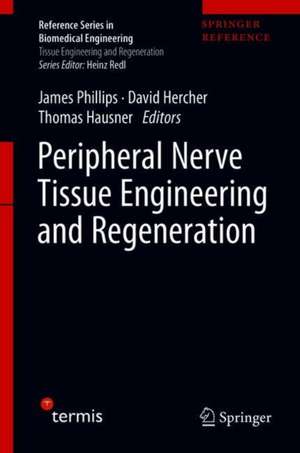
Peripheral Nerve Tissue Engineering and Regeneration: Reference Series in Biomedical Engineering
Editat de James B. Phillips, David Hercher, Thomas Hausneren Limba Engleză Hardback – 26 mai 2022
Actualizarea ghidurilor de practică în neuroregenerare reflectă o tranziție clară de la tehnicile clasice de sutură la soluții biologice avansate, impuse de nevoia de a depăși limitele ratei de recuperare funcțională. În volumul Peripheral Nerve Tissue Engineering and Regeneration, editat de James B. Phillips, David Hercher și Thomas Hausner, observăm o integrare clinică a noilor tehnologii de editare genică și utilizare a veziculelor extracelulare, elemente care au redefinit protocoalele de intervenție posttraumatică începând cu anul 2022. Notăm cu interes faptul că lucrarea nu se rezumă la prezentarea succeselor experimentale, ci fundamentează riguros mediul de reparare a nervilor periferici.
Subliniem organizarea logică a celor 400 de pagini, care ghidează cititorul de la fundamentele istorice și terminologice către complexitatea biomaterialelor și a terapiilor celulare. Structura este concepută pentru a asigura o progresie fluidă: de la modelele de cercetare necesare validării, până la provocările translației clinice. Acest manual de referință este comparabil cu Peripheral Nerve Regeneration de Rui Damázio Alvites, însă lucrarea de față, fiind publicată în 2022, aduce un plus de actualitate prin secțiunile dedicate opțiunilor terapeutice emergente și naturii sale actualizabile, menită să acomodeze evoluțiile tehnologice rapide.
Suntem de părere că abordarea multidisciplinară propusă de editura Springer transformă acest titlu într-o resursă critică. Spre deosebire de alte volume care se concentrează strict pe chirurgie, acesta explorează sinergia dintre ingineria materialelor și biologia moleculară, oferind o perspectivă de ansamblu asupra întregului ecosistem de regenerare nervoasă.
Preț: 2906.11 lei
Preț vechi: 3059.07 lei
-5%
Carte disponibilă
Livrare economică 30 iulie-13 august
Livrare express 15-21 iulie pentru 78.20 lei
Specificații
ISBN-10: 3030210510
Pagini: 400
Ilustrații: XVI, 612 p. 73 illus., 57 illus. in color.
Dimensiuni: 155 x 235 mm
Greutate: 1.34 kg
Ediția:1st ed. 2022
Editura: Springer International Publishing
Colecția Springer
Seriile Reference Series in Biomedical Engineering, Tissue Engineering and Regeneration
Locul publicării:Cham, Switzerland
V-ar putea interesa
-
 Biomaterials Science: An Introduction to Materials in MedicineWilliam R Wagner-29%Preț: 910.88 lei1291.04 lei
 -
 Neuromuscular and Electrodiagnostic Medicine Board ReviewThananan Thammongkolchai-31%Preț: 498.26 lei724.00 lei
 -
 -29%Preț: 448.16 lei629.84 lei
 -
 Atlas of Orthoses and Assistive DevicesDouglas P. Murphy-29%Preț: 1131.74 lei1593.54 leiRecomandat
 -
 Sabiston Textbook of Surgery: The Biological Basis of Modern Surgical PracticeDouglas Scott Tyler-30%Preț: 1133.01 lei1619.57 leiRecomandat
 -
 Peripheral Nerve Injuries: A Clinical GuideRolfe Birch-5%Preț: 1247.03 lei1312.66 lei
 -
 Plastic and Reconstructive SurgeryMaria Z. Siemionow-5%Preț: 1109.19 lei1167.56 lei
 -
 Therapeutic Modalities for Musculoskeletal InjuriesCraig R. Denegar-5%Preț: 653.75 lei688.16 lei
 -
 -25%Preț: 800.05 lei1065.87 lei
 -
 Plastic Surgery: Volume 1: Principles (Expert Consult Online and Print)Geoffrey C Gurtner-23%Preț: 1178.01 lei1533.71 lei
 -
 Plastic Surgery: Volume 4: Trunk and Lower ExtremityDavid H Song-24%Preț: 1155.31 lei1519.22 lei
 -
 Examination of Peripheral Nerve Injuries: An Anatomical ApproachStephen Russell-5%Preț: 550.92 lei579.91 lei
 -
 -30%Preț: 1685.29 lei2408.34 lei
 -
 Regenerative Medicine and Plastic SurgeryDominik Duscher-23%Preț: 798.00 lei1036.36 lei
 -
 Adipose Stem Cells and Regenerative MedicineYves-Gerard Illouz-5%Preț: 1052.30 lei1107.69 lei
 -
 Regenerative MedicineGustav Steinhoff-5%Preț: 1416.76 lei1491.33 lei
 -
 -5%Preț: 1260.47 lei1326.82 lei
De ce să citești această carte
Această resursă este esențială pentru cercetătorii și clinicienii din neurochirurgie și inginerie biomedicală care doresc să implementeze tehnologii de ultimă oră. Cititorul câștigă o înțelegere profundă a biomaterialelor și terapiilor celulare, beneficiind de un cadru teoretic solid pentru tranziția de la laborator la aplicația clinică. Este alegerea optimă pentru specialiștii care au nevoie de un protocol actualizat de regenerare a nervilor periferici.
Despre autor
James B. Phillips este un cercetător recunoscut în domeniul ingineriei țesuturilor, activând la University College London, unde conduce studii avansate despre regenerarea sistemului nervos. Alături de el, David Hercher și Thomas Hausner aduc expertiza clinică și experimentală necesară pentru a acoperi spectrul larg al neuroregenerării. Colectivul editorial reunește specialiști de talie internațională sub egida Springer International Publishing, contribuind la dezvoltarea unor soluții inovatoare pentru repararea leziunilor nervoase, integrând biologia celulară cu biomaterialele în serii de referință precum Tissue Engineering and Regeneration.