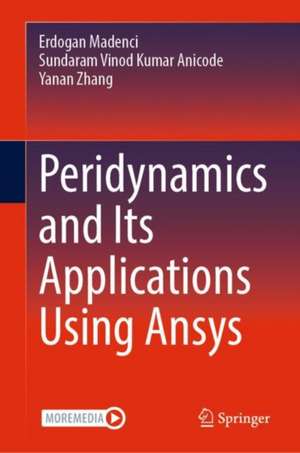
Peridynamics and Its Applications Using Ansys
Autor Erdogan Madenci, Sundaram Vinod Kumar Anicode, Yanan Zhangen Limba Engleză Hardback – 25 iul 2024
The book demonstrates that, unlike the conventional finite element method (FEM), the PD theory is highly suitable for progressive failure analysis, the multi-scale analysis of materials involving fracture and failure, and multi-physics analysis, including electromigration, corrosion, and electrodeposition. Additionally, it provides a step-by-step illustration of the specific procedures in the pre-processing, solution, and post-processing phases of the analysis through the Graphical User Interface (GUI) for various applications.
The book is designed to be introductory and self-contained, minimizing the need for additional reference material.
Preț: 579.21 lei
Preț vechi: 715.07 lei
-19%
Puncte Express: 869
Carte tipărită la comandă
Livrare economică 15-21 decembrie
Livrare prin curier în România Termenul estimat este afișat lângă disponibilitate.
Transport gratuit pentru acest produs Plată online sau ramburs, în funcție de opțiunile comenzii.
Retur gratuit în 14 zile Comandă securizată și suport în română.
Specificații
ISBN-13: 9783031598951
ISBN-10: 3031598954
Pagini: 512
Ilustrații: X, 470 p. 450 illus., 442 illus. in color. With online files/update.
Dimensiuni: 160 x 241 x 32 mm
Greutate: 0.97 kg
Ediția:2024
Editura: Springer
Locul publicării:Cham, Switzerland
ISBN-10: 3031598954
Pagini: 512
Ilustrații: X, 470 p. 450 illus., 442 illus. in color. With online files/update.
Dimensiuni: 160 x 241 x 32 mm
Greutate: 0.97 kg
Ediția:2024
Editura: Springer
Locul publicării:Cham, Switzerland
Cuprins
Chapter 1 Peridynamic theory.- Chapter 2 Peridynamic differential operator.- Chapter 3 Unified peridynamic approach.- Chapter 4 Weak form of peridynamic equilibrium and field equations.- Chapter 5 Coupling of peridynamics with finite elements.- Chapter 6 Coupled peridynamic and finite element analysis in the presence of initial strain.- Chapter 7 Peridynamics for multiphysics analysis.- Chapter 8 Ansys elements for peridynamic interactions.- Chapter 9 Ansys Menus for PD analysis.- Chapter 10 Implementation of PDDO in Ansys framework.- Chapter 11 Applications of field equations.- Chapter 12 Applications of peridynamics for static structural analysis.- Chapter 13 Coupled peridynamics and finite element method for static and transient structural analysis.- Chapter 14 Applications of coupled field equations.- Chapter 15 Peridynamics for failure prediction.
Notă biografică
Erdogan Madenci is a Professor in the Aerospace and Mechanical Engineering Department of The University of Arizona, Tucson, Arizona, USA. He received his B.S. degrees on both mechanical and industrial engineering, and his M.S. degree in applied mechanics from Lehigh University, Bethlehem, PA in 1980, 1981, and 1982, respectively. He received his Ph.D. degree in engineering mechanics from UCLA in 1987. Prior to joining the University of Arizona, he worked at Northrop Corporation, Aerospace Corporation, and Fraunhofer Institute. Also, he worked at the KTH Royal Institute of Technology, NASA Langley Research Center, Sandia National Labs and MIT as part of his sabbatical leaves. He is the lead author of four books on Peridynamic Differential Operator for Numerical Analysis, Peridynamic Theory and Its Applications, The Finite Element Method Using ANSYS, and Fatigue Life Prediction of Solder Joints. Recently, he started the Journal of Peridynamics and Nonlocal Modeling as the Co-Editor-in-Chief, and is an Associate Editor of ASME Open Journal of Engineering. He is a Fellow of ASME and an Associate Fellow of AIAA.
Pranesh Roy is an Assistant Professor in the Department of Civil Engineering at the Indian Institute of Technology (Indian School of Mines) (IIT-ISM) Dhanbad. He received his B.E. degree in Civil Engineering from Jadavpur University, Kolkata in 2012. He obtained his M.Tech. degree in Structural Engineering from the Indian Institute of Technology (IIT), Delhi in 2014. He received his Ph.D. degree in Civil Engineering from the Indian Institute of Science (IISc), Bangalore in 2019. He worked as a Postdoctoral Research Associate from 2019 to 2021 in Aerospace and Mechanical Engineering at The University of Arizona, USA. Dr. Roy is an expert in the broad area of theoretical and computational solid mechanics. Particularly, his research focuses on nonclassical continuum theories such as peridynamics, phase field theory, and gauge theory of solids.
Deepak Behera is a Postdoctoral Reseacher in the Department of Aerospace and Mechanical Engineering at the University of Arizona. He received his B.Tech.-M.Tech. dual degree in Aerospace Engineering from the Indian Institute of Technology (IIT), Kanpur in 2012. He received his Ph.D. degree in Aerospace Engineering from the University of Arizona in 2022. Prior to his Ph.D., he worked as a structural engineer at General Electric-Aviation, Bengaluru and IIT, Kanpur. He also worked at Idaho National Lab as a summer visiting scholar. His research focuses on numerical methods and theoretical and computational solid mechanics with an emphasis on failure analysis and peridynamics. His other research interest includes molecular dynamics, optimization, and uncertainty quantification.
Textul de pe ultima copertă
This book introduces a unified implementation of bond- and state-based peridynamic theory (PD) within a commercial finite element framework, Ansys, utilizing its native elements. It details the implementation of the PD theory and its integration with traditional finite elements. The primary objective is to equip students, researchers, and practicing engineers with both theoretical and practical knowledge of the PD theory, along with the skills necessary for analyzing engineering problems using Ansys.
The book demonstrates that, unlike the conventional finite element method (FEM), the PD theory is highly suitable for progressive failure analysis, the multi-scale analysis of materials involving fracture and failure, and multi-physics analysis, including electromigration, corrosion, and electrodeposition. Additionally, it provides a step-by-step illustration of the specific procedures in the pre-processing, solution, and post-processing phases of the analysis through the Graphical User Interface (GUI) for various applications.
The book is designed to be introductory and self-contained, minimizing the need for additional reference material.
- Describes an implementation of PD theory and its coupling to finite element method in Ansys, using its native elements;
- Utilization of Ansys through both the Graphics User Interface (GUI) and the Ansys Parametric Design Language (APDL);
- Explains the process for solving problems in various applications with the Ansys GUI, includes Ansys input files.