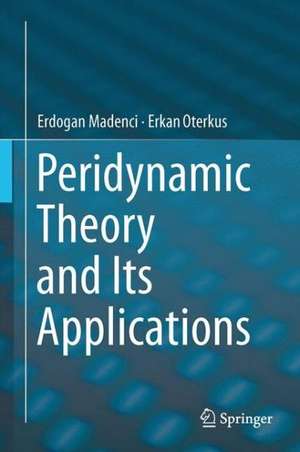
Peridynamic Theory and Its Applications
Autor Erdogan Madenci, Erkan Oterkusen Limba Engleză Hardback – 22 oct 2013
Preț: 670.03 lei
Preț vechi: 788.27 lei
-15%
Puncte Express: 1005
Carte tipărită la comandă
Livrare economică 23 noiembrie-07 decembrie
Livrare prin curier în România Termenul estimat este afișat lângă disponibilitate.
Transport gratuit pentru acest produs Plată online sau ramburs, în funcție de opțiunile comenzii.
Retur gratuit în 14 zile Comandă securizată și suport în română.
Specificații
ISBN-13: 9781461484646
ISBN-10: 1461484642
Pagini: 304
Ilustrații: XII, 289 p. 152 illus.
Dimensiuni: 160 x 241 x 22 mm
Greutate: 0.57 kg
Ediția:2014
Editura: Springer
Locul publicării:New York, NY, United States
ISBN-10: 1461484642
Pagini: 304
Ilustrații: XII, 289 p. 152 illus.
Dimensiuni: 160 x 241 x 22 mm
Greutate: 0.57 kg
Ediția:2014
Editura: Springer
Locul publicării:New York, NY, United States
V-ar putea interesa
-
 Elements of X-Ray DiffractionB. D. Cullity-15%Preț: 606.54 lei713.57 lei
 -
 -18%Preț: 1114.62 lei1359.29 lei
 -
 -18%Preț: 1641.11 lei2001.36 lei
 -
 -18%Preț: 835.53 lei1018.94 lei
 -
 Preț: 452.92 lei
 -
 Oxide Semiconductors and Thin FilmsAndré Schleife-11%Preț: 513.62 lei577.10 lei
 -
 -11%Preț: 426.08 lei478.74 lei
 -
 Advances in Materials for Nuclear EnergyChaitanya S. Deo-11%Preț: 508.26 lei571.07 lei
 -
 Film Silicon Science and TechnologyPaul StradinsPreț: 451.51 lei
 -
 Compound SemiconductorsMowafak Al-Jassim-11%Preț: 532.61 lei598.43 lei
 -
 Peridynamic Differential Operator for Numerical AnalysisErdogan Madenci-15%Preț: 611.08 lei718.91 lei
 -
 Thermal Non-Equilibrium in Heterogeneous MediaMarcelo J. S. De LemosPreț: 366.74 lei
 -
 Heat TransferPeter BöckhPreț: 472.08 lei
 -
 Kelvin Probe Force MicroscopySascha Sadewasser-15%Preț: 646.40 lei760.47 lei
 -
 Mesoscopic Phenomena in Multifunctional MaterialsAvadh Saxena-15%Preț: 671.56 lei790.08 lei
 -
 Chemistry and Physics of Solid Surfaces VR. VanselowPreț: 392.94 lei
 -
 Electronic Properties of Conjugated PolymersHans KuzmanyPreț: 401.44 lei
 -
 Dehnungsmessungen und ihre AuswertungF. RötscherPreț: 397.35 lei
 -
 Preț: 397.51 lei
 -
 -15%Preț: 490.78 lei577.39 lei
 -
 Werkstoffe für GleitlagerNA Berchtenbreiter-15%Preț: 459.71 lei540.84 lei
 -
 d-d Excitations in Transition-Metal OxidesBärbel FrommePreț: 382.55 lei
 -
 Low-Energy Ion Irradiation of Solid SurfacesHubert GnaserPreț: 376.47 lei
Public țintă
GraduateCuprins
Introduction.- Peridynamic Theory.- Peridynamics for Local Interactions.- Peridynamics for Isotropic Materials.- Peridynamics for Laminated Composite Materials.- Damage Prediction.- Numerical Solution Methods.- Benchmark Problems.- Nonimpact Problems.- Impact Problems.- Coupling of the Peridynamic Theory and Finite Element Methods.- Peridynamic Thermal Diffusion.- Fully Coupled Peridynamic Thermomechanics.
Recenzii
From the book reviews:
“The book is very interesting from the methodical viewpoint, presenting a comparatively new theory of solid mechanics, accompanying the text by many examples, which can be useful to students studying the novel approaches to solid mechanics and related topics, and also to their teachers preparing lectures and practical works.” (I. A. Parinov, zbMATH, Vol. 1295, 2014)
“The book is very interesting from the methodical viewpoint, presenting a comparatively new theory of solid mechanics, accompanying the text by many examples, which can be useful to students studying the novel approaches to solid mechanics and related topics, and also to their teachers preparing lectures and practical works.” (I. A. Parinov, zbMATH, Vol. 1295, 2014)
Textul de pe ultima copertă
The peridynamic theory provides the capability for improved modeling of progressive failure in materials and structures, paving the way to address multi-physics and multi-scale problems. Because it is based on concepts not commonly used in the past, the purpose of this book is to explain the peridynamic theory in a single framework. It presents not only the theoretical basis but also its numerical implementation.
The book begins with an overview of the peridynamic theory and derivation of its governing equations. The relationship between peridynamics and classical continuum mechanics is established, and this leads to the ordinary state-based peridynamics formulations for both isotropic and composite materials. Numerical treatments of the peridynamic equations are presented in detail along with solutions to many benchmark and demonstration problems. In order to take advantage of salient features of peridynamics and the finite element method, a coupling technique is also described. Finally, an extension of the peridynamic theory for thermal diffusion and fully coupled thermomechanics is presented with applications.
Students and researchers alike will find this book an essential and invaluable reference on the topic. It offers both theoretical and practical knowledge of the peridynamic theory and may be used in courses such as Multi-physics and Multi-scale Analysis, Nonlocal Computational Mechanics, and Computational Damage Prediction. Sample algorithms for the solution of benchmark problems are available at http://extras.springer.com for researchers and graduate students, who can modify these algorithms and develop their own solution algorithms for specific problems.
The book begins with an overview of the peridynamic theory and derivation of its governing equations. The relationship between peridynamics and classical continuum mechanics is established, and this leads to the ordinary state-based peridynamics formulations for both isotropic and composite materials. Numerical treatments of the peridynamic equations are presented in detail along with solutions to many benchmark and demonstration problems. In order to take advantage of salient features of peridynamics and the finite element method, a coupling technique is also described. Finally, an extension of the peridynamic theory for thermal diffusion and fully coupled thermomechanics is presented with applications.
Students and researchers alike will find this book an essential and invaluable reference on the topic. It offers both theoretical and practical knowledge of the peridynamic theory and may be used in courses such as Multi-physics and Multi-scale Analysis, Nonlocal Computational Mechanics, and Computational Damage Prediction. Sample algorithms for the solution of benchmark problems are available at http://extras.springer.com for researchers and graduate students, who can modify these algorithms and develop their own solution algorithms for specific problems.
Caracteristici
Introduces a new theory to advance in the analysis of existing and new structures and materials Provides sample algorithms for students, as well as researchers, to self-study and discover their own solutions to problems Provides a comprehensive introduction to this emerging method and is suitable for graduate courses Includes supplementary material: sn.pub/extras
Notă biografică
Erdogan Madenci is a Professor in the Aerospace and Mechanical Engineering Department of The University of Arizona, Tucson, Arizona, USA. He received his B.S. degrees on both mechanical and industrial engineering, and his M.S. degree in applied mechanics from Lehigh University, Bethlehem, PA in 1980, 1981, and 1982, respectively. He received his Ph.D. degree in engineering mechanics from UCLA in 1987. Prior to joining the University of Arizona, he worked at Northrop Corporation, Aerospace Corporation, and Fraunhofer Institute. Also, he worked at the KTH Royal Institute of Technology, NASA Langley Research Center, Sandia National Labs and MIT as part of his sabbatical leaves. He is the lead author of four books on Peridynamic Differential Operator for Numerical Analysis, Peridynamic Theory and Its Applications, The Finite Element Method Using ANSYS, and Fatigue Life Prediction of Solder Joints. Recently, he started the Journal of Peridynamics and Nonlocal Modeling as the Co-Editor-in-Chief, and is an Associate Editor of ASME Open Journal of Engineering. He is a Fellow of ASME and an Associate Fellow of AIAA.
Pranesh Roy is an Assistant Professor in the Department of Civil Engineering at the Indian Institute of Technology (Indian School of Mines) (IIT-ISM) Dhanbad. He received his B.E. degree in Civil Engineering from Jadavpur University, Kolkata in 2012. He obtained his M.Tech. degree in Structural Engineering from the Indian Institute of Technology (IIT), Delhi in 2014. He received his Ph.D. degree in Civil Engineering from the Indian Institute of Science (IISc), Bangalore in 2019. He worked as a Postdoctoral Research Associate from 2019 to 2021 in Aerospace and Mechanical Engineering at The University of Arizona, USA. Dr. Roy is an expert in the broad area of theoretical and computational solid mechanics. Particularly, his research focuses on nonclassical continuum theories such as peridynamics, phase field theory, and gauge theory of solids.
Deepak Behera is a Postdoctoral Reseacher in the Department of Aerospace and Mechanical Engineering at the University of Arizona. He received his B.Tech.-M.Tech. dual degree in Aerospace Engineering from the Indian Institute of Technology (IIT), Kanpur in 2012. He received his Ph.D. degree in Aerospace Engineering from the University of Arizona in 2022. Prior to his Ph.D., he worked as a structural engineer at General Electric-Aviation, Bengaluru and IIT, Kanpur. He also worked at Idaho National Lab as a summer visiting scholar. His research focuses on numerical methods and theoretical and computational solid mechanics with an emphasis on failure analysis and peridynamics. His other research interest includes molecular dynamics, optimization, and uncertainty quantification.