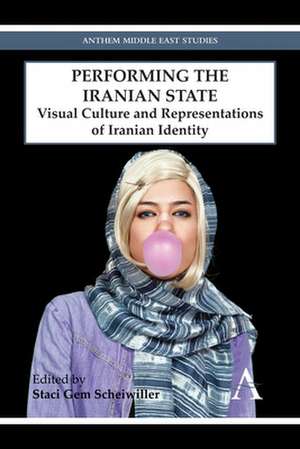
Performing the Iranian State: Anthem Middle East Studies
Editat de Staci Gem Scheiwilleren Limba Engleză Paperback – noi 2014
"Performing the State" refers to an individual (or a group of persons) who re-enacts rituals, ceremonies, customs, traditions and laws, or who dons certain guises, that either accomplish the State's goals or rebel against them as a form of critique. This anthology examines various approaches to determining the Iranian State via the performativity of persons, with the intention of illuminating how social practices, ideologies and identities are shaped, represented, visualized, circulated and repeated - not only nationally but also worldwide.


Preț: 270.30 lei
Puncte Express: 405
Carte disponibilă
Livrare economică 16-30 noiembrie
Livrare prin curier în România Termenul estimat este afișat lângă disponibilitate.
Transport gratuit de la 400.00 lei Plată online sau ramburs, în funcție de opțiunile comenzii.
Retur gratuit în 14 zile Comandă securizată și suport în română.
Specificații
ISBN-13: 9781783083282
ISBN-10: 178308328X
Pagini: 260
Dimensiuni: 152 x 229 x 15 mm
Greutate: 0.43 kg
Editura: Anthem Press
Colecția Anthem Middle East Studies
Seria Anthem Middle East Studies
ISBN-10: 178308328X
Pagini: 260
Dimensiuni: 152 x 229 x 15 mm
Greutate: 0.43 kg
Editura: Anthem Press
Colecția Anthem Middle East Studies
Seria Anthem Middle East Studies
V-ar putea interesa
-
 -32%Preț: 696.60 lei1025.11 lei
 -
 The Presentation of Self in Everyday LifeErving Goffman-31%Preț: 63.73 lei92.78 lei
 -
 On the State: Lectures at the Collège de France, 1 989-1992Pierre BourdieuPreț: 238.63 lei
 -
 Unbecoming NationalismHelene VostersPreț: 116.38 lei
 -
 Mcconnell, F: Rehearsing the StateFiona McConnell-19%Preț: 433.71 lei535.44 lei
 -
 Performing PowerMarcus MorganPreț: 157.34 lei
 -
 The Assault on the StateStephen E. HansonPreț: 140.73 lei
 -
 At the Margins of the Modern StateSeyla BenhabibPreț: 159.20 lei
 -
 The State and the SoldierKori SchakePreț: 172.90 lei
 -
 Drama of Democracy: Political Representation in MumbaiLisa BjörkmanPreț: 201.27 lei
 -
 IranHamid DabashiPreț: 173.48 lei
 -
 The PerformerRichard SennettPreț: 92.52 lei
 -
 Rethinking OurselvesAnwar IbrahimPreț: 164.85 lei
 -
 Preț: 428.69 lei
 -
 Nationalism in Architecture of Modern IranNiloofar Kakhi-27%Preț: 343.59 lei471.53 lei
 -
 The Idea of Persia: A Philosophical EnquiryRamin JahanbeglooPreț: 191.42 lei
 -
 -18%Preț: 309.95 lei380.00 lei
 -
 -18%Preț: 630.49 lei768.90 lei
 -
 Iran in RevoltHamid DabashiPreț: 128.92 lei
Cuprins
Acknowledgments; A Note on Transliteration; 1. Introduction: Setting the Stage – Staci Gem Scheiwiller; I – THE QAJAR DYNASTY: 1786–1925: 2. The Photographic Source for a Qajar Painting – Donna Stein; 3. Cartographic Desires: Some Reflections on the “Shahr-e Farang” (Peepshow) and Modern Iran – Staci Gem Scheiwiller; 4. Takkiyeh Dowlat: The Qajar Theater State – Babak Rahimi; II – THE PAHLAVI DYNASTY (1925–1979) AND TRANSITIONAL PERIOD AFTER THE IRANIAN REVOLUTION (1978–1979): 5. For the Love of her People: An Interview with Farah Diba about the Pahlavi Programs for the Arts in Iran – Donna Stein; 6. Shaping and Portraying Identity at the Tehran Museum of Contemporary Art (1977–2005) – Alisa Eimen; 7. Seismic Shifts across Political Zones in Contemporary Iranian Art: The Poetics of Knowledge, “Knowing” and Identity – Abbas Daneshvari; III – THE ISLAMIC REPUBLIC: 1979–PRESENT: 8. Performativity and Ritual Space in Postrevolutionary Tehran – David Simonowitz; 9. Reclaiming Cultural Space: The Artist’s Performativity versus the State’s Expectations in Contemporary Iran – Hamid Keshmirshekan; 10. Female Trouble: Melancholia and Allegory in Contemporary Iranian Art – Andrea D. Fitzpatrick; IV – THE IRANIAN DIASPORA: 11. Performing Visual Strategies: Representational Concepts of Female Iranian Identity in Contemporary Photography and Video Art – Julia Allerstorfer; 12. Painted and Animated Metaphors: An Interview with Artist Alireza Darvish – Mina Zand Siegel and Carmen Pérez González; 13. In the House of Fatemeh: Revisiting Shirin Neshat’s Photographic Series “Women of Allah” – Staci Gem Scheiwiller; Illustrations; List of Contributors