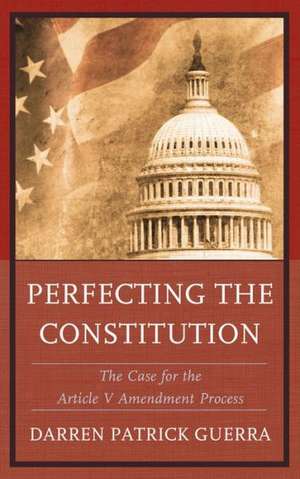
Perfecting the Constitution: The Case for the Article V Amendment Process
Autor Darren Patrick Guerraen Limba Engleză Paperback – 25 mar 2015
In recent years Article V has come under attack by influential legal scholars who criticize it for being too difficult, undemocratic, and too formal. Such scholars advocate for ignoring Article V in favor of elite adaptation of the Constitution or popular amendment through national referendums. In making their case, critics also assume that Article V is an unimportant and expendable part of the Constitutional structure. One notable scholar called the Constitution "imbecilic" because of Article V.
This book shows that, to the contrary, Article V is a unique and powerful extension of the American tradition of written constitutionalism. It was a logical extension of American constitutional development and it was a powerful tool used by the Federalists to argue for ratification of the new Constitution. Since then it has served as a means of "perfecting" the US Constitution for over 200 years via a wide range of amendments. Contrary to contemporary critics, the historical evidence shows Article V to be a vital element in the Constitutional architecture, not an expendable or ancillary piece. This book defends Article V against critics by showing that it is neither too difficult, undemocratic, nor too formal. Furthermore, a positive case is made that Article V remains the most clear and powerful way to register the sovereign desires of the American public with regard to alterations of their fundamental law. In the end, Article V is an essential bulwark to maintaining a written Constitution that secures the rights of the people against both elites and themselves.
Preț: 344.18 lei
Preț vechi: 483.26 lei
-29%
Puncte Express: 516
Carte tipărită la comandă
Livrare economică 18 noiembrie-02 decembrie
Livrare prin curier în România Termenul estimat este afișat lângă disponibilitate.
Transport gratuit de la 400.00 lei Plată online sau ramburs, în funcție de opțiunile comenzii.
Retur gratuit în 14 zile Comandă securizată și suport în română.
Specificații
ISBN-13: 9781498515443
ISBN-10: 1498515444
Pagini: 254
Dimensiuni: 151 x 229 x 19 mm
Greutate: 0.36 kg
Editura: Bloomsbury Publishing
Colecția Lexington Books
Locul publicării:New York, United States
ISBN-10: 1498515444
Pagini: 254
Dimensiuni: 151 x 229 x 19 mm
Greutate: 0.36 kg
Editura: Bloomsbury Publishing
Colecția Lexington Books
Locul publicării:New York, United States
V-ar putea interesa
-
 The Attalid Kingdom: A Constitutional HistoryR. E. Allen-33%Preț: 626.04 lei929.46 lei
 -
 The Oxford Handbook of Law and PoliticsKeith E. Whittington-19%Preț: 318.06 lei391.70 lei
 -
 -31%Preț: 806.33 lei1170.42 lei
 -
 -33%Preț: 854.69 lei1268.34 lei
 -
 -31%Preț: 626.45 lei909.30 lei
 -
 The Government of the PeoplesF. ChenevalPreț: 390.25 lei
 -
 Preț: 251.60 lei
 -
 Political Legitimacy in AsiaJ. KanePreț: 391.06 lei
 -
 Preț: 340.53 lei
 -
 Preț: 406.18 lei
 -
 Preț: 281.63 lei
 -
 The Constitution of France: A Contextual AnalysisSophie Boyron-21%Preț: 194.92 lei246.50 lei
 -
 -18%Preț: 191.44 lei232.70 lei
 -
 -17%Preț: 193.03 lei231.25 lei
Cuprins
Preface
Part I Creation of Article V
Chapter 1: Perfecting the Constitution
Chapter 2: Constitutional Revolution
Chapter 3: An Ultimate Remedy: Creating and Ratifying Article V
Chapter 4: The Founder's Article V Consensus
Part II Criticism of Article V
Chapter 5: The Progressive Challenge to Article V
Chapter 6: The Critics: Article V is Too Difficult
Chapter 7: The Critics: Article V is Undemocratic
Chapter 8: The Critics: Article V is Too Formal
Chapter 9: Conclusion: The Case for Article V
Bibliography
Index
About the Author
Part I Creation of Article V
Chapter 1: Perfecting the Constitution
Chapter 2: Constitutional Revolution
Chapter 3: An Ultimate Remedy: Creating and Ratifying Article V
Chapter 4: The Founder's Article V Consensus
Part II Criticism of Article V
Chapter 5: The Progressive Challenge to Article V
Chapter 6: The Critics: Article V is Too Difficult
Chapter 7: The Critics: Article V is Undemocratic
Chapter 8: The Critics: Article V is Too Formal
Chapter 9: Conclusion: The Case for Article V
Bibliography
Index
About the Author
Recenzii
Guerra (Biola Univ.) posits that the Article V provisions for formally amending the US Constitution are under attack from scholars, judges, and politicians. He argues that many of these individuals seek to amend the Constitution through permissive 'interpretation' rather than formal amendment. However, the author writes that Article V is not only a form of amendment but the exclusive form of amendment to the Constitution. Other forms, he suggests, do not comport with history or logic. Part 1 of this work examines the history and context of Article V, while part 2 defends Article V from its critics. Whether readers agree or disagree with Guerra's premise, this work makes for interesting reading and is recommended for those who study constitutional law. Summing Up: Recommended. General readers, undergraduate students, graduate students, and research faculty.
At a time when some prominent scholars are questioning the continuing efficacy of America's constitutional foundations, Darren Patrick Guerra makes a powerful case for America's written Constitution and its accompanying amending process. He argues that they help secure a system of ordered liberty embodied in a fundamental law that is grounded in popular sovereignty while protecting natural rights. He carefully explains how the amending process was designed to be an explicit, authentic, and exclusive means of amendment; how it promotes wisdom and justice through enhancing deliberation and prudence; and how the process complements federalism and separation of powers. Guerra thoughtfully challenges arguments by leading constitutional theorists that the process is too difficult, too undemocratic, or too formalistic. He traces many current criticisms to the misplaced Progressive faith in the perfectibility of man and the inevitability of progress and argues for the importance of recognizing the differences among constitution interpretations, constitutional constructions, and constitutional amendments. A must read both for those who continue to believe in, defend, and praise the existing process and for those who think it should be ignored, replaced, or supplemented by less deliberative measures.
In this well researched and carefully argued book, Darren Patrick Guerra makes a compelling case for why the amendment process spelled out in Article V is the explicit, authentic, and exclusive means of amending the Constitution because it is the only process consistent with the Framers' commitments to separation of powers and federalism. He mounts a vigorous and successful attack on those progressives who argue that Article V is 'a' but not 'the' means of amending the Constitution and contend that informal adaptations through Supreme Court interpretations, unchallenged congressional initiatives, and unchecked presidential actions are as legitimate and controlling as formal constitutional amendments. Until Guerra's book, these progressive arguments have gone largely uncontested, but no longer. The battle over Article V has now been joined.
It is easy to take Article V for granted. Most Americans know that it establishes a two-stage process involving Congress and the states that makes it difficult to amend the Constitution, but few among the public and the scholarly community appreciate the vital importance of Article V to American constitutional democracy. In this fine work of historical and political scholarship Professor Guerra shows how central Article V was to the design of the Constitution and he ably defends it against the growing number of scholars who view it as an indefensible restraint on majority rule. In the process Guerra offers a powerful critique of the increasingly influential arguments that the Constitution may be legitimately amended through court decisions or congressional acts.
Guerra's book . . . clearly takes the topic to the next level of scholarship in several ways. His research into how new state constitutions dealt with the amendment process is extraordinary, as is the specific chronology of amendment coverage at the 1787 Constitutional Convention. He effectively meshes the views of the Constitution's framers throughout the text to justify his positions.
At a time when some prominent scholars are questioning the continuing efficacy of America's constitutional foundations, Darren Patrick Guerra makes a powerful case for America's written Constitution and its accompanying amending process. He argues that they help secure a system of ordered liberty embodied in a fundamental law that is grounded in popular sovereignty while protecting natural rights. He carefully explains how the amending process was designed to be an explicit, authentic, and exclusive means of amendment; how it promotes wisdom and justice through enhancing deliberation and prudence; and how the process complements federalism and separation of powers. Guerra thoughtfully challenges arguments by leading constitutional theorists that the process is too difficult, too undemocratic, or too formalistic. He traces many current criticisms to the misplaced Progressive faith in the perfectibility of man and the inevitability of progress and argues for the importance of recognizing the differences among constitution interpretations, constitutional constructions, and constitutional amendments. A must read both for those who continue to believe in, defend, and praise the existing process and for those who think it should be ignored, replaced, or supplemented by less deliberative measures.
In this well researched and carefully argued book, Darren Patrick Guerra makes a compelling case for why the amendment process spelled out in Article V is the explicit, authentic, and exclusive means of amending the Constitution because it is the only process consistent with the Framers' commitments to separation of powers and federalism. He mounts a vigorous and successful attack on those progressives who argue that Article V is 'a' but not 'the' means of amending the Constitution and contend that informal adaptations through Supreme Court interpretations, unchallenged congressional initiatives, and unchecked presidential actions are as legitimate and controlling as formal constitutional amendments. Until Guerra's book, these progressive arguments have gone largely uncontested, but no longer. The battle over Article V has now been joined.
It is easy to take Article V for granted. Most Americans know that it establishes a two-stage process involving Congress and the states that makes it difficult to amend the Constitution, but few among the public and the scholarly community appreciate the vital importance of Article V to American constitutional democracy. In this fine work of historical and political scholarship Professor Guerra shows how central Article V was to the design of the Constitution and he ably defends it against the growing number of scholars who view it as an indefensible restraint on majority rule. In the process Guerra offers a powerful critique of the increasingly influential arguments that the Constitution may be legitimately amended through court decisions or congressional acts.
Guerra's book . . . clearly takes the topic to the next level of scholarship in several ways. His research into how new state constitutions dealt with the amendment process is extraordinary, as is the specific chronology of amendment coverage at the 1787 Constitutional Convention. He effectively meshes the views of the Constitution's framers throughout the text to justify his positions.